Source: Personal Copy

The Anubis Gates by Tim Powers

Posted October 30, 2014 by Michael @ Knowledge Lost in Fantasy / 0 Comments

The Anubis Gates by Tim PowersTitle: The Anubis Gates (Goodreads)
Author: Tim Powers
Published: Ace, 1983
Pages: 387
Genres: Fantasy
My Copy: Paperback

Buy: AmazonBook Depository (or visit your local Indie bookstore)

When millionaire J. Cochran Darrow finds The Anubis Gates that will make time travel possible, he quickly assembles a team to go back to 1801. He hires Professor Brendan Doyle to give advice about the poet Samuel Taylor Coleridge. Soon a band of misfits are assembled and they are off on an early 19th century London adventure and throughout time.

If you think the plot sounds a little weird, then you are not the only one. I spent a lot of time wondering about the logic behind the locations and people within The Anubis Gates. This was the steampunk pick for the Literary Exploration book club and true to the group’s purpose; this book really challenged my reading choices.  It was an interesting experience, I had no idea what to expect next and there was no way to predict anything.

The cast of characters was strange; I expected to like the book because Samuel Taylor Coleridge and Lord Byron were featured. Unfortunately they didn’t get enough development and that might be for the best but I was interested in finding out what Tim Powers would do with them. This book also featured an Egyptian wizard, werewolf, crazy clown and so much more.

What I found to be the biggest problem with this novel was the fact that Tim Powers took so many of his good ideas and tried to force it all into one novel. There was a lot going on and it was all over the place. There never was enough time to develop scenes or characters and it just felt like everything was condensed to make room for all his ideas. The concept was great, wacky and fun but the execution did not work for me.

Tim Powers is a well-respected fantasy author; his book On Stranger Tides (1987) was the inspiration behind the Monkey Island video games and also turned into the fourth Pirates of the Caribbean film. The Anubis Gates is often considered one of the pioneer sin the steampunk genre (though I am not sure I would class it as steampunk) and also won the Philip K. Dick Award in 1983. Powers seems like an author that you either love or hate. However from my experience, 1980’s science fiction and fantasy are all a bit odd and unusual.

This is such an unusual novel, which makes it extremely difficult to explain and review. I wanted to enjoy this book but for the most part I found myself skimming the pages. There are great concepts and ideas going on in this but the author didn’t want to explore them instead attempting for a fast moving adventure. For me that just made things difficult. I am fascinated by people who love this book, I’d love to know the reasoning. If you love science fiction or fantasy novels, this might work for you; unfortunately it didn’t for me.


Understanding Comics by Scott McCloud

Posted October 29, 2014 by Michael @ Knowledge Lost in Graphic Novel, Non-Fiction / 0 Comments

Understanding Comics by Scott McCloudTitle: Understanding Comics: The Invisible Art (Goodreads)
Author: Scott McCloud
Series: The Comic Books #1
Published: William Morrow, 1993
Pages: 215
Genres: Graphic Novel, Non-Fiction
My Copy: Paperback

Buy: AmazonBook Depository (or visit your local Indie bookstore)

I have been getting into comics lately and I am quickly discovering there is so much about this medium that I do not know. When trying to review a comic or graphic novel, I find it easy to talk about plot but talking about the art is difficult. I picked up Understanding Comics because there is so much to learn and I wanted a better grasp on the art form. And it is art, it might not be as highbrow as artists like Vincent van Gogh, Claude Monet or my personal favourite Michelangelo Merisi da Caravaggio, but it is still art. To exclude comics as an art form would be like removing Andy Warhol, Pablo Picasso, Jackson Pollack or René Magritte from the art world because you ‘don’t get it’.

Now that I have had a little rant about art, let’s talk about comics and Understanding Comics by Scott McCloud. This book is a graphical look into comics as an art form, exploring the history of comics and tries to explain the meaning behind the art. It starts off trying to define what a comic is, which I quickly realised was an impossible feat. McCloud ended saying “Comics are juxtaposed pictorial and other images in a deliberate sequence, intended to convey information and/or produce an aesthetic response in the viewer” but then went on to explain how problematic that definition can be.

A highlight for me was found in chapter two where Scott McCloud explored the vocabulary of comics. The chapter begins with explain René Magritte’s painting The Treachery of Images (1928-29), an artist I am a big fan of. I actually went to the Los Angeles County Museum of Art in the hope to see The Treachery of Images, but it was currently on loan to the Art Institute of Chicago. What I liked about this chapter was how he took the meaning of this painting and expanded on it to help explain comics. He took something easy to explain and built upon that to the more complex ideas.

Reading Understanding Comics makes comics sound like highbrow pieces of art and maybe that is how we should view them. Instead of thinking about comics as a lowbrow medium, it is about time we experience the art and what it can tell us. In this book six major ideas around the art. Idea/purpose, form, idiom/style, structure, craft and surface; explaining how they can all work together to make great pieces.

There is a lot of information within Understanding Comics and I don’t think I have explored it all yet. It has equipped me with some new tools when reading and reviewing comics. The best thing about this book is the way Scott McCloud changes his art style and methods to explore the different ways you can execute the theories behind this book. I am glad he referenced all his work, especially when talking about other artists and how they write comics. The graphical representation of the art theory in the book helped me to understand comics a little better but there is just so much here that I will need to reread this a few times before it sinks in.


All that is Solid Melts into Air by Darragh McKeon

Posted October 28, 2014 by Michael @ Knowledge Lost in Historical Fiction, Literary Fiction / 7 Comments

All that is Solid Melts into Air by Darragh McKeonTitle: All that is Solid Melts into Air (Goodreads)
Author: Darragh McKeon
Published: Viking, 2014
Pages: 391
Genres: Historical Fiction, Literary Fiction
My Copy: Paperback

Buy: AmazonBook Depository (or visit your local Indie bookstore)

All that is Solid Melts into Air tells the story of the Soviet Union in 1986. A nine year-old piano prodigy continuously falling victim to bullies, a surgeon throwing himself into his work to avoid the emotion pain of a failed marriage, a former dissident struggling to free herself from political constraints. Everyday Russians trying to make life work in this repressed state; that was until a disaster in Ukraine changes things.

Most people who know me know that I am a fan of Russian literature and books set in Russia. The Cold War years are of particular interest to me, the social and political unrest makes for a haunting backdrop for great story telling. When I head that All that is Solid Melts into Air was this year’s answer to A Constellation of Vital Phenomena, it was all I needed to buy this book. While reading the book I found out the novel centred around the Chernobyl nuclear accident which just gave that extra element to turn this into a new favourite.

I have never read a novel about the Chernobyl disaster before and I am struggling to think of other books that focus on this historical event. So I was pleased to have a new insight on a situation I hope to never experience. This was a beautiful and haunting tale of Russians living life and the connections they make along the way. However little gems like the controversial idea of implementing safety measure pre-disaster and the Soviet Union’s efforts to cover the accident up really helped make this novel great.

The title is taken from a line in The Communist Manifesto, which is quoted before the novel kicks off. This is an interesting quote to add, not just to give a reference to the title but the implications of what to expect within the novel. As Karl Marx and Friedrich Engels theorise in their political manifesto, “The history of all hitherto existing society is the history of class struggles”.

“All that is solid melts into air, all that is holy is profaned, and man is at last compelled to face with sober senses, his real conditions of life, and his relations with his kind.” – Karl Marx (The Communist Manifesto)

While this is a strong character driven novel, it is not the personal but political transgressions that stood out for me. All that is Solid Melts into Air is set in a time where the Iron Curtain is beginning to collapse; things are drastically changing and then the disaster involving the Chernobyl Power Plant throws the people into civil unrest. While the book focuses on a few characters the overall theme is one of class struggles. The Russian people struggling against the Soviet government; the fear and repression rules stronger than the radioactive atmosphere. An interesting concept considering the communist society that Marx wrote about was nothing like the political government at the time.

I am a little sad to see this gem has remained under the radar; All that is Solid Melts into Air deserves so much more attention. Despite that horrific setting, this is a novel of great beauty with visceral portrayals of both people and places. The struggle the people go through is handled with tender care and empathy. It is hard to believe that Darragh McKeon is a debut author; much like Anthony Marra, I am eagerly awaiting his next novel. All that is Solid Melts into Air is a new favourite and you can expect it to be near the top of my ‘best of 2014’ list.


Archie: The Married Life, Vol. 1 by Michael Uslan

Posted October 26, 2014 by Michael @ Knowledge Lost in Graphic Novel / 0 Comments

Archie: The Married Life, Vol. 1 by Michael UslanTitle: Archie: The Married Life, Vol. 1 (Goodreads)
Author: Michael Uslan
Artist: Norm Breyfogle
Published: Archie Comics, 2011
Pages: 320
Genres: Graphic Novel
My Copy: eBook

Buy: AmazonBook DepositoryKindle (or visit your local Indie bookstore)

When I was young tween, the only real reading I did was Archie comics. We had them in our house all the time; my parents must have thought they were safe enough because no one ever gets any action. There has been news recently about Archie being shot to death in the graphic novel Death of Archie which is the last book in The Married Life series. This news got me curious so I had to pick up the first trade paperback which covers the first six issues of this series.

I have always been on the side of Betty and never could understand why Archie would choose Veronica over her. Archie: The Married Life is split into two different timelines; almost like a Sliding Doors scenario, or, if you are a fan of Broadway, If/Then. This series follows the life of Archie married to Veronica and then Betty. There are some situations that are different in each timeline but mostly follow the same events. Unfortunately nothing much has changed since they were in high school.

Archie: The Married Life does try to look at the normal day-to-day issue facing adults but it holds back too much. For example, Midge finally breaks up with Moose because she is scared of his violent outbursts. This story arch could have gone into some interesting themes of emotional and physical abuse but it treads lightly around the topic. Moose does try and work on his anger issues but there is just so much more they could have done.

My favourite character was always Jughead and I enjoyed it when he hard a love life, luckily this is inserted into this series but not very well. He is getting married. I won’t tell you to who, but the only romance I saw between them was when they shared a milkshake at Pop’s Treat. This brings me to my next issue; why are they still hanging out at Pop’s Treat? I am sure it would be nice to have a place to hang but they could go to a bar or something different every now and then. They are working adults now, but they all still act like teenagers.

I think my biggest problem is the fact that this series is a sugar coated interpretation of what adult and married life would be like. No one has sex; although there was some alluding to an affair between Veronica and Reggie, but nothing happened. The series is still marketed to young tweens and this disappoints me, I thought Archie: The Married Life would have been a more adult look at the Archie world, I was wrong. I don’t even know if I want to continue, I might just read Afterlife with Archie instead.


The Dog by Joseph O’Neill

Posted October 21, 2014 by Michael @ Knowledge Lost in Contemporary / 0 Comments

The Dog by Joseph O’NeillTitle: The Dog (Goodreads)
Author: Joseph O'Neill
Published: Harper Collins, 2014
Pages: 256
Genres: Contemporary
My Copy: Paperback

Buy: AmazonBook DepositoryKindle (or visit your local Indie bookstore)

The Dog tells the story of a protagonist known simply as X; after a long-term relationship comes to an end he decides to make a change. Leaving New York, he takes an unusual job in a strange new city. Dubai is undergoing major transformations, the city is transforming into the ultimate futuristic city. Our protagonist finds himself in a different culture working as the “family officer” of the unpredictable and wealthy Batros family.

Right off the bat I can’t help but compare The Dog with Bret Easton Ellis’ book American Psycho and not for the reasons you might think. X might be an unlikeable character but he is no Patrick Bateman; well there are similarities but he isn’t going around killing people. Joseph O’Neill has created a shallow narcissistic character, thrown him into a very different culture and watched what might happen. This turns The Dog into a non-violent Ellis book just set in Dubai.

Can we also talk about the name X, not only does this book take its best ideas from Bret Easton Ellis and American Psycho but the protagonists name reminds me too much of the movie adaptation of J. J. Connolly’s novel Layer Cake. For those who don’t know or haven’t seen the movie, there is a character in that known as XXXX. Two connections to other novels and I am not off to a good start with this novel.

Normally I would love a novel with an unlikeable character stuck in in a culture clash but I kept seeing these similarities and it made it difficult. The book tried to make a humorous satire of the situation, playing on cultural differences and linguistics but I was still stuck. Every now and then I found glimpses of that craftsmanship I have heard about but maybe I should have just read Netherland, since that is the book people rave about.

The Dog was long listed for the Man Booker this year but I was assigned this book for book club. I just want it to be clear that I was not reading this book because of the long listing; in fact I was a little disappointed with this year’s list. I would have loved to enjoy this novel but for the most part it felt too similar to other novels. I felt the need to skim through The Dog rather than enjoying the writing and style.


Beowulf by Anonymous

Posted October 19, 2014 by Michael @ Knowledge Lost in Classic / 0 Comments

Beowulf by AnonymousTitle: Beowulf (Goodreads)
Author: Anonymous
Translator: Michael Alexander
Published: Penguin, 800
Pages: 137
Genres: Classic
My Copy: Paperback

Buy: AmazonBook DepositoryKindle (or visit your local Indie bookstore)

Beowulf is one of the oldest, complete surviving epic poems in existent. There are a few others from the same era that have survived in fragments, so the significance of Beowulf remains in regards to English literature. Written in Old English (or Anglo-Saxon) the manuscript of Beowulf is believed to date back to the 10th century (1,000AD). This is an example of a heroic poem, which can be defined as a text that deals with heroic actions in battle. Beowulf focuses on three great battles, with Grendel, Grendel’s Mother, and a Dragon.

While this is an English poem it is interesting to note that it is not set in England but southern Scandinavia, half in Denmark and the other in Geatland (or Götaland) which is one of three lands of Sweden. Beowulf does incorporate a large amount of Norse and Germanic history and legends, however I don’t have the knowledge to pick up on this within the text, just information I learnt after the reading. I suspect that this information was added into the poem to help pass on the information to Anglo-Saxon people, like a history lesson or as the poet calls it “the treasured repertory” (line 871). It is believed that Beowulf was composed in a time of stability, in a time of some democracy; an early medieval Christian civilisation. One might say this was an age where art and literature were flourishing and often used as methods of education.

Beowulf was no exception. What I got out of this poem was a reflection of the cultural and, to a lesser extent, political views of the time; a civilisation that values courtesy and formality. Chivalry, generosity and thoughtfulness are valued but still have a strong sense of precariousness, ready of imminent attack and war. Strength is still considered important; Beowulf is a warrior willing to fight against enemies both human and demonic. He even travelled to another country to fight a demonic menace. However you have to look to the other warriors as well, who appear as strong and capable as Beowulf but without their faith are rendered useless.

The role of the poet (or bard) is actually depicted in the poem itself several times. The poet is “…a fellow of the king’s” (line 868) which suggests that he is of a high rank. One who knows old and traditional stories, “Whose head was a storehouse of the storied verse, whose tongue gave gold to the language” (line 870). This allows the poem to have a unique perspective on the events that unfolds within Beowulf, a tactic that doesn’t always get explained within modern literature.

It is said that you can interpret this poem as having both Christian and pagan themes; however for me this had a very strong religious message. A battle of good and evil but I suspect this wasn’t a conflict of morality but an inevitable clash between the two. In a Christian context, Beowulf could be compared to Jesus, coming to save our souls from evil. You can even compare it to the story of Cain and Abel which is referenced within the text of Beowulf.

Given that Beowulf is meant to be experienced a spoken word I found myself struggling to read this as a written text. I had a look for the Michael Alexander translation (which was assigned to me for my university course) but was unsuccessful. However I did try to think about the text as if it was a story been spoken and I found it difficult. For me the narrative felt too slow, it lacked suspense and felt a little awkward (possibly the translation). The obscure historical allusions may not have been an issue back in the 800AD but it was for a modern reading.

I was nervous about reading Odyssey by but ended up loving it; I was hoping I would have a similar experience here. I suspected that Beowulf will remain a difficult text. There is some historical context that would be helpful before going into the poem that I just didn’t get. Reading the epic poem as part of a university course did help but for me it wasn’t enough. Medieval literature will remain difficult for me and would rather enjoy something a little more recent, like the 19th century. If you have read Beowulf and have some interesting insights that might help get my head around it, please let me know.


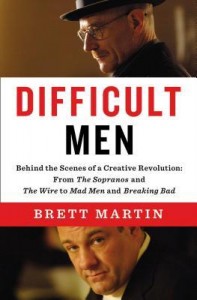
Difficult Men by Brett Martin

Posted October 14, 2014 by Michael @ Knowledge Lost in Non-Fiction / 0 Comments

Difficult Men by Brett MartinTitle: Difficult Men (Goodreads)
Author: Brett Martin
Published: Faber & Faber, 2013
Pages: 320
Genres: Non-Fiction
My Copy: Paperback

Buy: AmazonBook Depository (or visit your local Indie bookstore)

In the Third Golden Age of television (as Brett Martin calls it) things have changed drastically. With the rise of cable television, channels like HBO, Showtime and so on, are able to push the boundaries not afforded to network TV. Shows like The Sopranos, The Wire and Mad Men allowed the writers to offer something more complex or unpredictable. This saw the rise of the difficult men, characters like Tony Soprano (The Sopranos), Walter White (Breaking Bad) and Don Draper (Mad Men) offered a character study never seen before by viewers.

Brett Martin’s book Difficult Men looks at the stories behind some of the greatest shows of our time, mainly focusing on The Sopranos, Breaking Bad, The Wire and Mad Men. This is a deeper look into the evolution of modern story telling. The male protagonist within the Third Golden Age tends to be an enigma; complex, impulsive and so much more real. The type of characters that frustrates you with their mistakes but you can’t help but continuously watching.

The problem with this book is that it makes me want to watch all these shows. I have only gotten through half of The Sopranos and I haven’t found the time to try The Wire or Treme. All these shows look really great but finding time to binge watch them has become a real problem. I love reading about pop-culture and how it changes over the years and Difficult Men gave me everything I wanted. I enjoyed the insider information and the stories behind the stories. I can only hope that this evolution will start to extend toward better female leads. I would like to see the same treatment the Third Golden Age of television has give  to men offered to woman as well.

What I enjoy about these types of shows is not that the men are difficult but the way they tackle real issues and treat the protagonist as a real and flawed human being. They can explore ideas of life and death, love and sexuality, addiction, race and violence and the protagonist often struggles or makes mistakes. They often evolve as characters but it doesn’t mean they grow, there are times when I think Don Draper (Mad Men) or Hank Moody (Californication) have finally grown as a person but there is often slip ups or a spanner thrown into the mix, this makes for compelling television but also feels more real.

A huge section of Difficult Men is devoted to The Sopranos and James Gandolfini which is worth checking out. Gandolfini, in his own right, wasn’t a stereotypical leading man and there was a big exploration into his mental state. Playing the role of Tony Soprano was a very taxing role and what made James Gandolfini great at the job is how he didn’t act the role, he became the character. This ended taking a huge toll on his psychological wellbeing and this raises some interesting thoughts about the effect a role has on the actor.

Fans of television, pop culture or these shows in general will enjoy this book but I think a look into the psychological effect on the people involved will make this something to sit up and take notice. Hollywood is a complex industry and the effects can be damaging; all you have to do is walk down Hollywood Boulevard to see how it effects people. I am a big fan of the ground breaking changes these shows made towards the television industry but I didn’t realise the side effects. Brett Martin did a good job going behind the scenes and getting the back story.


California by Edan Lepucki

Posted October 11, 2014 by Michael @ Knowledge Lost in Speculative Fiction / 0 Comments

California by Edan LepuckiTitle: California (Goodreads)
Author: Edan Lepucki
Narrator: Emma Galvin
Published: Hachette, 2014
Pages: 320
Genres: Speculative Fiction
My Copy: Audiobook

Buy: AmazonBook DepositoryKindle (or visit your local Indie bookstore)

Cal and Frida is living in the middle of the 21st century, however it wasn’t the future we expected. Cities have crumbled, the internet has died and technology is worthless. Leaving city life behind, they now have to live in the wilderness, struggling to survive. Isolation and hardship are all new experiences; they live in fear of an uncertain future. A future that now consists of giving birth and raising a child in this post-apocalyptic world.

The post-apocalyptic back drop has been hugely popular lately and it isn’t just young adult fiction. Many literary fiction authors have tried their hand at the genre, giving them a unique world to explore real life issues. I’m thinking of great books like The Road by Cormac McCarthy, Super Sad True Love Story by Gary Shteyngart, The Passage by Justin Cronin and the Maddaddam series by Margaret Atwood. Edan Lepucki’s California sets out to join the ranks of the great with this overly ambitious first novel.

I will be honest, the only reason I picked up California was because of the promotion that appeared on The Colbert Report a while ago. The novel had enough to peak my interest but I had great difficulty getting a copy where I lived. Ironically I finally settled on getting the book through Audible to listen to. The premise of the novel was great; the idea of a world returning to the dark ages offered some interesting ideas. While we are never sure, the novel does allude to global warming as the underlining cause of this post-apocalyptic world.

I expected this novel to be the slow burn that The Road provided, building the characters and struggle while exploring the intended themes. However, I think this book burned a little too slowly, the flame went out halfway through and it turned into more of a chore to get through. Sure, the notions of communities, eco-terrorism and climate change were explored but for me it felt like I was being beaten over my head every chance they got. The book wanted to show off how smart and witty it was but, like many things that try to do this, the delivery never matched the intent.

California moved so slowly that as a reader, I was trapped in the wilderness of nothingness and I didn’t think I could escape. This was a real pity, everything seemed to start off so well; there was a plot arc and themes all set up and ready for execution. Somewhere on the way I feel like the author got a little lost and the readers were just following to her struggle to get back on track. I might come down hard on this novel; it isn’t too bad, there is a lot of potential and could have been a great book. For me it just didn’t work and wasn’t paced properly, I’m sure some people enjoyed it


The Odyssey by Homer

Posted October 7, 2014 by Michael @ Knowledge Lost in Classic / 0 Comments

The Odyssey by HomerTitle: The Odyssey (Goodreads)
Author: Homer
Translator: Walter Shewring
Published: Oxford World's Classics, 8th century BC
Pages: 349
Genres: Classic
My Copy: Paperback

Buy: AmazonBook DepositoryKindle (or visit your local Indie bookstore)

The Odyssey is one of two narrative poems that have been attributed to the Greek poet Homer; while it is not entirely clear that he actually composed both or any of them. While it can be said that The Odyssey is a sequel to Homer’s Iliad, reading them out of order will not put you at a major disadvantage. Iliad tells the story of the war on Troy and remains popular due to the fact that it is one of the only surviving Greek classics that actually deals with thetopic. The destruction of the Library of Alexandria was a great cultural loss and many poems and documents were lost, leaving Homer’s works even more culturally significant as it pretty much all we have left to go on. The Iliad and Odyssey remain fundamental to the Western canon for being the oldest works still in existent in literature.

While the Iliad focused on the events that happened in Troy, The Odyssey takes place ten years after the Trojan War. Odysseus has still not returned home from the war, his wife Penelope is still hopeful for his return while the Suitors (a group of over 100 men) try to persuade her to marry one of them. The Suitors are enjoying the hospitality of Odysseus, eating up his wealth while he is not around to stop them. Up on Mount Olympos, the gods are debating on whether to let Odysseus return. The goddess Athene pleads to her father Zeus in favour of letting him return, but Poseidon wishes to wipe his ship out. Obviously this is an over simplified synopsis; to give The Odyssey’s plot any justice, I would need to write a few paragraphs of information.

I was a little worried going into this epic poem; I have often found medieval literature difficult and the idea of reading something so much older scared me. I was lucky enough to be assigned a prose translation by Walter Shewring which was a perfect choice for me. Out of interest I had a look at another prose translation, the Project Gutenberg edition (translated by Alexander Pope) and was shocked to see Jove, Neptune and Minerva used in the text. A Greek epic poem that was using Roman gods, that didn’t work for me. Shewring’s was superb; it made things easier for me and helped me find the beauty with this text.

Obviously when The Odyssey was first composed (believed to be around the 8th century BC) it was shared in an oral tradition by an aoidos (poet or singer). We can see a lot techniques being used that have since been established as the literary norm. The Odyssey reads almost like a modern day thriller, continually keeping up a fast pace with slight repetition to remind the audience of key plot points. It is a story of a variety of adventures, told in a non-linear fashion that doesn’t have much in the way of philosophising or introspection.

While the Iliad and Odyssey is attributed to Homer, there isn’t much other information about this Greek poet. The bearded blind man often depicted as an image of Homer is not even one that can be historically verified. The lack of information about the author (if in fact he was the author) means that the poems have to speak for themselves; a new experience for me in my study of literature. It is surprising that the literary terms ‘Homeric Greek’ and ‘Homeric world’ were named after someone we know nothing about.

There is a lot going on in The Odyssey but I want to look at two things I found interesting; first of all the idea of hospitality. Within the poem the idea of hospitality is a little weird; the Suitors just move in and make themselves at home, taking advantage of the hospitality of someone who wasn’t around to stop them. Further in the poem, Odysseus and his soldiers are doing the exact same thing to the Cyclops. Hospitality is expected and within this poem it is often being taken advantage of. What does that say of humanity during the time this was set and has it changed much now?

Secondly I want to talk about gender inequality, ever since reading The Fictional Woman I see it in almost everything I read, so I can’t help but talk about. Odysseus is not faithful to his wife Penelope; there are countless times he is sleeping with someone else. In fact the idea of him being a highly sexual being is pretty much glorified within this poem but if it is a woman, then she isn’t an ‘ideal’ woman or evil. Just look at how Clytemnestra, the sirens and Calypso are portrayed within this poem. In fact Penelope is the symbol of a perfect woman and Odysseus has to test her before revealing who he is. My problem is the scary notion that this gender inequality is still a problem now; in the 8th century BC it was evident; why is this still a problem?

Odysseus is an interesting character, a smart and witty hero; you could even say he had the favour of Athene (goddess of wisdom, courage, inspiration, civilization, law and justice, strategic warfare, mathematics, strength, strategy, the arts, crafts, and skill) on his side. It is interesting the way Odysseus is portrayed as a hero; it is different to a modern interpretation of the word. He isn’t necessarily a good person, in fact, I would say he wasn’t but his actions are often heroic. He tries to save his men from the Cyclops but his pride and ego almost got them killed and there are many more instances of this. In this modern world we seem to combine a good character with heroics but that isn’t often the case. A person can be heroic and try to protect or save others, doesn’t mean they are not a jerk.

I went into this epic poem nervous and I ended up loving it; I will have to track down the Iliad and read that one as well. I think Walter Shewring’s translation did help and the fact that this was an Oxford World Classics edition meant that I knew I would have some helpful information to help me understand The Odyssey. On a more personal note, writing this review was rather difficult, I had to remember Homer didn’t write this, he spoke it and this is a poem not a novel or book. I have so much I want to say about this poem but I had to edit this review down already.


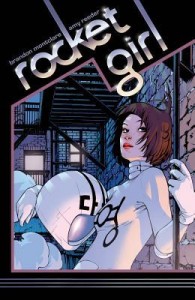
Rocket Girl, Vol. 1: Time Squared by Brandon Montclare

Posted October 5, 2014 by Michael @ Knowledge Lost in Graphic Novel / 0 Comments

Rocket Girl, Vol. 1: Time Squared by Brandon MontclareTitle: Rocket Girl, Vol. 1: Time Squared (Goodreads)
Author: Brandon Montclare
Artist: Amy Reeder
Published: Image Comics, 2014
Pages: 120
Genres: Graphic Novel
My Copy: eBook

Buy: AmazonBook Depository (or visit your local Indie bookstore)

Dayoung Johansson is a teenage cop from a high-tech future investigating a megacorporation for crimes against time. She goes back to New York in 1986 to investigate the Quintum Mechanics Corporation. What she finds is far different to what she expected. As she slowly pieces the clues while trying to navigate a different place and time. Discovering that what she knows about her home is really an alternate reality that shouldn’t exist.

Rocket Girl: Time Squared is the first five issues of this bright and quirky series that combines high-tech gadgets in a time where New York wasn’t exactly a safe place to live. Just a quick search of New York in the 1980s and I found that the subway system saw over 250 felonies committed every week. It was a dark and gritty time to live in this great city. So when you read a comic that is full of bright art work set to this gritty backdrop the contrast really stands out.

The past and future also play off each other within this series, Dayoung Johansson is a teen cop and when she lands in 1986 she meets a police petrol. She bosses them around like she would normally do in her 2014 reality but obviously gets a different response from these police officers. It is obvious to say that Rocket Girl is all about clashing; the vibrant colours against a gritty city, past and future, and the list goes on.

While this is a lot of fun to read sometimes I found that the series attempted to get too complex, which can often raise questions about the science. The artwork was too busy at times that you had to spend extra time on once panel just to absorb everything and make sense of it. This tended to throw the flow off but only remains a minor setback.

I would have liked to see more of an exploration into the moral issues of time travelling and alternate realities but I know this is only the beginning of the series and that there is still time for this. I’m not sure where this is going to go, I can imagine that Dayoung would want to return to her alternate reality but to what lengths would she go to make sure that reality will happen? Brandon Montclare has set up a good premise and teaming up with Amy Reeder for the art means we will continue to see vibrant colours in this strange little story.