Category: Literature

My Next Reading Project – Middlemarch

Posted May 25, 2014 by Michael @ Knowledge Lost in Literature / 8 Comments

I’ve often said that big books scare me and I still think that is true but there are exceptions. I’ve found that if I have a reading project and slowly work through a big novel, I not only finish the novel but also tend to enjoy the experience. I’ve done a few reading projects in the past, including making my way through Infinite Jest, which took a few months and increased my pretentious level. More recently I completed War and Peace; I think that took about five months to complete but well worth it.

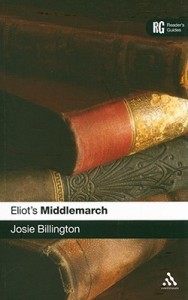
When I finish university for the semester I’m planning another reading project, this time for novel that isn’t as big as Infinite Jest and War and Peace. This time I’m going to tackle Middlemarch by George Eliot beginning in June. Middlemarch is a social critique so I’m going to have to get understand the historical and cultural context. To do this I’m going to try using a reading guide; I’ve never used one before but I think it is time I put them to the test. After asking around, I’ve settled on the reading guide Eliot’s Middlemarch by Josie Billington, which is part of the Continuum Reader’s Guides series.

I’m not sure what to expect but I’m looking forward to reading Middlemarch; I’ve heard some great things about this novel and I’m sure I’ll be a very proud man when I complete it. I am not entirely sure what to expect but I’m excited for the ride. Have people had as much success with reading projects as I have? I think they can be very useful for those big bricks. I like to slowly take my time and spend months chipping away at a novel like this; it allows me time to process in between. Like War and Peace, Middlemarch was originally published as a serial, so I suspect that I’ll get some repeated information, which is useful when reading a novel so slowly. I’m looking forward to this project and I hope the reading guide helps.

So this happened

Posted May 11, 2014 by Michael @ Knowledge Lost in Literature / 2 Comments

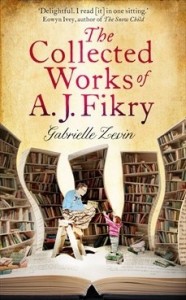
The Completed Works of A.J. FikryDo you remember the scene in The Collected Works of A. J. Fikry (known as The Storied Life of A. J. Fikry in the US) by Gabrielle Zevin where A. J. talks to a sales rep about the suspension of disbelief? In this scene they talk about how some novels require a suspension of disbelief. On one end of the scale you have literary fiction were everything is about real life situations, then three quarters of the way down the scale you have The Magicians with its references to magic and Fillory. At the end of the scale there is A. J. and his decision to adopt little Maya.

Do you remember this scene? I spent a sleepless night analysing this scene. Trying to understand the concept of ‘suspension of disbelief’ and what the author wanted to say on this topic. I’ve been enjoying The Collected Works of A. J. Fikry but this one scene really stuck with me. The only problem is, this scene doesn’t exist and I was analysing a scene that played out in my mind instead.

It got me wondering about this weird situation. Why would I be kept up all night wondering about a non-existent scene? That whole experience was odd and I’m not sure what to make of it. Do others have similar stories like this? It’s an entertaining story, worth sharing but I feel little a senile because of it.

My review of The Collected Works of A. J. Fikry will be out this week.


My Bookish Manifesto

Posted May 10, 2014 by Michael @ Knowledge Lost in Literature / 20 Comments

I love my blog, I’ve been very proud of it and I can’t think of anything better. I like to spend my time playing with it, slowly improving it and writing posts for it. I don’t make money off my blog but it is a real passion of mine and something I plan to continue for a very long time. Recently I read a fantastic article on advice to young critics, while this is focused on the TV and movie industry I think it is still relevant to what I want to achieve.

Feeling all inspired by this article, I started thinking about what I want to achieve in life. I want to be considered a critic and I would love to get paid to do what I love but if that never happens I will still enjoy doing it. I’m not satisfied to with my current skill level and I want to continuously be improving. I took the advice given in the article on board and decided to adapt it to reflect my intentions. Being as pretentious as I am, I’m calling this my book critic manifesto.

  • Read a lot of different books – make sure to explore a wide range of genres, going outside more comfort zones and reading from more nationalities, different translations and genres.
  • Read from the back list – avoid only reading from the novels that have only just come out. Read books from all periods of time. Go back further than the 18th century and try to understand how books from the past have paved a way for the present.
  • Learn about the book industry – the politics and what goes on behind the scenes, it is important to have a finger on the pulse of the bookish world and understand trends and strategies deployed by the publishers.
  • Write every day – Commit to writing at least one post a day, it doesn’t matter if they get published or not, develop a habit. Writing takes practice and the more you practise the better you will be come. This is an essential step for self-improvement.
  • Find time to read every day – I can’t improve as a book critic if I’m not spending time reading, make the time. Listen to audiobooks while working, driving or exercising. Carry a book (or ebook) at all times and use any free time to read a little more.
  • Write it down – any good ideas or notes I have need to be written down before I forget. I’ve started carrying a notepad with me and finding other methods to jot down notes and thoughts as they come to me.
  • Rewrite – Edit, edit and edit some more. First drafts are never going to be my best writing but I often don’t like to rewrite. I must disciple myself to put my best work forward and thing will mean rewriting.
  • Proof read – I’m lucky enough to have a great editor (my wife) who is supportive of my blogging. She generously takes the time to read over every post I write before it hits the blog. I have to train her to be tougher on me and tell me if I need to re-write something but with her help I will improve. However I need to make her life easier not harder, I need to make sure I’m not relying on her and I’m checking my work thoroughly before she sees it.
  • Read up on history and psychology – It is fascinating to see how helpful knowledge of history and psychology can help with critical thinking. I am to critique books, so I need to understand more about the historical context and the psychology behind it.
  • Study literary theory – I need to understand literary criticism better; I know I will never understand all the theories but a basic knowledge will be useful. I suspect that my primary focus will be Marxist and Psychoanalytical theory but I would also like to be able to read a book from a Feminist, Post-Colonial, etc. view point as well.
  • Learn about language – Read more books about language and grammar, they can be fun and I can learn a lot from them.
  • Interact with the bookish community – it is important to continually seek out people with different viewpoints, I don’t want to become an echo chamber. Interacting with people that read and review books differently to me will help me develop my style and avoid becoming stale. We don’t want to live in a world where everyone says the same thing and if I can spend time reading different opinions I hope to avoid being similar to the crowd.
  • Learn about creative writing – I sometimes wish I could write a story but I feel I’m better suited as a critic and a reader than an author. I do need to learn the tools of the trade so I can understand why an author does what they do and develop an appreciation for the craft.
  • Develop my voice – I feel like my style is very conversational and personal; this is how I relate to the novels and this is how I feel. With practice I can perfect my style but I must always remember what I’m trying to achieve and how I want to come across in my writing.
  • Avoid only writing reviews – I don’t want to fall in the habit of only writing book reviews, if I’m writing every day I’m never going to keep up. I will write non-review posts, about my bookish thoughts or what ever is going on in the bookish world. Memes are great but I don’t want to rely heavily on them.
  • Meet deadlines – If I’m going to request an ARC then I must make sure that I read and review the book before the deadline or release date. Non-solicited ARCs don’t need to be read before a deadline or at all. I have written a review policy that clearly states that not all ARCs will be read but I need to make sure if I’ve committed to one that I read it.
  • Don’t be afraid to be different – I’ve found that I often hate books that others may enjoy, I do enjoy writing a negative review and I must remember that there is nothing wrong with that. However I must also remember that the job of an author is hard and I must always use tack and constructive criticism. I can’t be afraid to try something different and have a voice that differs from the rest, stand firm in what I think and be uncompromising in my writing.
  • Be the best you can be – I need to learn that sometimes a piece of writing isn’t working and I should dump it and start again. I shouldn’t be afraid to start over, I want my editor to be hard on me and I should be hard on myself too. I can learn a lot from others and I must be willing to take criticism. It is a helpful to my growth as a critic and also essential. If I’m not happy with a piece how can I expect others to enjoy it. Try and try again until you get it right.
  • Just write – I know that there will be times where I will feel like I’m not writing well or am suffering from a writer’s block. I need to remember that I don’t have to publish everything I write to my blog. I can write a bad piece and then dump it and try again, I might get some decent lines out of my bad writing that can help form a better piece.
  • Have fun – This is a passion not a chore.

This is still a work in progress and I plan to add more to this manifesto when I think of it. I feel like I have a goal in sight and I want to work towards it. This is not about getting a job or anything like that; this is about developing my skills to be the best book blogger/critic I can be. I’m passionate about books and I love talking about them, I will improve and this is how I plan to do just that. If you have any good advice that I can add to this, let me know in the comments below.


How do you pick an imprint for classics?

Posted May 3, 2014 by Michael @ Knowledge Lost in Literature / 8 Comments

Every publisher seems to have their own classics section. Penguin Random House now control most of the market (Penguin Classics, Modern Classics, Signet Classics, Vintage Classics, etc). So how do you choose which collection to buy from? Do you even pay attention to the publisher? When I first started hording collecting books, I didn’t pay too much attention and went for the prettier cover but I’m beginning to wonder if this is a decent solution.

1-05-2014 11-38-14 AM

Sure, I would love to own every book released in the Pulp! the Classics; they are fun and I do own a few of them already but buying a classic because of their covers isn’t really effective. Not all editions are the same, in particular translated classics. When picking up a Russian classic do you know which translator to pick? Do you spend time researching the best translator or do you have a publisher you can trust?

I’ve often contemplated this question and since studying at university I’ve noticed that they often recommend two publishers more than any other; Norton Classics and Oxford World Classics. While they don’t have the best covers, I’ve had the greatest success with Oxford World Classics, to the point that I don’t want to buy any other editions. If asking the internet which translation of a novel I should read, for War and Peace it is Louise and Aylmer Maude and for Crime and Punishment, Jessie Coulson is often the answer. They are the translators used in the Oxford World Classics.

I’m not sure what it is, I just trust Oxford World Classics more than any other and they often offer some great questions to ask yourself in the back of the novel. My new found love for Oxford World Classics and the reason for this post is not to give a sales pitch or anything like that; I’m just curious if others think about this topic in as much detail as I do. If so, which publisher do you trust over all others?


What I Hate about Book Blogging

Posted April 26, 2014 by Michael @ Knowledge Lost in Literature / 12 Comments

As much as I love book blogging and have no desire to slow down anytime soon, there is one thing that annoys me. It is not exactly a huge problem and I think this falls under the category ‘First World Problems’ but it has been coming an increasing annoyance for me. I’m not talking about the lack of commenting (I know I’m guilty of this) or the struggle to be part of the crowd of first readers, who boost about all the wonderful ARC’s they read. I’m even not complaining about the lack of male book bloggers or the excess of blogs talking about the exact same thing, this is something completely different.
I started book blogging in April 2012 as a way to track my reading journal. I have an autodidactic blog where I previously discussed literature, but I found myself losing focus on what that blog was all about. I transferred most of my literary posts onto this blog and started blogging passionately about the books I’ve read, loved and hated. I love the way this blog documents my reading journey but the problem is the fact that it only covers my journey from 2012 onwards.

I started reading in 2009 when the reading bug hit me hard; in that time I read some fantastic books but they don’t show up on my blog. I’m at a point in blogging were I want to make reference to books I read before I started blogging but I have no post to link it to. This isn’t a huge problem but it is something that has become increasingly annoying.

I’m now at a stage in my book blogging where I want to go back and re-read a lot of those great or interesting books just so I can blog about them. This also means if I ever want to write a blog post on every book that is on the ‘1001 Books you must Read Before you Die’ list (a life goal of mine) then I will have to re-read over 50 of the books on the list. I was just wondering if I’m the only one who feels this way or if anyone has gone to the extreme of re-reading most of the books from their past just to blog about them?


Where is the Overall Story Arc in a Crime Series?

Posted April 19, 2014 by Michael @ Knowledge Lost in Literature / 2 Comments

One thing that annoys me about reading a crime series is the lack of an overall story arc. I’m not saying that this is the case with all book series but it seems to be for the majority of them. Within crime fiction especially, the overall story arc is often very basic and often feels like a crime of the week format. This isn’t the case with romance, science fiction and fantasy they are more likely to have a continuous story line and have huge success with it.

When I read a series it is more than often a crime series and I wish the ‘new novel, new crime’ wasn’t the norm. When I watch TV, I often enjoy a series with an ongoing story; Veronica Mars is a prime example on television of what I want in a crime novel. A case that needs to be solved in every book but a bigger mystery that lasts over a couple of novels. Why can’t they do that in a novel series? I know a book is a bigger investment but I often read one book in a series and never continue because there is nothing to keep me reading.

The problem is that everything seems to be a series at the moment; I like the idea of returning to a great character but I need more. I like hard-boiled and noir crime novels but I find myself reading them less and less. I don’t want to read a series if there is nothing to keep me reading. A character has to be amazing to keep me reading, or they could just give me an unanswered mystery. Does anyone know of a good crime series that develops characters over a long period of time and also has an overall story arc?  Let me know. I wish I could write, I have been developing a concept in my head but I have no idea how to put it onto a page.


Is Formalism still Relevant?

Posted April 12, 2014 by Michael @ Knowledge Lost in Literature / 2 Comments

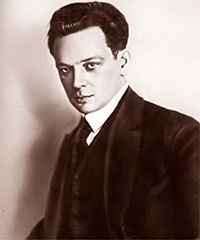
Yuri Tynianov

In a time of revolution a new form of literary theory also emerged. Russian Formalism was an influential school of literary criticism that involved a number of influential scholars including Viktor Shklovsky, Yuri Tynianov, Vladimir Propp, Boris Eichenbaum, Roman Jakobson, Boris Tomashevsky and Grigory Gukovsky. The movement may have been short lived from the 1910’s to the 1930’s but it played a big part in influencing modern criticism, including structuralism and post-structuralism.

The idea of Formalism is to study the mode, genre, discourse and forms of literature. Ignoring the social or cultural influences, Formalism choices to analyse the structure rather than analyse the meaning behind it. The approach takes a more scientific look at literature over the others at the time, but still influenced by other schools of thought like Ferdinand de Saussure’s linguistic theories and Symbolism.

While I don’t know much about literary theory, the concept of Formalism has been on my mind lately, and even been the subject of an interesting debate on Twitter. While this an out-dated school of thought, I do believe it is a useful form of literary criticism. While I wouldn’t recommend focusing on Formalism, it can serve as a basis into diving into the world of literary criticism. I have to wonder, is it just my university or does Formalism get taught as an early concept in other English lit courses?

By developing a basic understanding of mode, genre, discourse and forms, it allows us to ask questions we may not normally ask. Why is the text written in one perspective over another? What does the form say about its content? How does paradox, irony, ambiguity, or tension work in the text?  The idea is to help to develop critical thought, giving students a basis to work with.

Formalism is not a term used in the current subject I’m taking; it’s called Approaches to English Literature but the concept is the same. However recent trends in academic literary criticism suggest that maybe Formalism making a comeback. While I would never focus on Formalism, I think it is a useful skill to learn; I believe there is a use for this school of literary criticism. It may only be to develop skills needed for future studies. What are your thoughts on Formalism? Do you believe its useful or making a comeback? If you’ve studied it, do you believe it helped develop critical thinking?


A Two Year Reflection

Posted April 6, 2014 by Michael @ Knowledge Lost in Literature / 4 Comments

One of the things I love about book blogging is just expressing my bookish thoughts, the stuff I’ve been thinking about. My goal was to post a non-review at least once a week (Saturday) but sometimes life gets in the way, you get busy and fall behind on book reviews. I’m pleased to say I’ve written all my book reviews so now I can get back to what I love about book blogging. Two years ago (this month) I started book blogging, my newfound love for literature was evident on my now neglected autodidactic blog Knowledge Lost and I felt the need to document my reading journey.

While this book is a documentation of my reading journey over the past few years, I also want to share my bookish thoughts. It is interesting to see how much they change over the course of a few years. So this post is kind of like a reflection of the past few years and see how much things have changed. Surprisingly for two years of blogging, Literary Exploration has just over 600 posts and over 340 of those are book reviews. While I would like to see more non-review posts, I’m very happy with the direction this blog has taken.

Over the past few years you can see just how much my reading (see my infographic) and book reviews have improved, as I grow as a reader so does this blog. I’ve gone from avoiding re-read books to wanting to re-read favourites just so I can blog about those books. That is one of the biggest problems with book blogging, so many books I’ve read before blogging that I need to re-read just so I can add them to my review list. My literary wall of shame is now a little less shameful (I should write a new one), I still dislike eucatastrophic endings and I’m still planning to complete the 1001 Books You Must Read Before You Die list.

As for literary studies, most people know that I’m now starting at university part time, but I feel like my autodidactic studies are more educational. Those concepts of metafiction, satire and formalism (post coming soon) are all concepts I feel like I’ve got a handle on but still hope to learn about in more detail. If I were ever to teach an introduction course to literature, I probably would still pick the same books as those in this post.

It’s been a great two years, I love book blogging and I don’t plan to let up anytime soon. If I was better at self-editing I would probably try to post every day but unfortunately that is still a pipe dream. Though pop-culture is still destroying literature, books are still better than their movie adaptations. Books are here to stay, even if it feels like there is less and less people reading. I hope book bloggers are here to stay as well, but I would love to see more male bloggers out there.


2014 Reading Goals

Posted December 21, 2013 by Michael @ Knowledge Lost in Literature / 9 Comments

With 2014 so close, it is time again to start thinking about what my reading goals will be for next year. Firstly I want to have a quick look at how I went with my 2013 Reading Goals. First of all I went on a semi book buying ban which lasted most of the year but didn’t do much to reduce my TBR (To Be Read shelf) but it did get me to use the library more (see my post Book Buying Bans Don’t Work). Secondly there was the reading goal of 150 books (on Goodreads) which I did complete. I stated in my 2013 Reading Goals post that “I would just take the time and read some bigger books and some non-fiction” which I feel I failed. I did read some bigger books and non-fiction but not enough to satisfy myself. Lastly there was the Literary Exploration reading challenge, which was a lot of fun and I did complete.

What does that mean for 2014? Well I would like to move away from a reading goal, I like the idea of trying to hit 100 or 150 books in the year but I want the freedom. I don’t want to pressure myself to read x amount of books a week or year, I want to read bigger books and with no reading goal I might be able to achieve this. I’m not sure if I will achieve this, I’m sure I’ll cave and set my reading goal on Goodreads to 150 books.

I do want to read more non-fiction, maybe I can put pressure on this and set a 2 book a month goal on myself. I’ve recently enjoyed more non-fiction and might have finally caught the (non-fiction) reading bug, especially books about books. I want to try and nurture this and hopefully I’ll find a passion towards biographies and non-fiction as well as fiction. As for reading more big books, I’ll continue working on that, but I’m not going to force anything.

Finally the Literary Exploration reading challenge is back for another year. I will be doing the ‘Insane challenge’ again, that is 36 books in different genres. I might even get cocky and try and do two books from the 36 different genres, but I will see how I go. I like that I’m willing to explore all genres and want to make sure I read more in some of the genres I don’t normally read. I will continue to advocate the joys in reading more widely and I hope the Literary Exploration reading challenge will help more people discover this.

What are other people planning for next year? Are any trying something a little bit different? I’m interested in learning more about other people’s reading goals and hopefully discover some new ways to challenge myself for 2015. Hope everyone enjoys the holiday period and are excited for 2014’s reading challenges.


The Literary Exploration Reading Challenge Returns for 2014

Posted December 12, 2013 by Michael @ Knowledge Lost in Literature / 9 Comments

The Literary Exploration reading challenge is back, by popular demand. As most people know, Literary Exploration tries to explore all different genres in the hope to become a well-rounded reader and even discover something new. So we are challenging everyone to dedicate either 12, 24 or 36 books that you would normally read during the year to different genres. We have compiled a list which hopefully will give you a chance to explore literature a little deeper.

It’s real simple; below you will see an easy (12 books), hard (24 books) or insane (36 books) challenge. Each genre links to the Goodreads genre page if you need some suggestions on what to read. We want you to have some fun and explore; hopefully you might find a new genre that peaks your interest. To sign up either join the Literary Exploration book club on Goodreads and talk about your progress with others involved or for the bloggers out there, if you want to add it as part of your blogging experience simply let us know with a link (to your Literary Exploration Challenge page) in the comments below so our readers can see how you are going.

This year we have adjusted the insane challenge slightly to make it a little more rounded. The popularity of the reading challenge with overwhelming and we are pleased to see how many people wanted to do it again next year. We have even offered some bonus for those who want to take it to the next level. The idea of this challenge is to have a well-balanced list of genres and not focusing on one genre more than any others.

Good luck all who decide to join in. I personally am going to go for the 36 book, insane challenge and I’m really looking forward to it. While there are some genres I’m not looking forward to reading, it’s all part of being a literary explorer. What could be wrong with that?

Read More