California by Edan Lepucki

Posted October 11, 2014 by Michael @ Knowledge Lost in Speculative Fiction / 0 Comments

California by Edan LepuckiTitle: California (Goodreads)
Author: Edan Lepucki
Narrator: Emma Galvin
Published: Hachette, 2014
Pages: 320
Genres: Speculative Fiction
My Copy: Audiobook

Buy: AmazonBook DepositoryKindle (or visit your local Indie bookstore)

Cal and Frida is living in the middle of the 21st century, however it wasn’t the future we expected. Cities have crumbled, the internet has died and technology is worthless. Leaving city life behind, they now have to live in the wilderness, struggling to survive. Isolation and hardship are all new experiences; they live in fear of an uncertain future. A future that now consists of giving birth and raising a child in this post-apocalyptic world.

The post-apocalyptic back drop has been hugely popular lately and it isn’t just young adult fiction. Many literary fiction authors have tried their hand at the genre, giving them a unique world to explore real life issues. I’m thinking of great books like The Road by Cormac McCarthy, Super Sad True Love Story by Gary Shteyngart, The Passage by Justin Cronin and the Maddaddam series by Margaret Atwood. Edan Lepucki’s California sets out to join the ranks of the great with this overly ambitious first novel.

I will be honest, the only reason I picked up California was because of the promotion that appeared on The Colbert Report a while ago. The novel had enough to peak my interest but I had great difficulty getting a copy where I lived. Ironically I finally settled on getting the book through Audible to listen to. The premise of the novel was great; the idea of a world returning to the dark ages offered some interesting ideas. While we are never sure, the novel does allude to global warming as the underlining cause of this post-apocalyptic world.

I expected this novel to be the slow burn that The Road provided, building the characters and struggle while exploring the intended themes. However, I think this book burned a little too slowly, the flame went out halfway through and it turned into more of a chore to get through. Sure, the notions of communities, eco-terrorism and climate change were explored but for me it felt like I was being beaten over my head every chance they got. The book wanted to show off how smart and witty it was but, like many things that try to do this, the delivery never matched the intent.

California moved so slowly that as a reader, I was trapped in the wilderness of nothingness and I didn’t think I could escape. This was a real pity, everything seemed to start off so well; there was a plot arc and themes all set up and ready for execution. Somewhere on the way I feel like the author got a little lost and the readers were just following to her struggle to get back on track. I might come down hard on this novel; it isn’t too bad, there is a lot of potential and could have been a great book. For me it just didn’t work and wasn’t paced properly, I’m sure some people enjoyed it


A Death in the Family by Karl Ove Knausgård

Posted October 9, 2014 by Michael @ Knowledge Lost in Contemporary / 0 Comments

A Death in the Family by Karl Ove KnausgårdTitle: A Death in the Family (Goodreads)
Author: Karl Ove Knausgård
Translator: Don Bartlett
Series: Min Kamp #1
Published: Harvill Secker, 2009
Pages: 400
Genres: Contemporary
My Copy: Library Book

Buy: AmazonBook DepositoryKindle (or visit your local Indie bookstore)

A Death in the Family is the first book in the controversial six volume series by Norwegian author Karl Ove Knausgård. The controversy started with the title of the book Min Kamp, which is the same title as Hitler’s Mein Kampf as both translate to My Struggle. Secondly, while these are marketed as autobiographical novels, Knausgård has come under fire from friends and families for exposing their private lives. Karl Ove Knausgård has been often been called a Proustian and Min Kamp often compared to In Search of Lost Time. That is just enough pretention to make me want to pick up these novels and read them.

A Death in the Family (or My Struggle Book 1 in America) tells the story of Karl Ove Knausgård, a family man living in Sweden, trying to find the balance between his writing and his family. He reflects on his childhood and teenage years, as well as the loss of his father in what feels like a brutally honest portrayal of his life. What is interesting is the idea of this being an autobiographical novel rather than a memoir; as a reader I had to continuously remind myself of this fact. I had to question what is real and were liberties were taken. Honestly, I don’t think I could write about my childhood with such clarity and I suspect that the fiction was used to fill in the gaps and tell a better story.

Karl Ove Knausgård is approaching middle age, and with a young family I suspect that this six volume series is just a way for him to make sense of his life. Allowing him to work through issues and mistakes and explore different ideas he might have towards life. This is both an effective and fascinating insight of the life of a writer and I suspect it would have been very therapeutic for Knausgård, even if it caused friends or family members to hate him. As a novel, it is a roller coaster of emotions; sometimes it might come across as slow or even dull but that is life.

This first volume is even divided into two parts, one exploring the childhood/teenage years of Karl Ove and the other the death of his father. To understand the death of his father, obviously his childhood played a big part; his mother was almost invisible, always at work or somewhere and his father was distant and unpredictable. We often have a rose-coloured memory of our childhood but as Knausgård reflects on his past, you can recognise a similar distorted view in your own life. Karl Ove has a dark view on the world and death; it is interesting read this book in the context as he tries to understand his father and his death at such a young age.

While I can’t compare Karl Ove Knausgård to Marcel Proust (I really need to read him) or Min Kamp with In Search of Lost Time, I’m glad to have read this novel. I have reserved A Man in Love (Book 2) and I plan to read all six books. I like Knausgård’s view on the world and find it fascinating to read his books as he works through his own issues. His writing style obviously helps, I found great beauty in the dark and macabre views and credit has to go to Don Bartlett for the translation.

My only problem is going to be the fact that only the first three books of My Struggle have been translated and published. I suspect I will be caught up on this series very soon and I will have begin the year long waits between volumes. Book Four is expected in April 2015 and I am never going to learn Norwegian to avoid the wait. I have always shyed away from a series that is incomplete because of the wait but this sounded right up my alley and thought I had to try at least the first book; that was a mistake.

This was a pleasant balance between literary fiction and self-reflection. Karl Ove Knausgård even threw in some of his philosophical views; I remember some references to Danish philosopher Søren Kierkegaard in the text. This was so much more than an autobiographical novel of bewilderment, grief, relationship, love, loss and rock music; hard to explain but I recommend you experience it. Even if you just wish to increase your book snobbery levels, Karl Ove Knausgård’s My Struggle series is going to be something to watch. I suspect this will become a literary sensation, if it has not become one yet.


The Odyssey by Homer

Posted October 7, 2014 by Michael @ Knowledge Lost in Classic / 0 Comments

The Odyssey by HomerTitle: The Odyssey (Goodreads)
Author: Homer
Translator: Walter Shewring
Published: Oxford World's Classics, 8th century BC
Pages: 349
Genres: Classic
My Copy: Paperback

Buy: AmazonBook DepositoryKindle (or visit your local Indie bookstore)

The Odyssey is one of two narrative poems that have been attributed to the Greek poet Homer; while it is not entirely clear that he actually composed both or any of them. While it can be said that The Odyssey is a sequel to Homer’s Iliad, reading them out of order will not put you at a major disadvantage. Iliad tells the story of the war on Troy and remains popular due to the fact that it is one of the only surviving Greek classics that actually deals with thetopic. The destruction of the Library of Alexandria was a great cultural loss and many poems and documents were lost, leaving Homer’s works even more culturally significant as it pretty much all we have left to go on. The Iliad and Odyssey remain fundamental to the Western canon for being the oldest works still in existent in literature.

While the Iliad focused on the events that happened in Troy, The Odyssey takes place ten years after the Trojan War. Odysseus has still not returned home from the war, his wife Penelope is still hopeful for his return while the Suitors (a group of over 100 men) try to persuade her to marry one of them. The Suitors are enjoying the hospitality of Odysseus, eating up his wealth while he is not around to stop them. Up on Mount Olympos, the gods are debating on whether to let Odysseus return. The goddess Athene pleads to her father Zeus in favour of letting him return, but Poseidon wishes to wipe his ship out. Obviously this is an over simplified synopsis; to give The Odyssey’s plot any justice, I would need to write a few paragraphs of information.

I was a little worried going into this epic poem; I have often found medieval literature difficult and the idea of reading something so much older scared me. I was lucky enough to be assigned a prose translation by Walter Shewring which was a perfect choice for me. Out of interest I had a look at another prose translation, the Project Gutenberg edition (translated by Alexander Pope) and was shocked to see Jove, Neptune and Minerva used in the text. A Greek epic poem that was using Roman gods, that didn’t work for me. Shewring’s was superb; it made things easier for me and helped me find the beauty with this text.

Obviously when The Odyssey was first composed (believed to be around the 8th century BC) it was shared in an oral tradition by an aoidos (poet or singer). We can see a lot techniques being used that have since been established as the literary norm. The Odyssey reads almost like a modern day thriller, continually keeping up a fast pace with slight repetition to remind the audience of key plot points. It is a story of a variety of adventures, told in a non-linear fashion that doesn’t have much in the way of philosophising or introspection.

While the Iliad and Odyssey is attributed to Homer, there isn’t much other information about this Greek poet. The bearded blind man often depicted as an image of Homer is not even one that can be historically verified. The lack of information about the author (if in fact he was the author) means that the poems have to speak for themselves; a new experience for me in my study of literature. It is surprising that the literary terms ‘Homeric Greek’ and ‘Homeric world’ were named after someone we know nothing about.

There is a lot going on in The Odyssey but I want to look at two things I found interesting; first of all the idea of hospitality. Within the poem the idea of hospitality is a little weird; the Suitors just move in and make themselves at home, taking advantage of the hospitality of someone who wasn’t around to stop them. Further in the poem, Odysseus and his soldiers are doing the exact same thing to the Cyclops. Hospitality is expected and within this poem it is often being taken advantage of. What does that say of humanity during the time this was set and has it changed much now?

Secondly I want to talk about gender inequality, ever since reading The Fictional Woman I see it in almost everything I read, so I can’t help but talk about. Odysseus is not faithful to his wife Penelope; there are countless times he is sleeping with someone else. In fact the idea of him being a highly sexual being is pretty much glorified within this poem but if it is a woman, then she isn’t an ‘ideal’ woman or evil. Just look at how Clytemnestra, the sirens and Calypso are portrayed within this poem. In fact Penelope is the symbol of a perfect woman and Odysseus has to test her before revealing who he is. My problem is the scary notion that this gender inequality is still a problem now; in the 8th century BC it was evident; why is this still a problem?

Odysseus is an interesting character, a smart and witty hero; you could even say he had the favour of Athene (goddess of wisdom, courage, inspiration, civilization, law and justice, strategic warfare, mathematics, strength, strategy, the arts, crafts, and skill) on his side. It is interesting the way Odysseus is portrayed as a hero; it is different to a modern interpretation of the word. He isn’t necessarily a good person, in fact, I would say he wasn’t but his actions are often heroic. He tries to save his men from the Cyclops but his pride and ego almost got them killed and there are many more instances of this. In this modern world we seem to combine a good character with heroics but that isn’t often the case. A person can be heroic and try to protect or save others, doesn’t mean they are not a jerk.

I went into this epic poem nervous and I ended up loving it; I will have to track down the Iliad and read that one as well. I think Walter Shewring’s translation did help and the fact that this was an Oxford World Classics edition meant that I knew I would have some helpful information to help me understand The Odyssey. On a more personal note, writing this review was rather difficult, I had to remember Homer didn’t write this, he spoke it and this is a poem not a novel or book. I have so much I want to say about this poem but I had to edit this review down already.


Rocket Girl, Vol. 1: Time Squared by Brandon Montclare

Posted October 5, 2014 by Michael @ Knowledge Lost in Graphic Novel / 0 Comments

Rocket Girl, Vol. 1: Time Squared by Brandon MontclareTitle: Rocket Girl, Vol. 1: Time Squared (Goodreads)
Author: Brandon Montclare
Artist: Amy Reeder
Published: Image Comics, 2014
Pages: 120
Genres: Graphic Novel
My Copy: eBook

Buy: AmazonBook Depository (or visit your local Indie bookstore)

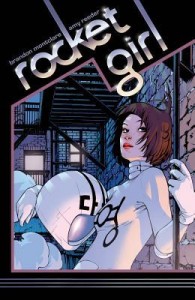
Dayoung Johansson is a teenage cop from a high-tech future investigating a megacorporation for crimes against time. She goes back to New York in 1986 to investigate the Quintum Mechanics Corporation. What she finds is far different to what she expected. As she slowly pieces the clues while trying to navigate a different place and time. Discovering that what she knows about her home is really an alternate reality that shouldn’t exist.

Rocket Girl: Time Squared is the first five issues of this bright and quirky series that combines high-tech gadgets in a time where New York wasn’t exactly a safe place to live. Just a quick search of New York in the 1980s and I found that the subway system saw over 250 felonies committed every week. It was a dark and gritty time to live in this great city. So when you read a comic that is full of bright art work set to this gritty backdrop the contrast really stands out.

The past and future also play off each other within this series, Dayoung Johansson is a teen cop and when she lands in 1986 she meets a police petrol. She bosses them around like she would normally do in her 2014 reality but obviously gets a different response from these police officers. It is obvious to say that Rocket Girl is all about clashing; the vibrant colours against a gritty city, past and future, and the list goes on.

While this is a lot of fun to read sometimes I found that the series attempted to get too complex, which can often raise questions about the science. The artwork was too busy at times that you had to spend extra time on once panel just to absorb everything and make sense of it. This tended to throw the flow off but only remains a minor setback.

I would have liked to see more of an exploration into the moral issues of time travelling and alternate realities but I know this is only the beginning of the series and that there is still time for this. I’m not sure where this is going to go, I can imagine that Dayoung would want to return to her alternate reality but to what lengths would she go to make sure that reality will happen? Brandon Montclare has set up a good premise and teaming up with Amy Reeder for the art means we will continue to see vibrant colours in this strange little story.


Dept. of Speculation by Jenny Offill

Posted October 3, 2014 by Michael @ Knowledge Lost in Contemporary / 0 Comments

Dept. of Speculation by Jenny OffillTitle: Dept. of Speculation (Goodreads)
Author: Jenny Offill
Published: Knopf Doubleday, 2014
Pages: 182
Genres: Contemporary
My Copy: ARC from Netgalley

Buy: AmazonBook Depository (or visit your local Indie bookstore)

Dept. of Speculation by Jenny Offill tells the story of an unnamed narrator known only as The Wife. This novella charts the narrator through all her uncertainties, as she overanalyses everything in her head from the small things to big things like her marriage. The analysis can invoke anything from Kafka to doomed Russian cosmonauts. The title comes from the letters the wife exchanged with her husband which are postmarked as Dept. of Speculation; the letters were a way to voice her uncertainties. However as the two drifts further apart she starts to lose this outlet, which could be her inherit downfall.

This novella offers a very real look at a person’s life who overanalyses everything. Now I am not going to tell you whether or not this narrator is unreliable or anything like that. I think this is something the reader needs to determine for himself or herself. It doesn’t matter either way, this book takes something intensely real and, at times, this can be a little too real. The way Offill has captured this character’s thoughts and emotions is what makes this book both deep and meaningful.

There is however a huge flaw in this novel, something that was pointed out by a friend before I went into this book. In the edition I read there was a huge amount of italicised text and not all of it was referenced. There are times that the author states who said the quotes and then for the most part leaves quotes unreferenced. While normally I have no problem with no referencing within fiction, but when it takes up a large chunk of the writing, it starts to become a problem. Especially when you find text that speaks to you but it is italicised.  Was it a famous quote and was she trying to pass this off as her own words?

There is great beauty within this novella and there is a lot to love about it. This large flow I found with the novel really caused a problem which is a shame. I love books that explore complex human emotions and thoughts, Julian Barnes does this really well and Jenny Offill is just as good. I wanted to love this book and jump on the bandwagon but I couldn’t. I try to wonder if I would have the same problem if it wasn’t pointed out to me before I started this novel, I like to think I would but this friend always puts me to shame when it comes to critical analysis.


Monthly Review – September 2014

Posted September 30, 2014 by Michael @ Knowledge Lost in Monthly Reading / 0 Comments

Gone GirlNow that September comes to a close, I would like to hear what people thought of Gone Girl. Did you read it? Did you like the ending? Did it keep you up all night? Or any other comments you want to make of this novel. Personally I was gripped and reading this to about 4 am, just to find out what happens. I know the ending is weird but there isn’t a better way to end it, that I’ve found.

Next month’s book we will be reading the some steampunk/fantasy with The Anubis Gates by Tim Powers. I ‘m not sure what to expect, I am a little nervous. I don’t have the best track record when it comes to steampunk or fantasy novels. However I am hoping everyone reading this book will generate some interesting discussions. Also, as a reminder, in November we will be reading Tales of Terror and Mystery by Arthur Conan Doyle as part of the short stories theme and we will be looking for a book to fit the Christmas/Religious Holidays theme to wrap up the year. If you are not aware, the book discussion and everything else will be happening over on the Goodreads forums, so feel free to join in there.

I have had an amazing reading month, which is a nice change after reading only three books during my vacation. I have read sixteen books this month (which included four comic collections) and some of the highlights included The Odyssey by Homer, A Death in the Family by Karl Ove Knausgård and The Circle by Dave Eggers. But my favourite of the month is a book, that is a top candidate for novel of the year was All That is Solid Melts into Air by Darragh McKeon. For fans of A Constellation of Vital Phenomena by Anthony Marra, I highly recommend picking up All That is Solid Melts into Air. What have you been reading this month and what were the highlights?

Read More


Gone Girl by Gillian Flynn

Posted September 29, 2014 by Michael @ Knowledge Lost in Book of the Month, Crime, Thriller / 0 Comments

Gone Girl by Gillian FlynnTitle: Gone Girl (Goodreads)
Author: Gillian Flynn
Published: Weidenfeld & Nicolson, 2012
Pages: 442
Genres: Crime, Thriller
My Copy: Personal Copy

Buy: AmazonBook Depository (or visit your local Indie bookstore)

I’ve been trying to review this book for a while now and it has become a real struggle. I don’t want to give any spoilers for this brilliant book so I will try my best. Advanced warning: this review may have spoilers or turn out incredible vague. When I first saw this book I kept thinking this was just another YA novel but then I noticed this book kept popping up everywhere so I thought I better read what this is about and when I did, I had to read it right away.

When Amy disappears in suspicious circumstances all eyes fall to her husband as the primary suspect. Nick claims he is innocent but the evidence is not in his favour. Did Nick kill his wife? As this novel progressed any ideas of what happened will be shattered, any presumptions you’ve made about the characters will be wrong. Gone Girl by Gillian Flynn is a dark and twisted journey with so much unpredictability that you will be up all night trying to find out what really happened to Amy.

What I loved about this book was that you never really know what to expect. The book is told from the perspective of Nick and Amy, the diary of Amy tells the back story of their lives while the alternative chapters told from Nick takes the story from the disappearance. Slowly the pieces start to fall into place but there is always another curve ball just around the corner. The dark and psychological aspects of this novel remind me of something Jim Thompson would write but then the thriller and suspense of this book reminds me a lot of books like Before I Go to Sleep or Into the Darkest Corner.

Flynn did a brilliant job with this novel, it kept me up at night, made me want to skip work to read this book and in the end any spare time I had I was back in this book trying to find out what really happened to Amy. I wasn’t sure what I was in for and I didn’t know who to believe but in the end I enjoyed the ride. On reflection this book seemed incredibly basic with its plot but writing in a brilliant way that while reading you never have enough pieces to solve this puzzle. Highly recommend this book to any lovers of mystery and suspense.


The Year of Reading Dangerously by Andy Miller

Posted September 28, 2014 by Michael @ Knowledge Lost in Non-Fiction / 0 Comments

The Year of Reading Dangerously by Andy MillerTitle: The Year of Reading Dangerously (Goodreads)
Author: Andy Miller
Published: Harper Collins, 2012
Pages: 252
Genres: Non-Fiction
My Copy: Hardcover

Buy: AmazonBook DepositoryKindle (or visit your local Indie bookstore)

It is no secret that I am a fan of books about books; I especially enjoy a bookish memoir. The idea of reading and learning about someone’s bookish life is fascinating to me. Let’s be honest, I blog about books because I think I have an interesting bookish journey to talk about and I want to capture that for posterity sake. I would love to learn how to write a bookish memoir, so I read anything I can get my hands on. I have even written a post asking for recommendations for books about books and I am always on the look out for more.

I am not sure how I discovered Andy Miller’s memoir The Year of Reading Dangerously: How Fifty Great Books Saved My Life but I do remember being really excited about it. I ordered the book and it sat on my shelf for a little too long. With a holiday to America planned, I packed the book in my suitcase and was determined to read it. Turned out Simon Savidge from Savidge Reads started talking about this book about the same time and now I look like I was just following him in an effort to be as cool as he is.

Andy Miller worked as an editor at the time of writing this book (I assume he still does) and found himself only reading for work. On impulse he picked up a copy of The Master and Margarita by Mikhail Bulgakov and something just clicked for him. He set out to read ten books, which he called The List of Betterment, which consisted of books he has once lied about reading or felt he should read. This list obviously expanded over the course of the year but it was his starting point into rediscovering a passion for reading.

My discovery for reading was not unlike Andy Miller’s except mine involved Frankenstein by Mary Shelley, the 1001 Books Before You Must Read Before You Die list and it wasn’t a lost passion. I loved this book, I was so happy to read about all the awesome books Miller was reading in the course of the year. While this memoir is not healthy for my TBR and judging by Andy Miller’s glowing praises for Absolute Beginners by Colin MacInnes, I really need to get onto this novel first.

My only problem with this memoir is that Miller didn’t spend enough time talking about my favourite novels, like Frankenstein by Mary Shelley and Crime and Punishment by Fyodor Dostoevsky. Iwas happy to see that The List of Betterment not only includes canon but also involves books like The Essential Silver Surfer Vol. 1 by Stan Lee. It is just good to see a memoir that doesn’t just involve highbrow literature. He even considered calling this book How Fifty Great Books (and Two Not-So-Great Ones) Saved My Life referring to Dan Brown.

There is so much to talk about within this memoir, especially when talking about the fifty books mentioned in the book. I’m hoping that I can find some more great bookish memoirs to follow this one. The Year of Reading Dangerously is essentially a book about connecting with great books and the positive effects reading has on a reader. I highly recommend the book and I hope the Andy Miller will write a follow up about his continuing bookish journey.


Straight Man by Richard Russo

Posted September 26, 2014 by Michael @ Knowledge Lost in Contemporary, Humour / 0 Comments

Straight Man by Richard RussoTitle: Straight Man (Goodreads)
Author: Richard Russo
Narrator: Sam Freed
Published: Vintage, 1997
Pages: 416
Genres: Contemporary, Humour
My Copy: Audiobook

Buy: AmazonBook DepositoryKindle (or visit your local Indie bookstore)

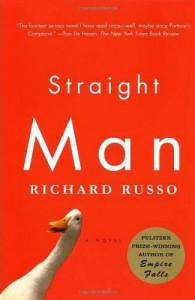
I must admit, I do enjoy a good campus novel and when I heard about Straight Man by Richard Russo I knew I had to read it as soon as I could. The story spouted from a real life situation Richard Russo had teaching at a small State University. Having made friends with the Dean of the university he found himself in a conversation about the budget. Year after year, the same thing happened and while walking past a duck pond the Dean jokingly complained that he would have to threaten to kill a duck a day until he got his budget. This ended up being the basis of not only the main character from Straight Man but the birth of the novel.

The novel tells the story of an English professor, William Henry Devereaux, Jr. at a fictional Pennsylvania University. He has been appointed as the interim chairman of the English department and once again the administration of the university has not provided a budget yet. William is also enjoying a midlife crisis and the complacency of being a tenure professor which gives us a sharp, witty and satirical look at college life.

You know what they say; ‘Everyone has a book in them’, and an English professor is more likely to know the pains of writing. For William, he has already enjoyed a brief brush with success when he released his fast forgotten novel. Despite his abilities, he will always remain in the shadows of his father; a far more popular and successful writer and professor. This creates a volatile mix of emotions and frustration for this character and the results play out wonderfully with Straight Man.

I was pleasantly surprised just how satirical this novel turned out, often humour was delivered in a number of different ways. From the outlandish situation, to dry deadpan deliveries and self-deprecation; these combinations worked well with the character and the novel itself. However behind the humour is the brutal truth of the bureaucratically nightmare an academic department faces year after year.

Ultimately what impressed me the most with this novel was the way Richard Russo managed to balance everything perfectly. He had a good sense of comedic timing and knows when to hold back or push forward. Yet he also knew how to sneak in some heavy themes without destroying the light hearted manner of the delivery. Above all, he has able to write great prose that showed beauty and tenderness as well as bitterness and comedy. It must have been difficult to balance everything but the execution made it look easy.


How to Build a Girl by Caitlin Moran

Posted September 24, 2014 by Michael @ Knowledge Lost in Young Adult / 0 Comments

How to Build a Girl by Caitlin MoranTitle: How to Build a Girl (Goodreads)
Author: Caitlin Moran
Published: Harper Collins, 2014
Pages: 352
Genres: Young Adult
My Copy: ARC from Edelweiss

Buy: AmazonBook DepositoryKindle (or visit your local Indie bookstore)

Take to trip back to the 1990s, a time I am all too familiar with; the music was great but being a teenager was not all that it was cracked up to be. Johanna Morrigan is a fourteen year old who is unhappy with her life. That was until she decided to reinvent herself. By sixteen she was a sharp tongued goth, aspiring music journalist who went by the name Dolly Wilde (named after the socialite). How to Build a Girl is the debut novel by Caitlin Moran who is more popularly known for her views towards feminism in books like Moranthology and How to Be a Woman.

I will be honest; the only reason I picked up this book was because it was often described as The Bell Jar if it was written by Rizzo from Grease. I’m a fan of The Bell Jar and this was enough to get me curious about this novel. I can’t say I have ever been a fan of Caitlin Moran or her view points but I think her underlying message that no one should be judged for being who they are is something I can get behind.

Moran has made it clear that this is far from an autobiographical novel; her parents were never like Morrigan’s parents. However there is an element of this novel that probably reflects her teenage years. I think the teenage years are often a journey of self-discovery and reinvention and this was the main reason I wanted to read this novel.

It doesn’t matter if I agree with Johanna Morrigan’s choices and decisions; this was about her finding herself. The whole notion of self-discovery being similar to reinventing yourself is an interesting one and I enjoyed watching Dolly Wilde evolve into the person she wanted to be. Her parents and family often got in the way and tried to unintentionally (or maybe it was intentional) mould her personality. This was just an interesting journey to watch evolve.

I’m not going to talk about the feminist views within this book, it is not my place to agree or disagree. How to Build a Girl reminds me of the TV show Girls (or what I have seen of it) and if you are a fan of this show then maybe you will enjoy the novel. My biggest problem with the book was not with the feminist themes but with the writing itself; it never seemed to work for me and I felt like the intent was to shock rather than tell a good story. It is a shame, the premise is excellent and I could have enjoyed the book if more time was spent improving the proses and editing.

I wanted to love this book; the whole coming of age, self-discovery, and sexual awakening topic has always been an interesting one to me. This book started off with the best intentions but it lost its way, both in plot and writing. The rise and fall of Dolly Wilde (the character in this book, not Oscar Wilde’s niece) was worth reading but there is so much in the middle that could have been taken out and the novel would have ended up being less than a hundred pages. But these are my opinions; there are people that loved this book, I wasn’t one of them.