New Moon by Stephenie Meyer

Posted October 28, 2013 by Michael @ Knowledge Lost in Romance, Young Adult / 2 Comments

New Moon by Stephenie MeyerTitle: New Moon (Goodreads)
Author: Stephenie Meyer
Series: Twilight #2
Published: Little Brown and Company, 2006
Pages: 565
Genres: Romance, Young Adult
My Copy: Library Book

Buy: AmazonBook DepositoryKindle (or visit your local Indie bookstore)

The most important thing in Bella Swan’s life is Edward Cullen (eye roll). So much so that college is plan B, but now he is gone, in an effort to keep her safe. But she is not safe, there are vampires out for revenge and since the Cullen’s are no longer around, Bella is their target. In comes Jacob Black; young, handsome and willing to protect Bella.

If you have read my review on Twilight, you must be wondering why I decided to read New Moon. Torture, joining the social commentary or most likely peer pressure. If you follow me on twitter or have read my post on reading Twilight then you know the fun I had with live tweeting the entire book in all its weirdness. This is what happened again with New Moon (see below for a full read of those tweets) and I think this was the only reason why I decided to continue, because truth be told, I hated the books but really enjoyed making sarcastic remarks about them.

Let’s have a quick look at the book. I’m not going to go into deep analysis of New Moon; I would have to read the book closer for that and really I only skimmed it to race through it. This is not to say I didn’t read the book, I am well aware of the plot and the key themes but this book had so much padding that skimming was the only real way to get through it. There was a paragraph dedicated to the voice of Edward Cullen and almost a full chapter where Bella and Alice flew to Europe (nothing else happened on the flight).

Bella is as always so co-dependent that it makes me sick; when Edward left she latched on to Jacob. She tells herself that she is not capable of falling in love again, like a whiny heartbroken teenager that thinks this is the end of her life and yet she is happy to lead Jacob on. There even was a time when it felt like she was going to be co-dependent on Alice; this would have made it more interesting.

Jacob started off as a whiny little lovesick puppy following Bella around everywhere. Then when it was revealed he was a werewolf he turned into a real asshole, too cool to hang out with a girl because he was in a gang. He went from one extreme to another and I just hated Jacob, there was a joke made by one of my Twitter followers of this being character development and it is sad to say this is the extent of development in the entire novel.

Apart from the constant angsty whining (and I normally love angst) this novel never really went anywhere, it was just 500 pages of treading water. The major problems I had with New Moon are (and I’m picking my top couple out of a long list), firstly the lack of consistency. Twilight and New Moon seem to contradict each other in so many ways; in book one Bella got sick at the smell of blood but in New Moon she was bleeding all over the place frequently and never seems to get sick. Then there was the fact that Stephenie Meyer, instead of doing a little research,  ignored any mythology and just made up her own. This really annoyed me, some slight changes in the vampire/werewolf mythology is acceptable if you are going to use it but to make a vampire sparkle so you can spend pages on how much Edward is like diamonds is ridiculous.

I hate to say this but I will probably read Eclipse and Breaking Dawn just to live tweet them, I don’t expect to like the books but I can’t help reading them. Obviously I pay them out but I do try to analyse them to see if there is anything interesting there; wishful thinking. I will need long breaks in between the novels but you can look forward to reading my thoughts in the very distant future. I doubt I will ever like this series but at least I have evidence to back up my claims.

Read More


If on a Winter’s Night a Traveler by Italo Calvino

Posted October 27, 2013 by Michael @ Knowledge Lost in Classic / 4 Comments

If on a Winter’s Night a Traveler by Italo CalvinoTitle: If on a Winter's Night a Traveler (Goodreads)
Author: Italo Calvino
Translator: William Weaver
Published: Everyman's Library, 1979
Pages: 254
Genres: Classic
My Copy: Library Book

Buy: AmazonBook DepositoryKindle (or visit your local Indie bookstore)

If on a Winter’s Night a Traveler is an experimental classic that follows two protagonists, the Reader and the Other Reader. The Reader buys a fashionable new book that opens with those famous lines “You are about to begin reading Italo Calvino’s new novel, If on a Winter’s Night a Traveler. Relax. Concentrate. Dispel every other thought.” Thirty pages or so into the book he realises his copy is corrupt and consists of the same thing over and over again. Returning to the book store he discovers that what he thought was Calvino was a book by a Polish writer Bazakbal. Given the choice between the two he goes for the Polish book, as does the Other Reader, but his book turns out to be yet another novel by a different writer, as does the next, and the next.

Trying to write a synopsis for this book is tricky, there is no way I can do the novel justice in a paragraph.  This Italian surrealist novel (1979) was translated in 1981 to critical acclaim. The novel is best known for its structure. The odd number chapters are written in second person, but you have to ask yourself is it possible to have a novel in second person. As you read along eventually the narrator “you” does something that will take the reader out of the equation and turning them into a character called You. For instance, in this novel You is male, this will rule out about 50% of the readers in one hit.  This doesn’t take away from the enjoyment of this novel but is something I was deeply aware of throughout this book. There were times where I felt like the novel was in first and third person as well, so you end up with characters called You, I and He/She.

This whole book is subjective, I’m sure some people get different things out of If on a Winter’s Night a Traveler than I did but that is just what makes for a great novel. I want to talk a little about post-structuralism as I believe this novel is a great example of this literary theory. Firstly you need to understand structuralism, which is a theory that states that in order to understand a piece of literature you need to understand its relationship with the bigger picture, the overarching system or structure. You need to look into its influences, the genre, narrative and any other elements that might be relevant. The problem with this is you going further and further back eventually you might lose sight of the original text. Basically this is a set of specific rules that govern literature. Post-structuralism is basically taking those rules (they often study and analyse the rules) then setting out to critique the premises. It isn’t really throwing out the rules, more demonstrating how the rules don’t always apply.

Italo Calvino doesn’t stop at narrative modes and post-structuralism, the novel explores many more literary themes; the most obvious is the use of metafiction; a book within a book. You won’t find Outside the Town of Malbork by Tazio Bazakbal on Goodreads, I’ve checked. Then you have intertextuality, pastiche, post-modernism and so on. If you are interested in exploring literary theories this novel might be a good way to experience a whole range of different concepts in one hit. I don’t know much about literary theory so I hope my understanding on these concepts have come across as accurate and I haven’t missed it completely. I would love to attend a series of lectures where this book is deconstructed and looked at in real detail; I think that would be incredibly interesting.

Don’t worry, this isn’t a dense or hard-to-read book and I’m aware that talking about literary theory might turn people off this novel but please reconsider. This book is not only devilishly clever but it is beautifully executed. I took my time with this novel because I wanted to re-read sections, write done quotes and just talk about the book to anyone that would listen. If I didn’t borrow this from the library I would have highlighted the entire books (seriously, every line is just that great). I have brought my own copy now (yes, I broke my book buying ban) and I hope to be able to re-read this again. I’m not sure if reading this with others will help but the whole experience of reading this novel is worth sharing.

I’ve heard Italo Calvino is heavily influenced by Vladimir Nabokov which makes a lot of sense to me, the writing style does feel similar, even the humour and wit. A literary labyrinth that is so masterfully executed that the novel needs to be read again and again. I won’t go into any more details as there are a few things you just need to experience. I’m jealous of anyone that gets to read this novel for the first time as that is an experience I will never have again.

 I have to wonder why the Vintage classics cover of the word “Traveller” written correctly but throughout the book it is written in the American (wrong) spelling. I have to wonder if there is anything in that. I wonder if there is a reading companion to If on a Winter’s Night a Traveler that you can read alongside this book (similar to Infinite Jest) to discover the brilliance of this novel. I really enjoy Post-Modern literature but there is so much that I’m probably missing.

All book lovers should experience If on a Winter’s Night a Traveler, there is nothing like that feeling of pure joy when you read a beautifully clever novel. You never want it to end, that ecstasy is like a drug and you immediately want to read it again only to find that feeling is just not the same. This is a masterpiece, I know I didn’t talk much about the plot but this was so I don’t give anything away. Go read it.


Hardcover verse Paperback

Posted October 26, 2013 by Michael @ Knowledge Lost in Literature / 15 Comments

I wanted to talk about hardcovers and paperbacks because I’m interested to know people’s thoughts on the topic and because Australians do things a lot differently to the rest of the world. Most books (outside Australia) have a hardback release and normally about a year later the paperback comes out. Obviously paperback release often changes and it does depend on popularity and many other factors. Why release a novel in paperback if we can charge more for the hardback edition?

Here in Australia most publishers have rejected this method. There are some hardbacks and there are normally special editions or if you are an author like Dan Brown or Ken Follett they may choose to adopt the same method as the rest of the world. Most releases in Australia come out in trade paperback (for their initial release). Trade paperbacks are the higher quality paperbacks that are normally the same size as the hardcover. Mass-market paperbacks (also known as B format) normally come out a year or more later, but the majority of books remain in the Trade paperback format.

I’m not sure why Australia does it this way but I prefer it. Sure hardcover books look better on the shelf but if I had to choose which I prefer to read I would pick Trade paperbacks. I just think they are more comfortable to read with, not too small and a little more flexible. I like the way Australia does it because really the whole hardcover-to-paperback method is slowly dying and it seems to work better for an indie bookstore. No longer do they have to get two lots of the same book, they just order what they think is the right amount and if it doesn’t sell as fast as expected that’s ok.

Let me know what you prefer and if you have more insights into the hardback/paperback marketing method. I’ve been thinking about this for a couple of days and honestly I think it is a dying marketing ploy. I just thought I would express my opinion, let people know how Australian publishing differs and hopefully create a discussion in the comments.


Monster by Dave Zeltserman

Posted October 25, 2013 by Michael @ Knowledge Lost in Horror / 0 Comments

Monster by Dave ZeltsermanTitle: Monster (Goodreads)
Author: Dave Zeltserman
Published: Duckworth Overlook, 2012
Pages: 222
Genres: Horror
My Copy: Library Book

Buy: AmazonKindle (or visit your local Indie bookstore)

Friedrich Hoffman (also known as the monster) recounts the false accusations of killing his fiancée and the other gruesome ‘crimes’ he has been accused of committing. He awoke hideously deformed on the table of Victor Frankenstein, without any real idea of what is going on. He now embarks on a single minded quest for revenge on Frankenstein for all the damage he has done.

This plot feels completely redundant; if you want to read a book from the perspective of Monster Frankenstein you read Frankenstein; this is nothing new, not interesting, and just cashing in on the same story. Sure this novel is different but there is nothing interesting about it, it is full of the typical horror tropes and doesn’t really offer an interesting perceptive. I cannot help but think of this as something like fanfic and I struggle to work out why I read this one; I seem to pick up all novels that try to do something with the Frankenstein story.

I will admit there were parts of the novel that really fit the Frankenstein plot, tiny little points to prove that the author had indeed read and been heavily influenced by this masterpiece. I am just not sure why this would be published; a re-imagining, change in perspective (assuming it wasn’t covered in the original book), prequel/sequel or modernisation I can understand but this was the exact same story with minor differences. This feels like the author loved Frankenstein so much that he rewrote the book in his own words, like a writing exercise that is never meant to be published. He has a good style even if he follows a very formulaic horror or gothic theme but the novel did indicate his talent. In an original novel he might have better luck but for me this was just ripping off a classic piece of literature.

When it comes to using classic literature as the basis of your own novel, I am normally a tough judge; you better do something unique and interesting or I will hate the novel. If you are trying to retell Frankenstein then I will be strict, this is my all-time favourite; I have read this multiple times and will be reading it many more, and I am more likely to notice every flaw. Monster and This Dark Endeavour have probably been the two novels that I’ve judged the harshest, since starting this blog and you can see the similarities.

When you look at something like The Machine which isn’t really a Frankenstein reimagining but rather you can see the influence. Some themes and messages are the same and I loved this book, it is in my top five for the year. I guess you are better off reading a book like Machine; I really wish I knew why I keep going for Frankenstein remakes. I think people should read Frankenstein and not bother with this book, but I am curious so see how Dave Zeltserman is as a novelist in something original; I hear Small Crimes is good.


The Year of the Flood by Margret Atwood

Posted October 24, 2013 by Michael @ Knowledge Lost in Dystopia, Speculative Fiction / 0 Comments

The Year of the Flood by Margret AtwoodTitle: The Year of The Flood (Goodreads)
Author: Margaret Atwood
Series: Maddaddam #2
Narrator: Lorelei King
Published: Bloomsbury, 2009
Pages: 434
Genres: Dystopia, Speculative Fiction
My Copy: Audiobook

Buy: AmazonBook DepositoryKindle (or visit your local Indie bookstore)

The Year of the Flood follows the lives of two characters, Toby and Ren. Toby is a young woman who lost her family and the corporations are to blame. She is forced work in a burger chain you would never want to eat at, that was until she met the Gardeners. Ren grows up working in a sex club called Scales and Tails. She previously dated Jimmy (Snowman) and found herself locked in bio-containment when the pandemic happened.

This is the second book in the Maddaddam trilogy and happens simultaneously to Oryx and Crake (for the most part). While book one jumped between the dystopian corporations-controlled world and after the pandemic, The Year of the Flood is more linear and set mainly in the pre-apocalyptic world. While it isn’t really necessary to read Oryx and Crake first, I think the majority of the world building was done in the first book leaving this one more open to focus on the characters and plot.

I will admit I loved the way Oryx and Crake portrayed the corporations dystopian world I love so much but I think The Year of the Flood was overall a better novel. I liked the characters more and the portrayal of a religious cult was fascinating. Margret Atwood seems to draw a lot on personal religious experiences and then build on that to create this cult. I’ve been in plenty of churches, have met many religious fanatics and it really feels like Atwood has too.

She even took the religious element one step further by adding 14 hymns; even during her book promotions and on the audio book they have performances of these hymns. I think Atwood managed to balance religious fanaticism and hostile corporation practises just right in the novel. Both never felt overpowering and allowed for character and plot development to take the foreground.

The more I read of Atwood the more I am in awe of her brilliance. I remember reading The Handmaids Tale and never really thought too much of it but now I that I know her style and the messages she wants to get across, I feel like I should try that book again. There are some other Atwood books I want to try as well so they might have to come first.

I’m entrenched in the Maddaddam world and looking forward to reading the final novel in the trilogy. Luckily I have the book on my shelf waiting and I probably read it soon. I don’t normally read a series (or the same author) so close together but I was sucked in and needed more from this world. Fans of both post apocalyptic and dystopian novels should check out the Maddaddam trilogy, there are some interesting themes through the first two books and I’m sure it will continue in book three.


Snapper by Brian Kimberling

Posted October 23, 2013 by Michael @ Knowledge Lost in Contemporary / 0 Comments

Snapper by Brian KimberlingTitle: Snapper (Goodreads)
Author: Brian Kimberling
Published: Tinder Press, 2013
Pages: 240
Genres: Contemporary
My Copy: Hardcover

Buy: AmazonBook Depository (or visit your local Indie bookstore)

Nathan Lochmueller is a birdwatcher; it is not every day you can build a career around doing something you love. Snapper charts the love affair that Nathan has with bird watching and the seamlessly unobtainable Lola. This is a coming of age, and quite possibly a semi-autobiographical, novel set in rural Indiana, ‘the bastard son of the Midwest’.

This is a bookclub book so it will be a little tricky reviewing this without some of the others’ insights being mixed in with mine. Normally I write a review before attending book club but I seemed to have run out of time. This is a coming of age story that explores life in Indiana as well as the life of a biologist.

Apparently the biology is right and this was important to one of the book club members, who is in fact a biologist as well. For me this felt more like a combination of little stories; just as I start getting into one story the chapter ends and we are on another story. Non-linear groups and the only thing that seems to hold the threads together is the relationship between Nathan and Lola.

I hate to use someone else’s thoughts but one group member hit the nail on the head when she called Lola a manic pixie dream girl. Nathan seems bitter and cynical about everything except when it comes to Lola. He seems blinded about this unobtainable girl, she was never leading him on but he still lived in hope.

I really enjoyed this novel, almost experimental in the style but I felt like the chapters were so disconnected it really took me out of the novel. My major problems with this novel were the editing. I don’t know how this got published with such inconsistencies in the formatting; some chapters have quotation marks, others don’t (I really don’t know why books choose not to have them) and this really annoyed me. If you want to print a book, at least have a standardised format for the entire book. It feels like some chapters were formatted by a different editor to the others and no one compared notes. Even the major mistake where the city Canberra is found in the country Canberra instead of Australia.

Apart from all of this, I enjoyed reading Snapper in all its nuances and will probably read more from this debut author. I’m sure if Brian Kimberling writes another novel it will be autobiographical and to do with biology which are not really my thing but this pretentious, semi-experimental novel is definitely my thing.


Top Ten Tuesday: Characters I Love

Posted October 22, 2013 by Michael @ Knowledge Lost in Top Ten Tuesday / 19 Comments

toptentuesdayIt’s Tuesday again which means time for another round of Top Ten Tuesday; I like joining in of this meme because I have a set topic to work with. Top Ten Tuesday is a book blogger meme that is hosted by The Broke and the Bookish and this week the theme is: Character Names I Love but that is boring so I’m going with Characters that I love.

10. Bernard Gunther from the Bernard Gunther series
9. James Bond from the James Bond series
8. Matt Scudder in the Matt Scudder series
7. Takeshi Kovacs from Altered Carbon
6. Bobby Dollar from the Bobby Dollar series
5. Dave Brandstetter from the Dave Brandstetter series
4. Harry Dresden from the Dresden Files
3. Dexter Morgan from the Dexter series
2. Alaska from Looking For Alaska
1. Philip Marlowe from the Philip Marlowe series


The Never List by Koethi Zan

Posted October 20, 2013 by Michael @ Knowledge Lost in Thriller / 0 Comments

The Never List by Koethi ZanTitle: The Never List (Goodreads)
Author: Koethi Zan
Published: Vintage, 2013
Pages: 303
Genres: Thriller
My Copy: ARC from Netgalley

Buy: AmazonBook DepositoryKindle (or visit your local Indie bookstore)

Sarah and Jennifer kept a “Never List”; this is a list of things to avoid, to keep safe. Rule number one “Never get into a strangers car” but this is what happened and they were abducted. Ten years later Sarah still struggles to get over the torturous event that took plays in that dungeon-like cellar. Now that her abductor is up for parole Sarah decides this is her last chance to find Jennifer’s body and keep this sadist in prison.

I want to compare Koethi Zan’s debut The Never List to thriller authors like S.J. Watson but maybe Gillian Flynn is a better choice. Much like Flynn’s Gone Girl, The Never List does something different to the thriller genre that I don’t think I’ve seen before. Rest assured the standard psychological thriller tropes are there but this novel focuses more on the psychological rather than the thriller elements.

The Never List focuses on the aftermath of the abduction and sadistic torture and focuses on Sarah as she tries to recover from these traumatic events. Though this wasn’t done to a full extent and I end up feeling like this was a missed opportunity to really explore the psychology and the road to recovery (if you can truly come back from that), rather it went to the thriller clichés instead.

I really enjoyed the focus on the aftermaths but Koethi Zan had other ideas for this novel. I did end up enjoying the thrilling journey it ended up taking but I felt like the twists were too visible and never unexpected. I choice to see the lack of character development as an attempt for Sarah and the others to protect themselves from being hurt again, this seemed to work well for the enjoyment of this novel.

I don’t want to give too much away, just in case people want to read this novel and it is well worth checking out. I did enjoy the book, I had questions and upon reflection when I tried to get these answers I noticed most of the major problems. For me the novel had the opportunity to do something different but took the safe path and followed a cliché thriller path. The ending felt anti climatic as a result of the safety in plotting.

Thriller fans will enjoy this book; I just think there was a missed opportunity to do something far more complex and interesting. As a debut novel, I can understand why Koethi Zan didn’t risk it but I would have liked the book a whole lot more. As I said before I would compare it to S.J. Watson and Gillian Flynn, so if you like their books you may enjoy this one. I’m interested to see what Zan does in the future; she has a promising career ahead of her.


Book Juggling

Posted October 19, 2013 by Michael @ Knowledge Lost in Literature / 0 Comments

juggling_books_3fqi

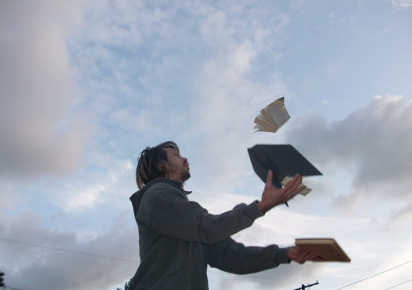
I’m curious to know if you read one book at a time or juggle books and if you do read multiple books, then how do you do it? I know some people prefer to read one book at a time and I’m not sure how they manage that; sometimes I wish I could be that focused but I read in multiple locations so it is easier to have a few books on the go at a time.

Here is how I go about juggling books. I have one book on the go while at work (normally an ebook) and an audiobook in the car. At home it depends on what I’m reading but normally a physical book and sometimes a short story collection as well. I just can’t read a short story collection the same way I would read a normal book. This is the general formula but it doesn’t always work out that way.

Sometimes a book is so heavy or slow (theoretically a big book as well) that I have two books on the go at home, as I spend most of my time reading there. Then there are those times where I dip into a book as I want to see what it’s like and then put it aside for a while. This isn’t because I didn’t like the book but I just get distracted with other books.

I’ve been very conscious about the amount of books I have on the go at once. I don’t want to fall into a trap where I have ten or more books on the go at the same time. I have had this happen and when I finish one book I always seem to prefer to start a new book than focus on the ones on the go. So I have to be careful. I would love to know how others read and what traps they seem to fall into, whether it is reading multiple books or not.