Format: Audiobook

There But For The by Ali Smith

Posted July 16, 2015 by Michael @ Knowledge Lost in Literary Fiction / 0 Comments

There But For The by Ali SmithTitle: There But For The (Goodreads)
Author: Ali Smith
Published: Penguin, 357
Pages: 2011
Genres: Literary Fiction
My Copy: Library Book

Buy: AmazonBook DepositoryKindle (or visit your local Indie bookstore)

A dinner party in a posh home in Greenwich took a sudden turn when Miles, one of the guests, leaves the table mid meal and locks himself in an upstairs room. He refuses leave and the diverse group of neighbours tell their story of the events trying to make sense of Miles motivations. There But For The is told in four points of view: Anna, who is in her forties; Mark, a man in his sixties; May, a woman in her eighties and ten year old Brooke.

Genevieve Lee sets out to host an elaborate dinner in her elegant Greenwich home; her husband Eric has planned to serve scallops and chorizo. However these people are a little different to the people that normally run in the couple’s social circles. The story revolves around Miles Garth who is now an unwanted guest of the Lee’s, after he locked himself away in an upstairs bedroom. However the book really looks at the four narrators and their connection between everyone else.

There tells a story of Anna, a social worker, who knew Miles thirty years ago. Genevieve found her email address in Miles phone and invited her in the hope of persuading him to leave. But follows Mark who is a photo-researcher, who invited Miles to the dinner party. Mark is mourning his old love and, at times, his dead mother speaks to him in rhymes. For is set entirely in the mind of eighty year old May. She is suffering from dementia but also has regular contact with Miles. The revolves around ten year old Brooke, who is the daughter of two of the party guests and the only one that has made contact with Miles since he locked himself in the room.

Where this book shines is in the writing; it is full of what has been now considered Ali Smith’s trademark wit and puns. It is an exploration into humanity, centred on a whimsical yet devastating dinner party. The stand out for me is the way that Smith masterfully used identity shifts and language gaps to explore language in what is essentially a locked-room mystery. This writing style may cause issues for some people but I was just in awe of just how clever If For But The really was.

As this is the first Ali Smith novel that I have read, I am unsure what to say about her as a writer. If all books are anything like If For But The then I would have to call her a master at puns, wordplays, metaphors and pretty much linguistics in general. There is plenty of buzz around her latest book How to Be Both, so I will save my opinion until I have read at least that novel. I am very confident I will be a new fan of Ali Smith but as I say, I have to experience more of her writing.


Double Indemnity by James M. Cain

Posted June 29, 2015 by Michael @ Knowledge Lost in Book of the Month, Pulp / 0 Comments

Double Indemnity by James M. CainTitle: Double Indemnity (Goodreads)
Author: James M. Cain
Published: Vintage, 1936
Pages: 114
Genres: Pulp
My Copy: Personal Copy

Buy: AmazonBook DepositoryKindle (or visit your local Indie bookstore)

When small time insurance man Walter Huff meets Phyllis Nirdlinger, her beauty quickly seduced him. The wife of a wealthy oil executive convinces him to help get rid of her husband, but not before a substantial policy was taken out on him. Accident insurance often causes suspicion but when Phyllis’ husband dies from what looks like a train accident, double indemnity kicks in and Walter’s bosses suspect foul play.

James M. Cain is the master at noir with books like The Postman Always Rings Twice, Mildred Pierce and recently The Cocktail Waitress was released posthumously.  Double Indemnity is one of his most notable pieces of work and was adapted into the 1944 classic film noir movie of the same name. The movies screenplay was written by fellow master of pulp Raymond Chandler and has been dubbed culturally, historically, and aesthetically significant by the US Library of Congress.

Double Indemnity is a clause often found in accident insurance policies where the issuer agrees to pay double (or more) if the accident happens in certain conditions. It is often used to make the policy more appealing but applies to low risk incidents. Death by train accident is one of these examples and when Phyllis’ husband died in these conditions the insurance company was naturally suspicious.

This classic pulp novel follows Walter Huff who plots the perfect murder all for the beautiful Phyllis Nirdlinger. What he didn’t count on was that he was seduced into helping a femme fatale and now he was under her thumb. In true James M. Cain style, Double Indemnity holds nothing back, both in style and plot. Everything you expect in a 1930s noir novel can be found in this thrilling novella.

This is a re-read for me of Double Indemnity and I must admit I was so happy to return to the style of James M. Cain. Everything you expect from the pulp style and dialogue can be found within this classic story. I know I need to dive into some more of Cain’s novels, with some re-reads and completing his bibliography. I have no words to describe the feeling of returning to a much-loved author and I know I need to re-watch the movie. If you have never read Cain or anything from the classic pulp genre, then you can never go wrong with a book like Double Indemnity.


The Yellow Wallpaper and Other Stories by Charlotte Perkins Gilman

Posted April 28, 2015 by Michael @ Knowledge Lost in Short Stories / 0 Comments

The Yellow Wallpaper and Other Stories by Charlotte Perkins GilmanTitle: The Yellow Wallpaper and Other Stories (Goodreads)
Author: Charlotte Perkins Gilman
Published: Dover Thrift, 1892
Pages: 70
Genres: Short Stories
My Copy: Personal Copy

Buy: AmazonBook DepositoryKindle (or visit your local Indie bookstore)

In the title story “The Yellow Wallpaper” Charlotte Perkins Gilman tells the story of a woman on the verge of a nervous breakdown. A specialist recommends that she takes rest cure; a treatment in which has her lying in bed all day and only allowed two house of intellectual activities a day. After a few months of staring at the walls, things are far from improving.

While this is a collection of short stories, I am focusing on the title story simple because it gives you a sense of what to expect when reading Charlotte Perkins Gilman. “The Yellow Wallpaper” explores the decline of the protagonist’s health, both physically and mentally. Written in a series of diary entries, the story not only looks at depression but, on a deeper level, gender roles. The doctor and her husband are portrayed as repressors; while their intentions are to help her heal they never take into account her own opinion.

This in turn critiques that position of the woman, especially when it comes to the institution of marriage. Gilman looks at marriage as a hierarchy; the male is actively working and knows what is best for the house, while the wife is put in charge of the domestic jobs (cooking, cleaning and so on). The wife becomes a second class citizen; a servant only there to serve her husband. When the protagonist of “The Yellow Wallpaper” gets sick she is demoted further and her role becomes similar to a petulant child.

While I have focused on the story “The Yellow Wallpaper”, these similar themes are found throughout this collection. What I found so satisfying is the way Charlotte Perkins Gilman uses irony to express her opinions. The use of both verbal and dramatic irony is found in all her stories but I enjoyed the sarcasm the most. There is a lot of symbolism and motifs within the stories well worth exploring that really empathises her point.

I loved this collection of short stories by Charlotte Perkins Gilman, there are so many interesting topics worth exploring and I used “The Yellow Wallpaper” to emphases and provide a glimpse into what you can expect. I am determined to read a whole lot more of Gilman’s works, I fell in love with her writing style and got so much pleasure out of reading these stories. The Yellow Wallpaper and Other Stories is a collection of stories well worth picking up and adding to your personal library.


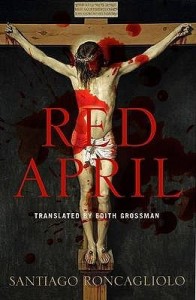
Red April by Santiago Roncagliolo

Posted April 18, 2015 by Michael @ Knowledge Lost in Crime, Thriller / 2 Comments

Red April by Santiago RoncaglioloTitle: Red April (Goodreads)
Author: Santiago Roncagliolo
Translator: Edith Grossman
Narrator: Jonathan Keeble
Published: Atlantic Books, 2011
Pages: 288
Genres: Crime, Thriller
My Copy: Audiobook

Buy: AmazonBook DepositoryKindle (or visit your local Indie bookstore)

Associate District Prosecutor Felix Chacaltana Saldivar does everything by-the-book, he is organised and knowledgeable on the laws of the land but this tends to rub people the wrong way. When a body is found burnt beyond recognition, Chacaltana’s life is never going to be the same. The investigation into this unique murder leads the associate District Prosecutor to question the choices the government are making. Set during Holy Week in Peru, Red April is a chilling political thriller that explores a twisted murder and a morally bankrupt government.

Red April takes place during Lent 2000, mainly in the Peruvian city of Ayacucho and follows a methodical prosecutor as he investigates a bizarre crime. These were the final days of Alberto Fujimori who vacated the presidency and fled the country in November 2000 due to a major corruption scandal and allegations of human rights violations. When Fujimori came to power in 1990, Peru was dominated by two terrorist organisations, the Maoist group Sendero Luminoso and the Marxist-Leninist organisations known as Túpac Amaru Revolutionary Movement (MRTA). It was not until about 1997 when most of this internal conflict resolved, but this was achieved by the Grupo Colina, which was a death squad made up of members of the Peruvian Armed Forces.

Set in the early 2000s, this novel explores that period of time where people loved Alberto Fujimori for making them feel safe but corruption is becoming a big problem. Even the main protagonist struggled with the idea of not supporting the president. Saying something like “the terrorist killed my mother, brother and sister but since the president took office, no one else from my family has been killed. Why would I vote for somebody else?” This hold on the past is something that runs strong throughout the novel, particularly with Associate District Prosecutor Felix Chacaltana Saldivar who holds on to the memory of his mother. The book is set during Lent and then Holy Week which is a time of reflection and to remember the past, when Christ died for the sins of the world.

Peru is a very religious country, in the 2007 census only 2.9% identified as non-religious, with 81.3% claiming to be Roman Catholic. The Catholic Church is a very important part of the country, even Article 50 of its constitution states that “[the Church is] an important element in the historical, cultural, and moral development of the nation.” The city of Ayacucho, in which the majority of this novel is set. lays claim to 33 Catholic Churches (one for every year of Jesus’ life) and hosts a large religious celebration during Holy Week every year. When reading Red April you quickly learn just how important religion is to the Peruvian people and the plot of the novel.

One of the things that fascinated me about Red April is the culture depicted within the book. Santiago Roncagliolo did not shy away from depicting the dark themes or the problematic political situation that Peru faces. He questions the counter-terrorism strategies of the Fujimori government but also depicts the overall sense of relief that the people had when terrorist organisations were dealt with. The corrupt government and the bureaucratic nightmare that Felix lived through all gave a sense of the political landscape. The Associate District Prosecutor did everything to the letter of the law, including sending rapists to prison; however this made him an outcast, even the rape victims got angry that they were unable to marry their attackers and get their reputation intact.

One reason I read a lot of translated fiction is because I find it interesting to explore different cultures and worlds. The Peru depicted in Red April is so foreign to me that I could not help but be spellbound by the cultural differences. Red April was the 2011 winner of the International Foreign Fiction Prize (IFFP), a literary award I have started to follow closely now that I read more books in translation. The novel was translated into English by Edith Grossman and is a book that I picked up in order to read more books from South America. I am very glad to have read Red April, not only is it an excellent mystery/thriller but as you can see it was an interesting insight into Peru.


Go Tell It on the Mountain by James Baldwin

Posted March 22, 2015 by Michael @ Knowledge Lost in Classic / 0 Comments

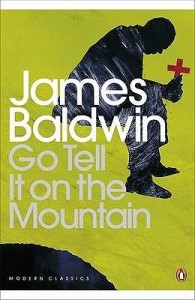
Go Tell It on the Mountain by James BaldwinTitle: Go Tell It on the Mountain (Goodreads)
Author: James Baldwin
Narrator: Adam Lazarre-White
Published: Penguin, 1953
Pages: 256
Genres: Classic
My Copy: Audiobook

Buy: AmazonBook Depository (or visit your local Indie bookstore)

Go Tell It on the Mountain is the first major release by James Baldwin and is a semi-autobiographical novel about growing up in Harlem. James Baldwin never knew his biological father and his stepfather was a strict Baptist minister. Go Tell It on the Mountain mainly follows the character John Grimes (who is the autobiographical character in the novel) but really shifts focus to other characters, to allow the exploration of John’s immediate family.

It took James Baldwin ten years to write Go Tell It on the Mountain and he has often stated that it was not a book he wanted to write but a book he felt he had to get out of his system before he would write anything else. This is a semi-autobiographical novel that focuses mainly of the hypocrisy within the community. James Baldwin’s stepfather was a minister and the way he acted in church was vastly different than when he was at home. He was a strict and abusive parent and this hypocrisy was evident within this novel.

However, there is so much more to this novel than just exploring how different people act when at church. Baldwin has a lot to say about the community and, while racism plays a big part within this debut novel, it was some of the other themes that interested me the most. The struggle between life and faith is a topic that I am fascinated in and while it is not the same as found in the memoir The Dark Path, this is explored in an interesting way within this novel. John Grimes had a spiritual awakening as a teenager and went onto become a preacher, however the hypocrisy he found within the church disheartened him and eventually he walked away from that life.

Yet Go Tell It on the Mountain goes a little deeper in exploring the hypocrisy of the church with subtle references to Baldwin’s sexuality. This is not explored in great detail within this book but it is a major theme in Giovanni’s Room. The way this novel explores the church life is fascinating and he shows great care for his characters; take for example John’s stepfather Gabriel, he may be hypocrite but he still requires some sympathy. He married John’s mother and raised him even if their union would be considered controversial within the church. I love how this novel plays with the religion and the way people differ between their church and home life.

This was my first James Baldwin novel but I have had the opportunity to read some of his short stories in the past. On the surface Go Tell It on the Mountain does sound like it is just focused on the hypocrisy of the church but I love the depth James Baldwin put into this book. The characters are so well crafted that even if you want to hate them you still feel a little compassion towards them. I cannot put my finger on James Baldwin’s writing style; at times it reminds me of dirty realism but all I know is that it makes me want to read more of his novels.


Save Me the Waltz by Zelda Fitzgerald

Posted March 14, 2015 by Michael @ Knowledge Lost in Classic / 2 Comments

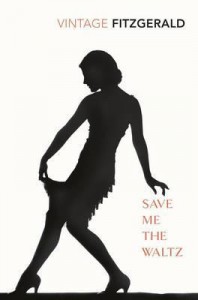
Save Me the Waltz by Zelda FitzgeraldTitle: Save Me the Waltz (Goodreads)
Author: Zelda Fitzgerald
Narrator: Jennifer Van Dyck
Published: Vintage, 1932
Pages: 225
Genres: Classic
My Copy: Audiobook

Buy: AmazonBook DepositoryKindle (or visit your local Indie bookstore)

Save Me the Waltz is the story of Alabama Beggs, a young Southern girl who meets and falls in love with David Knight during World War I. The two inevitably get married and David goes on to become a successful painter, before moving their family to the French Riviera. However Alabama is determined to find her own success and takes up ballet. When she lands her first solo debut in the opera Faust the cracks in their marriage become evident.

After an episode of hysteria in 1932, Zelda Fitzgerald was admitted to the Johns Hopkins Hospital in Baltimore for treatment. Dr Adolf Meyer, an expert on schizophrenia was her doctor and as part of her recovery routine he got her to write at least two hours a day. Save Me the Waltz was written over the course of six weeks and was the first and only novel to be published by Zelda Fitzgerald. Her husband was outraged that she took so much of their personal life and added it into this novel. Despite the fact that the majority of F. Scott Fitzgerald’s novels are also autobiographical and he used the same material for his novel Tender is the Night.

I wanted to read Save Me the Waltz after reading Tender is the Night to compare the similarities. The problem I soon discovered is that Save Me the Waltz has possibly been whitewashed by F. Scott Fitzgerald. Apparently he helped Zelda revise her book and the amount that has been changed is unknown because her original manuscript has been lost. However Scott went from being irate to writing to Maxwell Perkins at Scribner (their publisher) “Here is Zelda’s novel. It is a good novel now, perhaps a very good novel—I am too close to tell.” I am inclined to believe that he has made sure he comes across better than originally written but without the original that is purely speculation.

The major theme within Save Me the Waltz is around the intense desire for Alabama/Zelda to succeed for themselves. It was not enough for either person to be the wife behind a successful man, and it explores the problems faced in doing this in a male dominated society. When Alabama gets her dream job in Naples with the San Carlo Opera Ballet Company, David does not want to move. Considering that he is a painter and could really work from anywhere, it says a lot about their marriage. This does not hinder Alabama from perusing her dreams and she goes to Naples anyway, leaving her husband to look after their child alone. Now this move may make people uneasy but it really plays with the power dynamic of marriage. Zelda Fitzgerald wants to challenge the conceptions people had of the role of a wife in a marriage and ask why it was alright for a man to go away for work but not the woman.

This can be a very difficult novel to read, knowing the historical context and history behind the story. Comparing this book with Tender is the Night does not leave F. Scott Fitzgerald in pleasant light but then again his novel did not do that either. One of the most powerful lines in this novel can be found right near the end and it beautifully wraps up the whole book into a few lines. “Emptying the ashtrays was very expressive of myself. I just lump everything in a great heap which I have labelled ‘the past,’ and having thus emptied this deep reservoir that was once myself, I am ready to continue.”

While I cannot say that Save Me the Waltz is a strong novel, it was a fascinating exploration into the lives of the Fitzgeralds. I am glad to have read and compared this book to Tender is the Night but I think it has only fuelled my interest into this couple. I still need to read a biography or two on the Fitzgeralds but I am beginning to get a better idea of their lives. I think if you are going to read Tender is the Night, you need to read Save Me the Waltz so you can have perspective on the autobiographical elements; even if they were tainted by F. Scott Fitzgerald’s edits.


Broken Homes by Ben Aaronovitch

Posted March 6, 2015 by Michael @ Knowledge Lost in Fantasy / 2 Comments

Broken Homes by Ben AaronovitchTitle: Broken Homes (Goodreads)
Author: Ben Aaronovitch
Series: Peter Grant #4
Narrator: Kobna Holdbrook-Smith
Published: Orion, 2013
Pages: 324
Genres: Fantasy
My Copy: Audiobook

Buy: AmazonBook Depository (or visit your local Indie bookstore)

Peter Grant has gotten himself an arch-nemesis; a twisted magician known as the Faceless Man is reeking having on London’s underground. On the case of a suspected serial killer named Robert Weil, Peter Grant has discovered a deeper conspiracy involving his nemesis and weirdly enough a neo-brutalist housing estate. Will Peter finally stop the Faceless Man? Can he work out just how he feels about his partner Lesley Mai? Or can he make it through one case without destroying a major landmark?

As most people know, I am a fan of the Peter Grant series and Broken Homes (the fourth book) did not disappoint. Ben Aaronovitch has created a great world that mixes police work, urban fantasy and humour together perfectly. So much so, that as soon as I finished Whispers Under Ground, which is book three, I picked up Broken Homes.

The best thing about this series is the overarching story that unfolds. This does mean you have to read the books in order but it is something that I found was missing in many crime series and The Dresden Files. I enjoy watching the characters grow and discovering new details about this world. So much so that I was ready to pick up book five, which is called Foxglove Summer right away. I haven’t done that but I suspect it will happen soon.

In every book there is something that is revealed about the world or characters that really helps cement my love for the series and the world that has been created. This time there was more around Inspector Nightingale’s back story including the elite wizardry school he attended when he was young; which means plenty of Harry Potter jokes to be told.

I have talked a lot about this series, since I have reviewed every book but one thing I find hard about reviewing a series, especially a crime one, is how to avoid spoilers. There is so much to love about these books and I highly recommend them but I cannot say much about them. This does make it difficult to recommend them or convince people to read them but know that I enjoyed Whispers Under Ground so much that Foxglove Summer will probably be read very soon. Then I will have to wait til November for The Hanging Tree (book six) to be released.


Whispers Under Ground by Ben Aaronovitch

Posted February 25, 2015 by Michael @ Knowledge Lost in Fantasy / 4 Comments

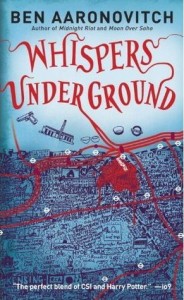
Whispers Under Ground by Ben AaronovitchTitle: Whispers Under Ground (Goodreads)
Author: Ben Aaronovitch
Series: Peter Grant #3
Narrator: Kobna Holdbrook-Smith
Published: Orion, 2012
Pages: 303
Genres: Fantasy
My Copy: Audiobook

Buy: AmazonBook DepositoryKindle (or visit your local Indie bookstore)

When a body is found stabbed to death at the far end of Baker Street tube station, it seems like an ordinary murder. The victim is an exchange student at Central St. Martins named James Gallagher and his father is an American senator. The Folly have been called in to assist with the investigation and it is quickly discovers that there is a supernatural component to this crime. This case leads Peter Grant into the secret underground that lies underneath the streets of London.

Peter Grant is back in the third book in the series, still a sorcerer’s apprentice to Inspector Nightingale. The Folly, which is the police department that specialises in the supernatural has grown to three, as Lesley May officially joins the team. Yet again this is a natural progression in the series, Peter doesn’t know many spells and still struggles with his form but he has grown as a police officer, a wizard and a person. What I enjoyed about Whispers Under Ground is the character Dr Abdul Haqq Walid is explored in greater detail. He is a world renowned gastroenterologist and cryptopathologist who works with the Folly and is investigating how magic effects the world. This allows Ben Aaronovitch to build his world a bit more and explores the effects of magic.

While this is an urban fantasy series, it follows the tropes found in a police procedural and Peter Grant never just relies on his magical abilities but rather sticks to his strengths, which he learned from his training. There is a lot of investigational work within the series and sometimes I worry that the police procedural elements will over power the urban fantasy or humour, however Aaronovitch gets the balance right.

If you have not read the series, I would highly recommend it mainly because of the character development, in particular Peter Grant and Nightingale. Peter Grant is a biracial character (his mother is from Sierra Leone and I am pretty sure his father is white) and his heritage and life play a big part in shaping him. This also allows Ben Aaronovitch to play a little with racism but I feel like he handles the whole subject well. Inspector Nightingale is a prim and proper Englishman and the last officially sanctioned English Wizard, having gone to a now defunct private school for wizardry allows for plenty of Harry Potter jokes.

This is a fun series that I am completely immersed in; when I finished Whispers Under Ground I didn’t want to leave the world. I started Broken Homes (which is book four) straight away, which is unusual for me but I needed to know what happened next. For fans of urban fantasy, police procedurals and British humour, I highly recommend the Peter Grant series, I do not think you will be disappointed.


The Secret History of Wonder Woman by Jill Lepore

Posted February 20, 2015 by Michael @ Knowledge Lost in Non-Fiction / 4 Comments

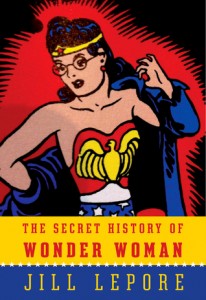
The Secret History of Wonder Woman by Jill LeporeTitle: The Secret History of Wonder Woman (Goodreads)
Author: Jill Lepore
Narrator: Jill Lepore
Published: Scribner, 2014
Pages: 432
Genres: Non-Fiction
My Copy: Audiobook

Buy: AmazonBook DepositoryKindle (or visit your local Indie bookstore)

The Secret History of Wonder Woman is the story behind Wonder Woman and her creator William Moulton Marston. The life of Marston is a fascinating and unconventional one, full of contradictions and this book really explores this in a bit more detail. The idea of Wonder Woman grew from the Amazons in Greek mythology and the feminist movement. Wonder Woman first appeared in All Star Comics #8 in 1941 and is now one of the most recognisable superhero’s to grace the comic book pages. Despite this fact, there has not been a major motion picture about Wonder Woman yet, The Lego Movie (2014) has been her first and only film appearance to date.

American psychologist, lawyer and the inventor of the Lie Detector, William Moulton Marston created Wonder Woman under the pen name Charles Moulton, but it is his life that seems to be the biggest influence on this caped crusader. Wonder Woman is a powerful feminist and this may have been a little problematic for the movement. First of all, Marston’s Wonder Woman was a powerful woman but she lost her powers when bound by a man. This could be considered a symbol of the oppressive nature of a male dominated society however the frequency use pointed to his a fixation of bondage and submission.

Originally William Moulton Marston called his character Suprema and she stated that she was a “tender, submissive, peaceloving as good women are, [combining] all the strength of a Superman plus all the allure of a good and beautiful woman”. This in itself shows the problems facing the creation of Wonder Woman and Marston was very controlling of his creation and the vision he had for her. While on the surface Marston was promoting the feminist movement, his personal life contradicted his ideals; living with two women, his wife and his mistress, he expected them to fulfil all there wifely duties at home while his wife was the main source of income for the majority of their lives.

The Secret History of Wonder Woman is an interesting micro-history that explores the life of William Moulton Marston and Wonder Woman. While some of what is revealed within this book is nothing new, Jill Lepore does a good job of bringing feminist history into the world of pop-culture. There is so much worth talking about here and this book asks the question, should Wonder Woman be recognised as a feminist icon? Well worth checking out if you are a fan of this superhero or are just interested in the history behind her.


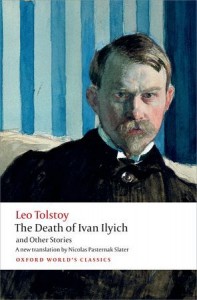
The Death of Ivan Ilyich by Leo Tolstoy

Posted January 15, 2015 by Michael @ Knowledge Lost in Classic / 0 Comments

The Death of Ivan Ilyich by Leo TolstoyTitle: The Death of Ivan Ilyich (Goodreads)
Author: Leo Tolstoy
Translator: Nicolas Pasternak Slater
Published: Oxford World's Classics, 1884
Pages: 256
Genres: Classic
My Copy: Paperback

Buy: AmazonBook DepositoryKindle (or visit your local Indie bookstore)

Ivan Ilych’s life revolved around his career; as a high court judge he takes his job very seriously. However after he falls off a ladder, he soon discovers that he is going to die. The Death of Ivan Ilyich is a novella that deals with the meaning of life in the face of death. A masterpiece for Leo Tolstoy written after his religious conversion in the late 1870s.

Something that was fascinating about The Death of Ivan Ilyich is the drastic change in writing style when comparing it to Anna Karenina and War and Peace. I am not just referring to the length, but that does play a big part. I have read somewhere that Tolstoy intentionally made Anna Karenina and War and Peace so long because he wanted to replicate life and the journey the characters face. Allowing the reader to experience every decision and moral dilemma that the character is facing, exploring the growth or evolution of each and every person within the novels.

The Death of Ivan Ilyich takes a more focused approach, dealing with major questions revolving around the meaning of life, death and spirituality. Leo Tolstoy had a major conversion in the late 1870s and the questions in this novel were the questions he was asking himself. Whether or not Ivan Ilyich found the answers he was looking for is up to the reader but it is believed that Leo Tolstoy was still looking for the same answers well after finishing this novella.

There is a lot of pain and torment that appears in this book, which reflects the authors search for answers and that is what really stood out for me. Not only was I reading a spiritual/existential struggle of the protagonist but Tolstoy’s own feeling really came out within the pages. This is what makes this a masterpiece that explores the tortured artist in great detail. I don’t want to say much more, this is the type of book people have to read and make their own mind up about the themes presented, but it is worth reading.