Format: Audiobook

A Christmas Carol by Charles Dickens

Posted December 30, 2014 by Michael @ Knowledge Lost in Book of the Month, Classic / 4 Comments

A Christmas Carol by Charles DickensTitle: A Christmas Carol (Goodreads)
Author: Charles Dickens
Published: Oxford World's Classics, 1843
Pages: 438
Genres: Classic
My Copy: Paperback

Buy: AmazonBook DepositoryKindle (or visit your local Indie bookstore)

When it comes to Christmas books, A Christmas Carol by Charles Dickens is probably the first book that comes to mind. Published in 1843, this novella was an instant success and has been a beloved classic since then. I am not going to go into a plot summary because I believe most people know the story but if you don’t, go watch A Muppet’s Christmas Carol. Told in five staves (similar to stanzas or verses) this book has been adapted so many times that A Christmas Carol has just become a part of the Christmas period.

While compassion, forgiveness and getting into the Christmas spirit is the major theme of this novella, one thing that really stuck with me is Dickens’ ideas of isolation and loneliness. While it is true that Ebenezer Scrooge never indicates he is feeling alone, since the death of Jacob Marley seven years earlier there is a sense that he has falling in despair. Marley died on Christmas Eve and appeared to be Scrooge’s only companion, which leads to a disdain for the holiday period.

Charles Dickens wanted to emphasise the importance of being with friends and family, especially during Christmas. However I got the sense that he may have treated the idea of isolation poorly. Sure, Scrooge was a grumpy old man who was tight with his money but I got no real indication that he was unhappy to be alone. Scrooge could have been an introvert and enjoyed the quiet solitude; is that really such a bad thing?

Then all of a sudden Scrooge is cured from his rationality and becomes an extravert. This is a little strange, Scrooge’s emotional and psychological makeup might not be pleasant or agreeable to the popular worldview but they were his own thoughts. Scrooge was a financial supporter of The Poor Law Amendment Act of 1834 and didn’t want to give money to a charity that worked against his political ideology.

I am not bagging out A Christmas Carol, I do enjoy it but as I was re-reading this novella I kept wondering what this story is saying if we take out the element of Christmas. Basically this is the story of curing someone of his or her personality. I had a lot of fun looking at this book from another point of view, it just gave me a lot more to think about. A Christmas Carol is a nice quick story about the importance of being with your friends and family during this holiday period. Next year I might try Truman Capote’s collection of stories about Christmas.
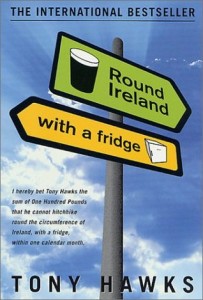

Round Ireland with a Fridge by Tony Hawks

Posted December 11, 2014 by Michael @ Knowledge Lost in Humour, Non-Fiction / 0 Comments

Round Ireland with a Fridge by Tony HawksTitle: Round Ireland with a Fridge (Goodreads)
, 1997
Pages: 248
Buy: AmazonBook Depository (or visit your local Indie bookstore)

What happens when you make a stupid bet while drunk at a bar? If you are anything like Tony Hawks, you actually try to win the bet. With £100 at stake, Tony Hawks decides to hitchhike around Ireland with a fridge (even though buying the fridge cost him £130). Round Ireland with a Fridge is a travel memoir about the adventures Tony Hawks had with his fridge.

First of all, it is important to point out that Tony Hawks is a British comedian and is not to be confused with the skateboarder. While he is best known for his travel memoirs, Hawks first claim to fame was as the lead of the comedy band Morris Minor and the Majors, which had a hit with a Beastie Boys parody in 1988.  He is also a voice actor, most notable for voicing a vending machine and a suitcase in Red Dwarf.

This book starts off with Tony Hawks talking about how he doesn’t spend much time drinking or going to bars. Then for the entire novel he drinks in bars as he hitchhikes around Ireland. Putting aside this huge contradiction this book is actually very entertaining and manages to captivate the audience for its 246 pages. Travelling from Dublin to Donegal, from Sligo through Mayo, Galway, Clare, Kerry, Cork, Wexford, Wicklow–and back again to Dublin this a story of the people he meets along the way.

The fridge actually become more of an asset that Tony Hawks originally expected, helping him get rides, free accommodation and even pick up woman. Even the fridge had its own adventures; it was christened by a nun and even went surfing. While this may seem like a gimmick you will find some interesting philosophical thoughts on people and life as Tony Hawks reflects on all the experiences he had with his fridge.

I had a lot of fun with this book and I am so glad to have read it. There were so many laugh out loud moments (I especially enjoyed Hawks views on marathons) and still offered plenty to think about. As a travel memoir I expected something like Bill Bryson and while the comedy is there I think there was more opportunity to teach people about Ireland and its culture. Highly recommend this book and I plan to seek out Playing the Moldovans at Tennis so I can dip back into Tony Hawks writing again.


Wonder Boys by Michael Chabon

Posted December 3, 2014 by Michael @ Knowledge Lost in Contemporary / 6 Comments

Wonder Boys by Michael ChabonTitle: Wonder Boys (Goodreads)
Author: Michael Chabon
Published: Harper Perennial, 1995
Pages: 384
Genres: Contemporary
My Copy: Library Book

Buy: AmazonBook DepositoryKindle (or visit your local Indie bookstore)

Grady Tripp is a writer of a few novels; following the success of his award winning novel The Land Downstairs he has set out to write his follow up. Seven years later his manuscript for Wonder Boys was over 2600 pages long and nowhere closer to being finished. In his personal life things were messed up, his wife has walked out on him, and his mistress Sara has revealed she was pregnant. Wonder Boys (1995) is Michael Chabon’s second novel following the success of his debut book The Mysteries of Pittsburgh (1988).

Michael Chabon spent five years writing a book called Fountain City following The Mysteries of Pittsburgh. Fountain City ballooned into a 1500 page novel about an architect building the perfect baseball stadium in Florida. Chabon stated that he “never felt like [he] was conceptually on steady ground.” Without telling his agent or publisher he abandoned the book and started Wonder Boys which steamed from the melodrama involved around Fountain City. The main character, Grady Tripp is apparently based on one of Chabon’s professors from University of Pittsburgh who had a 3000 pages manuscript which eventually was published in 2001.

This being my third novel by Michael Chabon, I was struck by how different this book was to the other two. The Amazing Adventures of Kavalier & Clay and The Yiddish Policemen’s Union play with intertextuality and genre blending but Wonder Boys didn’t have this at all. Sure there were some similarities, the frequent use of metaphors and recurring themes (particularly with Jewish identity) were still present but it felt very different. Wonder Boys felt raw and emotional, and now understanding the fate of Fountain City I can see the birth of this book.

Chabon plays on the ideas of how we view the stereotypical struggling writer; a person surrounded in melodrama. Wonder Boys is set over the course of one weekend in which Grady’s third wife has left him and his mistress has told him he will be a father. To make things worse, his mistress is the chancellor of the university he works at and her husband in the head of the English department, which makes him his boss. The drama continues to unfold as his agent has arrived in town in the hopes to get a peek at his new novel, which is far from finished. However that is not the half of Grady’s problems and this novel is overly dramatic to give the reader a chance to re-examine the ideas they have of a struggling writer; not all of them are Grady Tripp or Hank Moody (Californication).

Michael Chabon wanted to play with the idea of drama as a reflection of the internal struggle that is experienced with a novel that just isn’t working. Everything is over the top, much like the 1600 page novel that needs to be trimmed down and turned into a more accessible novel. However everything that Grady tries to do to make his life a little less complicated just makes everything worse. This metaphor plays out throughout the entire novel and I had to wonder if it is better to abandon the novel and start again or continue trying to fix it (this plays out near the end of this book but I won’t give spoilers). The fact this book is full of anxiety and raw emotions only serves to enhance the experience and the metaphor.

Wonder Boys was also turned into a movie starring Michael Douglas, Tobey Maguire, Katie Holmes and Robert Downey, Jr. I haven’t seen the movie yet but I can see what it working on a very fundamental level but I am not sure how it would translate. The movie does seem to have a cult classic status so maybe it translated onto the screen perfectly.

Yet again I find myself being impressed with the works of Michael Chabon and a little sad that is takes me so long to read another novel of his. I have Telegraph Avenue on my TBR bookcase waiting for me but it is a bit of a tome. I have so many big books I would love to read but they still scare me, I really need to work on this problem. Wonder Boys is a wonderful and emotional journey and a great place to start if you have never read Michael Chabon before.


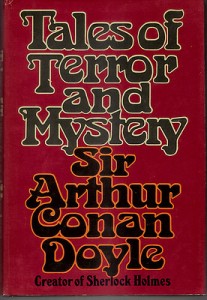
Tales of Terror and Mystery by Arthur Conan Doyle

Posted November 29, 2014 by Michael @ Knowledge Lost in Crime, Short Stories / 0 Comments

Tales of Terror and Mystery by Arthur Conan DoyleTitle: Tales of Terror and Mystery (Goodreads)
Author: Arthur Conan Doyle
Published: Knopf Doubleday, 1913
Pages: 224
Genres: Crime, Short Stories
My Copy: Library Book

Buy: AmazonBook DepositoryKindle (or visit your local Indie bookstore)

When we talk about Sir Arthur Conan Doyle, Sherlock Holmes always seems to be one of the first things that spring to mind. Sadly for this Scottish writer, this turned into both a blessing and a curse. Firstly, Sherlock Holmes remains a seminal part of crime writing and English literature, but limited the writer’s chances in exploring something different. In 1893 Doyle famously tried to kill off Sherlock Holmes in the story “The Final Problem” but due to public outcry and high demands the eccentric detective returned in the 1901 novel The Hound of the Baskervilles.

While Arthur Conan Doyle is known for his prolific writing, he didn’t gain much recognition for his works outside of Sherlock Holmes. Even though some critics believe his historical novels are some of his best works and The Lost World being the inspiration behind Michael Crichton’s Jurassic Park. I picked up Doyle’s 1923 short story collection Tales of Terror and Mystery as part of our book club, but this afforded me the opportunity to explore his writing outside of Sherlock.

Tales of Terror and Mystery is a collection of thirteen short stories broken up into two topics; six stories on terror and seven on mystery. The book kicked off on a positive gear, the tales of terror are almost like a homage to Edgar Allen Poe. Even the short story “The New Catacomb” has a remarkable similarity to Poe’s “The Cask of Amontillado”. What I enjoyed about these tales of terror was the way Doyle went a little darker and macabre to what I expected from this author.

Having such a great experience with the tales of terror it was a shame to move onto the tales of mystery. Here is a fun experiment; replace the protagonist name with Sherlock Holmes in these stories and see if they feel any different. It doesn’t work in all the stories; I wanted Conan Doyle to explore different styles of writing but I felt like the tales of mystery was almost like Holmes stories at times and the rest just didn’t work too well at all.

Some of the stories with Tales of Terror and Mystery worked really well but then the rest just feel short. I loved that Arthur Conan Doyle seemed to be influenced by great short story writers like Edgar Allen Poe or H.P. Lovecraft in some of the stories. However for the most part I was left wanting something a little more. Also, like what I have found with Doyle’s writing, there are some incredibly racist moments within this collection, with stories like “The Japanned Box” and “The Jews Breastplate”. After reading The Sign of Four earlier this year I have come to expect this colonialism nature from his writing. I like that some of these stories were macabre but overall I think this lacked the stylistic approach I am used to from this author.


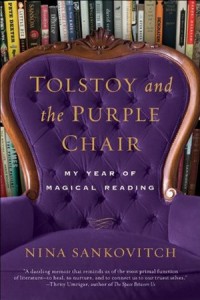
Tolstoy and the Purple Chair by Nina Sankovitch

Posted November 25, 2014 by Michael @ Knowledge Lost in Non-Fiction / 0 Comments

Tolstoy and the Purple Chair by Nina SankovitchTitle: Tolstoy and the Purple Chair (Goodreads)
Author: Nina Sankovitch
Published: Harper Collins, 2011
Pages: 241
Genres: Non-Fiction
My Copy: Audiobook

Buy: AmazonBook DepositoryKindle (or visit your local Indie bookstore)

When Nina Sankovitch lost her eldest sister to cancer, she grieved for a long time. However when she turned forty six, she decided to stop her grief by reading. Tolstoy and the Purple Chair is the memoir of a year of reading, dealing with loss and loving books. Reading a book a day Nina learned about the magical healing powers of books.

I started reading this book as soon as a finished Ex Libris; I wanted to continue in the joys of personal essays about reading and thought this one would be a good choice. While there is a lot of beauty in the writing, especially in the tender moments about her sister and dealing with her death, something just was not quite right. I spent a lot of time thinking about why this book did not work for me; I just could not put my finger on what was causing the problem. Then I realised this book is just a repetitive conversion narrative.

What I mean by conversion narrative (there probably is a better name for this) is something like Confessions by St. Augustine; where the author writes about all their problems and how they miraculously were saved. This isn’t normally a religious journey like Eat, Pray, Love by Elizabeth Gilbert but it is often a memoir of a struggling person that found a way to heal and have a better life. Tolstoy and the Purple Chair has that same formula over and over again; “I was grieving and then I found books”, “I had another problem so I picked up a book”.

Then there is the overly ambitious task of reading a book a day; from the start of the book I saw it to be problematic when she wanted to only read books about 200 pages. Then there was a moment where she didn’t want to read her son’s favourite book Watership Down by Richard Adams because it was almost 500 pages. The whole idea of ‘quality over quantity’ came to mind; what happens when you want to take your time with a book?

In theory the idea of reading so much might sound good but there is so much practicality that gets in the way. Nina Sankovitch does explore these day to day problems but more so in a way where cooking dinner or having a sick kid is getting in the way of her reading project. I like reading about someone taking up a reading project and documenting the results but I think this didn’t work. If you want something similar try The Year of Reading Dangerously by Andy Miller.


Ex Libris: Confessions of a Common Reader by Anne Fadiman

Posted November 19, 2014 by Michael @ Knowledge Lost in Non-Fiction / 0 Comments

Ex Libris: Confessions of a Common Reader by Anne FadimanTitle: Ex Libris: Confessions of a Common Reader (Goodreads)
Author: Anne Fadiman
Narrator: Suzanne Toren
Published: Farrar, Straus and Giroux, 1998
Pages: 162
Genres: Non-Fiction
My Copy: Audiobook

Buy: AmazonBook DepositoryKindle (or visit your local Indie bookstore)

Anne Fadiman has often stated that she learned about sex from her father’s copy of Fanny Hill (correct title for this book is Memoirs of a Woman of Pleasure) by John Cleland. Ex Libris (which is Latin for ‘from books’) is a collection of essays that recounts her life and her love affair with books. This collection of personal essays documents her life and those small problems only a fellow book lover would truly understand. Like when Anne and her husband finally decided to merge libraries five years into their marriage in the essay “Marrying Libraries”.

I have to admit, I love Anne Fadiman; she is the embodiment of everything I want to be as a reader. She is smart, witty, a little wry and can talk about books with great passion and intelligence. She does come across as pretentious and throws in some quotes in French just to show off, however her writing is so beautiful and she talks about books, not just as a personal experience but also includes some literary criticism.

This collection recounts a lifelong love affair she had with books; exploring the joys and passion that comes with being a book lover. I love how she talks about books in the form of personal essays; it gives me a whole new concept about writing. I obviously knew about personal essays in the past but something about this book just opened my eyes and made me think “I should be doing this”. The way she talks about her reading journey in a collection of connecting essays is wonderful; it turns the book not into a linear progression but rather focuses each essay on an experience or book.

You might have noticed that when I review books I tend to put a bit of my personal life and journey into the blog post. The style suits me and because I want to think of my book blog as a personal journal into my reading life, I feel it fits that theme. Anne Fadiman has a similar idea but in the form of essays and she puts my writing to shame; I now aspire to write as elegantly as she does with wit and beauty within each essay. I am nowhere near where I want to be but practise makes perfect; right?

This is the kind of collection I plan to read over and over again. I obviously love books and Anne Fadiman has obviously set the bar high for future books. I started reading memoirs from bibliophiles because I wanted to learn different ways to talk about books. Ex Libris has taught me so much more about books and just reminds me how much I love books about books. I have a whole heap of other memoirs to read and to be honest reading about people’s reading life has given me an appreciation for memoirs in general. I want to read more styles; not just readers but writers and then progress to other types of creativity. I remember starting the year struggling through non-fiction but it looks like I am ending this year with a completely new attitude towards them.


The Cold Dish by Craig Johnson

Posted November 16, 2014 by Michael @ Knowledge Lost in Crime, Western / 11 Comments

The Cold Dish by Craig JohnsonTitle: The Cold Dish (Goodreads)
Author: Craig Johnson
Series: Walt Longmire #1
Narrator: George Guidall
Published: Penguin, 2004
Pages: 400
Genres: Crime, Western
My Copy: Audiobook

Buy: AmazonBook DepositoryKindle (or visit your local Indie bookstore)

The Cold Dish is the first book in the Walt Longmire series by Craig Johnson, which is basis of the short lived A&E television show Longmire. While the book and show both have western mystery vibes, they have subtle differences. The book shares similar attributes but does not have the same feel as the television program, which seems to target western fans before adding any mystery or drama. I suspect the reason the show never really took off was the fact that everyone was middle aged.

Walt Longmire is the sheriff of the fictional Wyoming county of Absaroka. His only friend is Henry Standing Bear; together they remind me of a more serious Statler and Waldorf with their self-deprecation. The novel revolves around the death of Cody Pritchard, a man who two years earlier was suspected for raping a Cheyenne girl. Longmire is on the case and Henry helps him by being a liaison between the Sheriff’s office and the Cheyenne reservation in the effort to solve this crime.

I have only watched the first season of Longmire so it is hard to compare between the book and the show. I know Longmire is portrayed as rough and tough in the show but it leaves out a lot of his wit and humour. Deputy Victoria Moretti shows the most change between the book and series; her whole attitude and backstory played out in very different ways. To be honest I do not know why I did not watch any more of this show, I think it was a matter of timing and a busy schedule.

I read this for my Literary Exploration reading challenge and I thought a western with a mystery was the best way to experience this genre. While this novel is full of the typical mystery tropes, this was actually a very entertaining novel. The wry wit and self-deprecation is what worked for me within the novel; it almost makes me want to re-watch the TV show to see what I missed. I am tempted to read more of this series but I fear the formulaic elements will quickly get in the way.


California by Edan Lepucki

Posted October 11, 2014 by Michael @ Knowledge Lost in Speculative Fiction / 0 Comments

California by Edan LepuckiTitle: California (Goodreads)
Author: Edan Lepucki
Narrator: Emma Galvin
Published: Hachette, 2014
Pages: 320
Genres: Speculative Fiction
My Copy: Audiobook

Buy: AmazonBook DepositoryKindle (or visit your local Indie bookstore)

Cal and Frida is living in the middle of the 21st century, however it wasn’t the future we expected. Cities have crumbled, the internet has died and technology is worthless. Leaving city life behind, they now have to live in the wilderness, struggling to survive. Isolation and hardship are all new experiences; they live in fear of an uncertain future. A future that now consists of giving birth and raising a child in this post-apocalyptic world.

The post-apocalyptic back drop has been hugely popular lately and it isn’t just young adult fiction. Many literary fiction authors have tried their hand at the genre, giving them a unique world to explore real life issues. I’m thinking of great books like The Road by Cormac McCarthy, Super Sad True Love Story by Gary Shteyngart, The Passage by Justin Cronin and the Maddaddam series by Margaret Atwood. Edan Lepucki’s California sets out to join the ranks of the great with this overly ambitious first novel.

I will be honest, the only reason I picked up California was because of the promotion that appeared on The Colbert Report a while ago. The novel had enough to peak my interest but I had great difficulty getting a copy where I lived. Ironically I finally settled on getting the book through Audible to listen to. The premise of the novel was great; the idea of a world returning to the dark ages offered some interesting ideas. While we are never sure, the novel does allude to global warming as the underlining cause of this post-apocalyptic world.

I expected this novel to be the slow burn that The Road provided, building the characters and struggle while exploring the intended themes. However, I think this book burned a little too slowly, the flame went out halfway through and it turned into more of a chore to get through. Sure, the notions of communities, eco-terrorism and climate change were explored but for me it felt like I was being beaten over my head every chance they got. The book wanted to show off how smart and witty it was but, like many things that try to do this, the delivery never matched the intent.

California moved so slowly that as a reader, I was trapped in the wilderness of nothingness and I didn’t think I could escape. This was a real pity, everything seemed to start off so well; there was a plot arc and themes all set up and ready for execution. Somewhere on the way I feel like the author got a little lost and the readers were just following to her struggle to get back on track. I might come down hard on this novel; it isn’t too bad, there is a lot of potential and could have been a great book. For me it just didn’t work and wasn’t paced properly, I’m sure some people enjoyed it


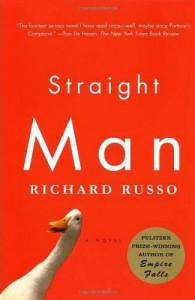
Straight Man by Richard Russo

Posted September 26, 2014 by Michael @ Knowledge Lost in Contemporary, Humour / 0 Comments

Straight Man by Richard RussoTitle: Straight Man (Goodreads)
Author: Richard Russo
Narrator: Sam Freed
Published: Vintage, 1997
Pages: 416
Genres: Contemporary, Humour
My Copy: Audiobook

Buy: AmazonBook DepositoryKindle (or visit your local Indie bookstore)

I must admit, I do enjoy a good campus novel and when I heard about Straight Man by Richard Russo I knew I had to read it as soon as I could. The story spouted from a real life situation Richard Russo had teaching at a small State University. Having made friends with the Dean of the university he found himself in a conversation about the budget. Year after year, the same thing happened and while walking past a duck pond the Dean jokingly complained that he would have to threaten to kill a duck a day until he got his budget. This ended up being the basis of not only the main character from Straight Man but the birth of the novel.

The novel tells the story of an English professor, William Henry Devereaux, Jr. at a fictional Pennsylvania University. He has been appointed as the interim chairman of the English department and once again the administration of the university has not provided a budget yet. William is also enjoying a midlife crisis and the complacency of being a tenure professor which gives us a sharp, witty and satirical look at college life.

You know what they say; ‘Everyone has a book in them’, and an English professor is more likely to know the pains of writing. For William, he has already enjoyed a brief brush with success when he released his fast forgotten novel. Despite his abilities, he will always remain in the shadows of his father; a far more popular and successful writer and professor. This creates a volatile mix of emotions and frustration for this character and the results play out wonderfully with Straight Man.

I was pleasantly surprised just how satirical this novel turned out, often humour was delivered in a number of different ways. From the outlandish situation, to dry deadpan deliveries and self-deprecation; these combinations worked well with the character and the novel itself. However behind the humour is the brutal truth of the bureaucratically nightmare an academic department faces year after year.

Ultimately what impressed me the most with this novel was the way Richard Russo managed to balance everything perfectly. He had a good sense of comedic timing and knows when to hold back or push forward. Yet he also knew how to sneak in some heavy themes without destroying the light hearted manner of the delivery. Above all, he has able to write great prose that showed beauty and tenderness as well as bitterness and comedy. It must have been difficult to balance everything but the execution made it look easy.


Levels of Life by Julian Barnes

Posted September 19, 2014 by Michael @ Knowledge Lost in Non-Fiction, Short Stories / 0 Comments

Levels of Life by Julian BarnesTitle: Levels of Life (Goodreads)
Author: Julian Barnes
Published: Random House, 2013
Pages: 128
Genres: Non-Fiction, Short Stories
My Copy: Personal Copy

Buy: AmazonBook DepositoryKindle (or visit your local Indie bookstore)

“Every love story is a potential grief story.”

It is official, I’m now a huge fan of Julian Barnes. Having read and enjoyed The Sense of an Ending and Metroland, I knew I had to read more of his novels. I did try Through the Window and found his essays challenging but mainly because the man is far too intelligent and I couldn’t keep up. I decided to try Levels of Life simply because I wanted to see how Barnes connects love and loss with ballooning and photography.

“Love is the meeting point of truth and magic. Truth, as in photography; magic, as in ballooning.”

Told in three masterful parts, Levels of Life tells stories that don’t seem connected but Barnes manages tol fit together. He is a master at the metaphor and this book told in narrative form tells the highs and lows of love. Part one “The Sin of Height” tells a narrative of Colonel Frederick Burnaby, an English soldier and traveller who crossed the English Channel in a hot air balloon in 1882. This story focuses on the obsessions that both Burnaby and French photographer Nadar had towards ballooning.

The next part, called “On the Level” looks at Colonel Burnaby and the French exotic actress, Sarah Bernhardt. Both shared an interest in ballooning which led to love. Two larger than life characters and a love that could never last, while Burnaby believed it was possible, Bernhardt thought differently. Here we have two stories; one depicting the highs of passion and love and the second, the idea of love fizzling out which only leaves one last essay.

“You put together two people who have not been put together before. Sometimes it is like that first attempt to harness a hydrogen balloon to a fire balloon: do you prefer crash and burn, or burn and crash?”

But sometimes it works, and something new is made, and the world is changed. Then, at some point, sooner or later, for this reason or that, one of them is taken away. And what is taken away is greater than the sum of what was there. This may not be mathematically possible; but it is emotionally possible.

“The Loss of Depth” is the last essay and is the story of the loss Julian Barnes suffered when his wife died of a brain tumour in 2008. This is a tender account of dealing with grief. The build-up of the other two essays just made the last one heart breaking and I found myself crying (something I don’t often do). Barnes explores life after losing his wife and at times it is a little funny, yet remains very moving.

“Initially, you continue doing what you used to do with her, out of familiarity, love, the need for a pattern. Soon, you realise the trap you are in: caught between repeating what you did with her, but without her, and so missing her; or doing new things, things you never did with her, and so missing her differently. You feel sharply the loss of shared vocabulary, of tropes, teases, short cuts, injokes, sillinesses, faux rebukes, amatory footnotes – all those obscure references rich in memory but valueless if explained to an outsider.” 

Julian Barnes managed to capture love and loss so perfectly, I felt like adding so many quotes to this review but I had to hold off. This is the type of book that will sit with me for a long time and I tear up just thinking about it. I’m amazed at Barnes’ skill as a writer and how he fit so much beauty and so many emotions into a short book is beyond me. I am going to have to read every book I can find from Julian Barnes.