Source: Library Book

My Life in Middlemarch by Rebecca Mead

Posted December 27, 2014 by Michael @ Knowledge Lost in Non-Fiction / 6 Comments

My Life in Middlemarch by Rebecca MeadTitle: My Life in Middlemarch (Goodreads)
Author: Rebecca Mead
Published: Crown, 2014
Pages: 293
Genres: Non-Fiction
My Copy: Library Book

Buy: AmazonBook DepositoryKindle (or visit your local Indie bookstore)

Rebecca Mead grew up in a coastal town in England and often dreamed of escaping to somewhere more exciting. She gained admission to Oxford and later become a journalist in the United States. When she was young Middlemarch was a favourite of hers and now as she re-reads this classic she is sharing her story along with it. My Life in Middlemarch is told partly as a bookish memoir, but also explores the life of George Eliot and her novel Middlemarch.

This book started off really well; in the prelude the reader gets to discover a bit about the life of Rebecca Mead. Beginning like a bookish memoir this insight into the author gave a fascinating look into her relationships with books, especially with Middlemarch. However as I progressed with My Life in Middlemarch, the memoir elements became fragmented and I found myself yearning to return to this style. I love bookish memoirs, I have been reading so many of them lately and this had the potential to be great but it had two other strands to weave into this book.

My Life in Middlemarch also looks at the life of George Eliot, which allows some perspective about this author. Though I had already done some extensive research. I know that the life of Eliot played a big part in understanding Middlemarch so my autodidactic nature kicked in and I learned a bit about her. I was reading Middlemarch with a reading guide as well, so I had the added advantage of gaining some insight as I read. Apart from access to George Eliot’s journals, I didn’t gain much information; it was a very broad strokes look at her life and I would have gained that information from Wikipedia. I would have been better off reading a biography or her journals instead.

Finally we come to the literary criticism within this book and yet again I felt a little disappointed. I would have liked to know what Rebecca Mead got from the book but instead she just referenced others people’s criticisms on the novel. Having smarter people’s insight into Middlemarch is useful but I would enjoy a personal opinion mixed in with all the references. It reminds me on how I write a research paper for university; I pack it with quotes and references that say what I want it to say but don’t offer much in the way of personal opinion

Combine these three parts and you have an accessible look at Rebecca Mead and her life with Middlemarch but it felt like a huge generalisation. There are some interesting elements worth exploring in this book and I feel like it could have done so much more. We have three interwoven strands within the book but nothing of substance from any of them. This would be an enjoyable book for someone that has not read Middlemarch but for me, I had just finished the classic and I picked this book up because I was not ready to move on.


Authority by Jeff VanderMeer

Posted December 19, 2014 by Michael @ Knowledge Lost in Horror, Science Fiction / 4 Comments

Authority by Jeff VanderMeerTitle: Authority (Goodreads)
Author: Jeff VanderMeer
Series: Southern Reach Trilogy #2
Published: Fourth Estate, 2014
Pages: 341
Genres: Horror, Science Fiction
My Copy: Library Book

Buy: AmazonBook DepositoryKindle (or visit your local Indie bookstore)

For thirty years, the clandestine government agency simply known as the Southern Reach have been sending expeditions into an isolated area known as Area X. Twelve expeditions have been sent to this unspoilt stretch of the US coastline but they are no closer to unlocking the mysteries of Area X. John Rodriguez, or as he is better known, Control is the newly appointed head of Southern Reach and he is determined to sort out this agency from all its disarray.

While Annihilation focused on Area X and served as an exhibition into nature, Authority is more about the bureaucratic nightmare of a secretive government organisation. The story follows Control, who serves as more of an outsider trying to make sense of everything that is going on within the Southern Reach. While this novel focuses on the organisation rather than Area X, readers can still expect to experience the same building of tension and terror found in Annihilation.

Even though it is a different cast of characters, I am very mindful of giving spoilers to the series so I will be a little vague and won’t be able to say everything I would like to say. Having said that, I tend to view Authority as a novel that parallels Annihilation in many ways. This makes me believe that the effects of Area X is not just a physical anomaly but also psychological. Yet again the reader is left with more questions than answers; What is going on here?

While I don’t think Authority was nearly as exciting as Annihilation. I am still very curious how this series will end with the last book Acceptance. I do have the last book from the library and I will probably read it sometime in January; I just need to know the answers. These books are a fun departure from the types of books I normally read but I do hate how vague I have to be in the reviews. Go out and read them; that is pretty much all I can really say.


A Man in Love by Karl Ove Knausgård

Posted December 18, 2014 by Michael @ Knowledge Lost in Contemporary / 4 Comments

A Man in Love by Karl Ove KnausgårdTitle: A Man in Love (Goodreads)
Author: Karl Ove Knausgård
Translator: Don Bartlett
Series: Min Kamp #2
Published: Harvill Secker, 2009
Pages: 528
Genres: Contemporary
My Copy: Library Book

Buy: AmazonBook Depository (or visit your local Indie bookstore)

Karl Ove Knausgård’s six volume autobiographical novel, My Struggle (Min Kamp) has been dubbed a literary sensation more often than I can count. Despite what the critics think, I often look to the book blogging community to help measure the success and popularity of a book and sadly this series hasn’t really become the sensation it should be. It has been compared to Proust but I think that is mainly because of the large autobiographical nature, My Struggle tells the story of Karl Ove Knausgård’s life in a non-linear way; A Death in the Family (My Struggle #1) focuses on the theme of death, while A Man in Love (book 2) looks at love.

When Karl Ove Knausgård leaves Oslo and starts his life afresh in Stockholm, it is because of a messy breakup with his wife. His move to Stockholm is aided by Geir, in which he develops a deep friendship with. He also meets a beautiful Swedish poet, Linda Boström, who captivated him and becomes the object of his affection. A Man in Love is the story of Karl Ove and Linda’s blossoming romance, eventual marriage and children.

As stated in my review of A Death in the Family, this series of books have been met with massive controversy and his friends and family have been none too pleased. His ex-wife has stated in an interview that he has made a “Faustian bargain”, sacrificing relationships for this series of books. Karl Ove Knausgård is brutally honest and doesn’t paint the best light on himself or others, despite the fact this is considered an autobiographical novel.

Compared to A Death in the Family, A Man in Love is a linear story that focuses on the relationship between Karl Ove and Linda. Knausgård writes with such affection and love towards Linda and there is such a tender and sweet tone to the book. However because he wants to remain viciously truthful there are moments where she isn’t portrayed as the sweet woman he feel in love with. Knausgård airs all their domestic disputes and Linda sometimes comes across as aggressive, angry and stubborn. In contrast, the reader will also notice that Karl Ove Knausgård is flippant, arrogant and narcissistic.

I loved the dark themes and what Knausgård had to say on bewilderment and grief, so I kind of felt like this was a little light and flowery for me. Don’t get me wrong, there are some dark moments here and Linda Boström Knausgård’s outbursts make their relationship rough but there was just something that bugged me about this novel. Karl Ove kept threating to leave Linda every time she had an outburst and that bothered me but I realised that was his style of arguing and at least he was honest about his flaws as well. After a little bit of research I found out that Linda suffers from bipolar disorder, which I don’t remember being revealed in the book but helps put things into perspective.

A Man in Love is a novel about love and Karl Ove’s relationship with Linda, which is an important part of his life but doesn’t always make for a compelling read. I did enjoy this novel and I am looking forward to picking up book three in the Min Kamp series, Boyhood Island. It sounds like the majority of the story has been covered in A Death in the Family but I will find out soon. The fourth book in the series is set to be released in March next year, but then I will be stuck waiting for the last two books. Karl Ove Knausgård’s My Struggle is well worth checking out and I am disappointed that not many other people are reading it, but maybe they are just waiting till the entire series is released.


What Is Literature? by Jean-Paul Sartre

Posted December 16, 2014 by Michael @ Knowledge Lost in Non-Fiction / 2 Comments

What Is Literature? by Jean-Paul SartreTitle: What Is Literature? (Goodreads)
Author: Jean-Paul Sartre
Translator: Bernard Frechtman
Published: Routledge, 1947
Pages: 280
Genres: Non-Fiction
My Copy: Library Book

Buy: AmazonBook Depository (or visit your local Indie bookstore)

What Is Literature? (Qu’est ce que la littérature?) by Jean-Paul Sartre has also been published as Literature and Existentialism. It is a collection of freestanding essays originally published in the French literary journals Les Temps Modernes, Situations I and Situations II. Jean-Paul Sartre is best known as the French philosopher who played a key part in the schools of existentialism and phenomenology. It is sometimes forgotten that he was also a literary critic and a Marxist who was often vocal about the abuses of human rights by the Soviet Union.

The reason I mention that Jean-Paul Sartre was a Marxist is because this plays a big part of What Is Literature? To understand his political standing is useful because it plays an important role in his literary criticism; Sartre was very vocal political, and though he embraced Marxism he never joined the communist party. While his literary criticism is always focused on Marxism, his schools of thought in philosophy are relevant, as well as his views on sociology and post-colonialism.

There are four essays found within What Is Literature? “What is Writing?”, “Why Write?”, “For Whom Does One Write?” and “Situation of the Writer in 1947”. “What is Writing?” is probably the most fascinating (for me, anyway) of the four essays, exploring the ideas of writing that distinguish it as an art form apart from poetry, painting and music. I found it interesting how Sartre has separated poetry and journalism out of his thoughts of writing to focus on literature as an art form. Whether you believe his idea of not, Jean-Paul Sartre will give you plenty of food for thought and I have to admit that a sufficient amount of it went over my head.

Jean-Paul Sartre has spent a great deal of time thinking about literature and writing as an art and philosophical idea, more than I could ever imagine. Because of this, it can be difficult and as a reader I had to admit that I wouldn’t understand everything. What Is Literature? did however leave me with plenty to think about and offer me a fresh perspective and that is all I wanted from this book. Let’s face it, this is a pretty pretentious book to read but I still think it is worth exploring the ideas within What Is Literature?


Why I Read by Wendy Lesser

Posted December 10, 2014 by Michael @ Knowledge Lost in Non-Fiction / 2 Comments

Why I Read by Wendy LesserTitle: Why I Read: The Serious Pleasure of Books (Goodreads)
Author: Wendy Lesser
Published: Farrar, Straus and Giroux, 2014
Pages: 240
Genres: Non-Fiction
My Copy: Library Book

Buy: AmazonBook DepositoryKindle (or visit your local Indie bookstore)

Wendy Lesser is the founding editor for the American literary magazine The Threepenny Review; she is lucky enough to spend her days with books. She is a bibliophile with a lifetime of reading experience to offer as well as an eclectic taste. Why I Read is a collection of essays that explores Lesser’s thoughts and ideas on literature in through the lens of different topics like character and plot.

This sounds like the type of book I should love and it ticked all the right boxes for what I look for in a book about books; eclectic taste, part memoir and offering some literary criticism. However I felt a huge disconnection with this book and I spend a lot of time just trying to pin-point what wasn’t working. Clearly Wendy Lesser is passionate about books and is well read, though I felt like that passion didn’t translation into her writing. This felt more like academic writing, so all emotion felt removed from Why I Read, but this is the type of book that needs that emotion and passion.

I enjoyed the fact that Wendy Lesser jumped from Henry James or Fyodor Dostoevsky, to Jim Thompson, Ross MacDonald, Patricia Highsmith and other crime novelists. It was fascinating to see crime novels used as examples in literary criticism, I was happy to see examples of science fiction, and fantasy also included rather than sticking to just literary fiction or classics. It is a real shame that the writing was so flat; the concepts and ideas were great and with some polishing this could have made for a wonderful book.

I am disappointed that this book never grabbed me and the writing held the book back. There are plenty of interesting ideas and literary criticism worth exploring but the dull nature really made that difficult. I sounds like Wendy Lesser is passionate about books and would have a lot ideas worth listening to if only that passion was visible in the writing.


Not Drowning, Reading by Andrew Relph

Posted December 7, 2014 by Michael @ Knowledge Lost in Non-Fiction / 4 Comments

Not Drowning, Reading by Andrew RelphTitle: Not Drowning, Reading (Goodreads)
Author: Andrew Relph
Published: Fremantle Press, 2012
Pages: 184
Genres: Non-Fiction
My Copy: Library Book

Buy: AmazonBook DepositoryKindle (or visit your local Indie bookstore)

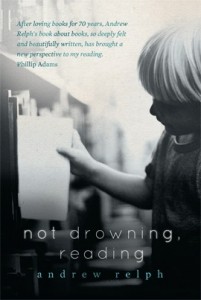
As a child Andrew Relph had a reading disability, but he never let that stop him. He realised the value and importance of reading and writing and worked harder to learn these skills. Now a psychoanalyst and professional conversationalist, Relph’s book Not Drowning, Reading explores his relationship with books and how they fit into his life experiences.

The title Not Drowning, Reading is a fascinating one and also comes with an interesting backstory. It references a time the author almost drowned but also is a perfect metaphor for how Relph felt during his school years struggling with a reading disability. A feeling of struggling to keep his head above water and not get lost in the depths of the educational waters seems to give me an idea of the battle he was having internally. It is interesting to think that he went from an internal battle into a career helping others with psychological struggles.

Divided into essays on his life, Andrew Relph explores the impact literature has had on his life with continual references to his career as a psychoanalyst. Considering I have an interest in psychoanalysing literature, this was a fascinating read for me and gave me plenty to think about. Relph shares his love for authors like Martin Amis, Saul Bellow, William Shakespeare, Virginia Woolf and to my disappointment D.H. Lawrence. In fact his thesis was centred on Lawrence and the psychoanalysis.

For those people who don’t know, I consider Lady Chatterley’s Lover by D.H. Lawrence as one of the worst books I have ever read. I will admit that I just didn’t get the appeal and have never returned to Lawrence again. There are plenty of reviewers I respect and trust that love the works of D. H. Lawrence and while I hate to admit this, I feel like I need help in understanding the appeal. Lady Chatterley’s Lover was read when I first started out as a reader and there would be a lot I missed but I also suspect that it wasn’t the best starting point for me as a reader.

Now I have had a rant about D.H. Lawrence, I should return to Not Drowning, Reading by Andrew Relph. This memoir is a very deep look at his life and literature through the lens of psychoanalysis;  this reminds me I need to learn about these literary theories but for others it might come across as a little dense. I was completely immersed and fascinated by what Andrew Relph had to say but I am well aware that compared to other memoirs about literature this might be too heavy on theory for some readers.


Ariel by Sylvia Plath

Posted December 5, 2014 by Michael @ Knowledge Lost in Poetry / 0 Comments

Ariel by Sylvia PlathTitle: Ariel (Goodreads)
Author: Sylvia Plath
Published: Faber & Faber, 1965
Pages: 81
Genres: Poetry
My Copy: Library Book

Buy: AmazonBook Depository (or visit your local Indie bookstore)

It feels like Sylvia Plath’s life overshadowed her literary value; her autobiographical novel The Bell Jar was like a confessional and people tend to read it for all the juicy bits. Ariel is a collection of poems published posthumously, just a few years after her suicide. It is true that we have Plath to think for advancing the confessional poetry form and exploring topics previously taboo like suicide, mental illness and domestic abuse.

I would like to thank Meg Wolitzer’s book Belzhar for pushing me into reading more of Sylvia Plath. The book explores a struggling student that was sent to a private school that put her in a special English class. This class spent the semester journaling and reading Plath, most importantly The Bell Jar but also Ariel. That book made me want to re-read The Bell Jar which I loved but instead decided it was time to give her poetry a go.

However I am very aware that I don’t know how to review poetry let alone a whole collection, so this is more about my experience with this book. I feel like I am becoming a better reader but if you ask me to read out loud I am going to struggle. So I decided this is an issue I needed to work on and I read Ariel to my wife (she read some of it to me as well). This may seem like a romantic and intimate thing to do with your partner but Plath has a way of killing any sexy moods.

I loved the experience but I am struck with a sense that Sylvia Plath might have been a poor choice to begin with. She has a very strong sense of imagery and plays a lot with metaphors; some of which I picked up on but there was some stuff that went over my head. Poetry is meant to be read out aloud and I thought this would help with my understanding as well as develop my skills. However I found it extremely difficult to work out punctuation in these poems. Some sentences span over a few stanzas but my natural impulse was to pause after ever line.

Having said that, this was a wonderful experience and while the poems are often dark and depressing I am glad I shared this moment with my wife. Ariel kind of reminds me of those people on the internet that overshare about their lives and you can’t help but be glued to what they write even if it annoys you. Sometimes I think, that is too much information but Sylvia Plath seems to get to the heart of that raw emotion.

Sylvia Plath was an incredibly intelligent and complex woman; I can’t help being fascinated by her. I want to learn more about her life, and understand the emotion behind her writing. Take for example her poem “Daddy”; there is this anger toward her father as well as some holocaust imagery that I just want to understand. I am going to have to find a biography on Plath’s life because I think this places a big part in her writing. Can anyone recommend me a good biography?


Wonder Boys by Michael Chabon

Posted December 3, 2014 by Michael @ Knowledge Lost in Contemporary / 6 Comments

Wonder Boys by Michael ChabonTitle: Wonder Boys (Goodreads)
Author: Michael Chabon
Published: Harper Perennial, 1995
Pages: 384
Genres: Contemporary
My Copy: Library Book

Buy: AmazonBook DepositoryKindle (or visit your local Indie bookstore)

Grady Tripp is a writer of a few novels; following the success of his award winning novel The Land Downstairs he has set out to write his follow up. Seven years later his manuscript for Wonder Boys was over 2600 pages long and nowhere closer to being finished. In his personal life things were messed up, his wife has walked out on him, and his mistress Sara has revealed she was pregnant. Wonder Boys (1995) is Michael Chabon’s second novel following the success of his debut book The Mysteries of Pittsburgh (1988).

Michael Chabon spent five years writing a book called Fountain City following The Mysteries of Pittsburgh. Fountain City ballooned into a 1500 page novel about an architect building the perfect baseball stadium in Florida. Chabon stated that he “never felt like [he] was conceptually on steady ground.” Without telling his agent or publisher he abandoned the book and started Wonder Boys which steamed from the melodrama involved around Fountain City. The main character, Grady Tripp is apparently based on one of Chabon’s professors from University of Pittsburgh who had a 3000 pages manuscript which eventually was published in 2001.

This being my third novel by Michael Chabon, I was struck by how different this book was to the other two. The Amazing Adventures of Kavalier & Clay and The Yiddish Policemen’s Union play with intertextuality and genre blending but Wonder Boys didn’t have this at all. Sure there were some similarities, the frequent use of metaphors and recurring themes (particularly with Jewish identity) were still present but it felt very different. Wonder Boys felt raw and emotional, and now understanding the fate of Fountain City I can see the birth of this book.

Chabon plays on the ideas of how we view the stereotypical struggling writer; a person surrounded in melodrama. Wonder Boys is set over the course of one weekend in which Grady’s third wife has left him and his mistress has told him he will be a father. To make things worse, his mistress is the chancellor of the university he works at and her husband in the head of the English department, which makes him his boss. The drama continues to unfold as his agent has arrived in town in the hopes to get a peek at his new novel, which is far from finished. However that is not the half of Grady’s problems and this novel is overly dramatic to give the reader a chance to re-examine the ideas they have of a struggling writer; not all of them are Grady Tripp or Hank Moody (Californication).

Michael Chabon wanted to play with the idea of drama as a reflection of the internal struggle that is experienced with a novel that just isn’t working. Everything is over the top, much like the 1600 page novel that needs to be trimmed down and turned into a more accessible novel. However everything that Grady tries to do to make his life a little less complicated just makes everything worse. This metaphor plays out throughout the entire novel and I had to wonder if it is better to abandon the novel and start again or continue trying to fix it (this plays out near the end of this book but I won’t give spoilers). The fact this book is full of anxiety and raw emotions only serves to enhance the experience and the metaphor.

Wonder Boys was also turned into a movie starring Michael Douglas, Tobey Maguire, Katie Holmes and Robert Downey, Jr. I haven’t seen the movie yet but I can see what it working on a very fundamental level but I am not sure how it would translate. The movie does seem to have a cult classic status so maybe it translated onto the screen perfectly.

Yet again I find myself being impressed with the works of Michael Chabon and a little sad that is takes me so long to read another novel of his. I have Telegraph Avenue on my TBR bookcase waiting for me but it is a bit of a tome. I have so many big books I would love to read but they still scare me, I really need to work on this problem. Wonder Boys is a wonderful and emotional journey and a great place to start if you have never read Michael Chabon before.


The Elegance of the Hedgehog by Muriel Barbery

Posted December 2, 2014 by Michael @ Knowledge Lost in Contemporary / 3 Comments

The Elegance of the Hedgehog by Muriel BarberyTitle: The Elegance of the Hedgehog (Goodreads)
, 2006
Pages: 325
Buy: AmazonBook Depository (or visit your local Indie bookstore)

Renée Michel is a concierge for an upscale apartment building that is inhabited by bourgeois families. Renée is an intelligent autodidact that hides herself from the residents of this elegant apartment, trying to confirm every stereotype they might have towards a concierge. However a precocious girl named Paloma suspects there is something more about Renée. When a wealthy Japanese business man moves into the building, he sees right through the concierge’s façade and tries to befriend her for some intellectual conversations.

The Elegance of the Hedgehog is a highly successful novel by Muriel Barbery who obtained her agrégation in philosophy before becoming a professor for the Université de Bourgogne. The publication I read was a Europia edition that was translated by novelist and Literary translator Alison Anderson. L’Élégance du hérisson was translated into more than forty languages and has also been adapted into the 2009 movie The Hedgehog (Le hérisson) staring Josiane Balasko, Garance Le Guillermic and Togo Igawa.

This novel is full of allusions towards works of literature, music, films, and paintings, which is one of the reasons I loved this book. While it might come across as pretentious and somewhat cynical The Elegance of the Hedgehog plays a lot with the ideas of stereotypes, class-consciousness and acceptance. A philosophical novel that explores ideas of how we present ourselves to the world and if we should pretend to be someone different, if that is what others expect from you.

There are plenty of philosophical ideas running through this novel that presents different ideologies, Muriel Barbery has stated that literature is an effective way to explore philosophy. Having sat through plenty of long and boring philosophy classes she wanted a way to explore the ideas in a more effective and interesting way. I suspect people can get lost in the pretentious nature of this book but also the ending; however I think it was a fitting ending for the novel.

I found The Elegance of the Hedgehog to be a beautiful, if not recherché little novel and I enjoyed every moment of it. I wanted to turn back to page one and start again; I think there is plenty within this book to offer its readers. If you pay close attention to the book you might also notice that most of the book was told in a first person, present day nature that makes for a fresh look at the story that I didn’t notice till near the end. I know I should have paid more attention but this is one of the main reasons I wanted to re-read the book.

Lovers of philosophy and literature would love this book but also anyone interested in Marxism.  I know I didn’t talk much about the class struggle within the book but that is because I have much to learn in this area. The Elegance of the Hedgehog is an intelligent novel, full of references to literature, witty and smart humour with a satirical nature. The way this French novel translates into an elegant English novel is a testimony to Alison Anderson’s ability but she had a great piece of literature to work with. I would highly recommend this novel to everyone but maybe that isn’t a good idea, I think you have to be in the right frame of mind or mood to truly enjoy this book.


Tales of Terror and Mystery by Arthur Conan Doyle

Posted November 29, 2014 by Michael @ Knowledge Lost in Crime, Short Stories / 0 Comments

Tales of Terror and Mystery by Arthur Conan DoyleTitle: Tales of Terror and Mystery (Goodreads)
Author: Arthur Conan Doyle
Published: Knopf Doubleday, 1913
Pages: 224
Genres: Crime, Short Stories
My Copy: Library Book

Buy: AmazonBook DepositoryKindle (or visit your local Indie bookstore)

When we talk about Sir Arthur Conan Doyle, Sherlock Holmes always seems to be one of the first things that spring to mind. Sadly for this Scottish writer, this turned into both a blessing and a curse. Firstly, Sherlock Holmes remains a seminal part of crime writing and English literature, but limited the writer’s chances in exploring something different. In 1893 Doyle famously tried to kill off Sherlock Holmes in the story “The Final Problem” but due to public outcry and high demands the eccentric detective returned in the 1901 novel The Hound of the Baskervilles.

While Arthur Conan Doyle is known for his prolific writing, he didn’t gain much recognition for his works outside of Sherlock Holmes. Even though some critics believe his historical novels are some of his best works and The Lost World being the inspiration behind Michael Crichton’s Jurassic Park. I picked up Doyle’s 1923 short story collection Tales of Terror and Mystery as part of our book club, but this afforded me the opportunity to explore his writing outside of Sherlock.

Tales of Terror and Mystery is a collection of thirteen short stories broken up into two topics; six stories on terror and seven on mystery. The book kicked off on a positive gear, the tales of terror are almost like a homage to Edgar Allen Poe. Even the short story “The New Catacomb” has a remarkable similarity to Poe’s “The Cask of Amontillado”. What I enjoyed about these tales of terror was the way Doyle went a little darker and macabre to what I expected from this author.

Having such a great experience with the tales of terror it was a shame to move onto the tales of mystery. Here is a fun experiment; replace the protagonist name with Sherlock Holmes in these stories and see if they feel any different. It doesn’t work in all the stories; I wanted Conan Doyle to explore different styles of writing but I felt like the tales of mystery was almost like Holmes stories at times and the rest just didn’t work too well at all.

Some of the stories with Tales of Terror and Mystery worked really well but then the rest just feel short. I loved that Arthur Conan Doyle seemed to be influenced by great short story writers like Edgar Allen Poe or H.P. Lovecraft in some of the stories. However for the most part I was left wanting something a little more. Also, like what I have found with Doyle’s writing, there are some incredibly racist moments within this collection, with stories like “The Japanned Box” and “The Jews Breastplate”. After reading The Sign of Four earlier this year I have come to expect this colonialism nature from his writing. I like that some of these stories were macabre but overall I think this lacked the stylistic approach I am used to from this author.