Source: Personal Copy

The Portrait of Mr. W.H. by Oscar Wilde

Posted February 27, 2014 by Michael @ Knowledge Lost in Short Stories / 0 Comments

The Portrait of Mr. W.H. by Oscar WildeTitle: The Portrait of Mr. W.H. (Goodreads)
Author: Oscar Wilde
Published: Hesperus Press, 1889
Genres: Short Stories
My Copy: Personal Copy

Buy: AmazonBook DepositoryKindle (or visit your local Indie bookstore)

The fact that William Shakespeare’s Sonnets are dedicated to one Mr W.H. has been the source of much speculation. Eighteenth century critic Thomas Tyrwhitt suggests that the sonnets are written for a person known as William Hughes. He bases this theory on his interpretation of the Sonnets, lines like “A man in hue, all Hues in his controlling” (the 20th sonnet) where the word ‘Hue’ is capitalised and italicised and the multiple puns on the name ‘Will’ found in the sonnets.

The Portrait of Mr. W.H. is a short story by Oscar Wilde; it only took me about twenty minutes so I don’t think I’ll say much about it but it was a story I wanted to review. Yes, it was required reading for university but it was an interesting enough piece that getting my thoughts down seemed like a good idea. I remember reading The Picture of Dorian Gray a long time ago and not getting on with it; maybe I wasn’t for me or maybe I just hadn’t had the literary knowledge to get something out of it. In any case, I’m curious enough that maybe Dorian Gray will be a reread in the future.

I want to compare The Portrait of Mr. W.H. with My Life as a Fake because they both seem to talk about a similar topic. While My Life as a Fake covered a literary hoax, The Portrait of Mr. W.H. looks at a piece of literary criticism that has been around for a long time and is often talked about. I don’t agree with this theory and it is important to know that Oscar Wilde didn’t either, although by the end he almost did. What I really liked about this story is the fact that Wilde took a differing view of the Sonnets and tried to explore it. This is an excellent example of literary criticism because it got me looking at the Sonnets in another way, even if I didn’t agree with it.

The fact that Oscar Wilde managed to write this literary criticism in a form of a story was equally impressive. The whole story has this real gothic feel about it and the character of Willie Hughes showed vampiric characteristics in the way he destroyed lives, in particular Cyril’s. Yet another similarity to My Life as a Fake is the whole idea that literature or the author can be portrayed as a monster.

I read this story as social criticism, looking at the homo-eroticism of Shakespeare’s Sonnets and question if a particular piece of text has any effect on the value of the art form. I don’t know many people complaining about the homoerotic nature of Shakespeare but I’ve heard complaints about it when referring to Oscar Wilde. Wilde was a big believer in celebrating art as being art and not letting the opinion of the artist affect it. This means The Portrait of Mr. W.H. is a satirical look at the art, where you have to take a more literal approach and explore the life of William Shakespeare as an artist and its connection to the Sonnets.

Oscar Wilde tantalises the reader with his literary and social criticism, mix in the satirical nature of this story and the wit of the author and you have a compelling read. One thing I’ve been thinking about is the connection between this story and The Picture of Dorian Gray which I would like to leave you with. They both share very similar titles but in Dorian Gray you have a portrait that ages and the reader see the truth, of Gray and all his sins. While in The Portrait of Mr. W.H. the picture of Willie Hughes is a lie and I have to wonder the meaning behind this imagery when comparing the two.


All That Is by James Salter

Posted February 22, 2014 by Michael @ Knowledge Lost in Historical Fiction, Literary Fiction / 0 Comments

All That Is by James SalterTitle: All That Is (Goodreads)
Author: James Salter
Published: Picador, 2013
Pages: 304
Genres: Historical Fiction, Literary Fiction
My Copy: Paperback

Buy: AmazonBook DepositoryKindle (or visit your local Indie bookstore)

After 30 years James Slater returns to the literary world with a new novel, All That Is. With 88 years of life experience under his belt, Salter offers a unique perspective of life, passion and regret. All That Is explores fragment of Philip Bowman’s life, as a naval officer in World War II, attending Harvard University and going on to be an editor of a small publishing house. While this doesn’t cover Bowman’s life in the way a memoir would, we get little snippets of his life and what is important to him.

James Salter has been often dubbed as a writer’s writer, a title he wished to shed when writing All That Is, but does he pull that off? For me, this title means that he is a writer than other writers and serious readers love, but that the casual reader often won’t enjoy. The reasoning is that the beauty in Salter’s books is in the proses and not the plot. He feels like an old fashion writer; he writes proses so  elegant that it is often intimidating. He doesn’t try to write the perfect sentence that will blow the reader away every time; he does not want to lavish the reader, but you’ll still find a style that I think is graceful from page to page.

Something that I think goes against what is often taught to writers is that Salter is really good at ‘telling not showing’. He knows what he is doing and he executes this method in a precise way that just works for him. There are times when his similes and metaphors do come across as weird but for the most part everything flows and I found myself being swept away in the cleverness of his writing.

When exploring Philip Bowman’s life, we really get a sense of him as a person and the people he meets along the way. Some people we only meet for a few paragraphs but the style of Salter is enough to give the reader a good sense of who they are in such a short amount of time. This is a real talent and I really loved the little snap shots of people along the way. He manages to explore the little details and while we don’t know everything, he has painted a magnificent portrait of Bowman’s life.

As if it was a refrain to the novel we are often taken to a cocktail party and often we read about Philip Bowman making a move on a woman (often a married one) and inviting them to lunch. This often leads to sex and I think we are constantly reading about these conquests because they are important to Bowman. While this does feel a little repetitive at times, I think it is interesting to show the behavioural pattern of Bowman and his tried and true method of picking up woman.

I want to talk about the sex within All That Is (and Salter novels in general), while there isn’t as much as there was in A Sport and a Pastime (which I consider an erotic novel) there was still a lot in this one. The sex scenes in his novels might be considered crude and offensive to some, but they do play an important part, in All That Is we explore the passion and regrets of Philip Bowman’s life, a man that likes sex and though he can be a bit of a dick at times when trying to get laid, it felt honest and real. Salter doesn’t play around with euphemisms when he writes sex scenes, they are non-ludicrous and sometimes over descriptive. The thing I like about his sex scenes is that he doesn’t always try to be erotic, sometimes they are awkward or unintentionally funny, this just makes it feel more real; sometimes there is passion and it’s erotic, sometimes things go wrong. Often better than the sex itself is the events that follow, they may just be lying in bed making small talk, but it is here we get some real unseen insights into these characters.

I think I’m becoming a fan of James Salter, while I would recommend A Sport and a Pastime over this novel, there is a real joy in reading proses like this. James Salter does give a huge nod to the book industry and his love of books, but for me this was about life, love, passion and regret. Exploring the life of Philip Bowman was an interesting endeavour; sure, he is fictional but the book says a lot about life in general. Salter is not for everyone but if you like beautiful language and not afraid of some graphic depictions of sex then he is an author worth checking out.


Encyclopedia of a Life in Russia by José Manuel Prieto

Posted February 20, 2014 by Michael @ Knowledge Lost in Literary Fiction / 0 Comments

Encyclopedia of a Life in Russia by José Manuel PrietoTitle: Encyclopedia of a Life in Russia (Goodreads)
Author: José Manuel Prieto
Translator: Esther Allen
Published: Grove Press, 2013
Pages: 224
Genres: Literary Fiction
My Copy: Paperback

Buy: AmazonBook DepositoryKindle (or visit your local Indie bookstore)

Encyclopedia of a Life in Russia tells the story of Cuban immigrant Thelonious Monk (not his real name) living in post-Soviet Russia. Monk loves women, many of them, particularly beautiful women. In St Petersburg he meets a young woman named Linda Evangelista (also not her real name) and after brief affair and some correspondence the two strangers become an inseparable pair. He takes her to Yalta where he starts work on a new novel about her, his notes for this novel comprise of this Encyclopaedia.

This is a really tricky novel to talk about, let alone try to understand but I will try to do my best. The novel explores these two misfits as they try to explore through a world that is changing. They are caught between old traditions and modern consumerism. I suspect that Encyclopedia of a Life in Russia is semi-autobiographical as José Manuel Prieto spent twenty years in Russian. Not knowing much of José’s life only leaves me to speculate, but I have to wonder if he is Thelonious, then who is Linda (real name Anastasia Stárseva according to an entry in the ‘L’). She comes across as a really interesting and mysterious character, a modernist who in a past like was an unorthodox poet and bourgeois muse.

The novel is a fusion of history, philosophy, social-critique and in my opinion autobiographical fiction. Though, like many other postmodern novels, there is a degree of difficulty in reading it; the rewards are great but I can’t help wondering just what I’m actually reading here. It’s a satirical, philosophical, meta-fictional encyclopaedia which is evocative of the era in which it was compiled in. This makes it incredibly complex and that would require more knowledge to understand it better. There are references that range from Bach to Dostoyevsky but also consumerism. I found a lot of nods to Russian literature and a better knowledge of this (especially Checkov) would be a huge asset to this novel.

The characters think of themselves as avatars of consumer culture, navigating the border between art and commerce during the Soviet Union’s collapse in 1991. This means we get this interesting perpective of a changing Russia. Mixed in are conversations about advertisement copy and art criticism. This is invoking a blending (and changing) from the old traditional high art to a more commercial culture.

I love the way that the novel is broken into mock Encyclopaedia entries; it was an interesting narrative type but surprisingly informative. The book did force me to flip between entries, I often found myself going back and forth but this ended up creating an ever-deepening picture of the world they are living in. Reading Encyclopedia of a Life in Russia runs the risk of looking like an idiot while trying to understand this overly complex novel but the reward is far greater and in the end well worth the effort.

I did take me a while to get through this book and even longer to put together my thoughts from the notes I made (yes, I’m trying to write notes now, does it reflect in my reviews?) but I’m so glad I read this novel. The novel is packed with wit, irony, philosophical thought and the written in a poetic voice. This is a translated book from Spanish and I can’t help but be angry that something can sound so beautiful after being translated out of its original language. If you are not afraid of post modernist novels and are willing to put the time and effort into this book, then reading Encyclopedia of a Life in Russia will be highly rewarding experience.


My Life as a Fake by Peter Carey

Posted February 16, 2014 by Michael @ Knowledge Lost in Literary Fiction / 0 Comments

My Life as a Fake by Peter CareyTitle: My Life as a Fake (Goodreads)
Author: Peter Carey
Published: Random House, 2003
Pages: 320
Genres: Literary Fiction
My Copy: Paperback

Buy: AmazonBook DepositoryKindle (or visit your local Indie bookstore)

In 1943 two conservative classicists set out to expose the absurdity of modernist poetry. Both James McAuley and Harold Stewart were classical trained poets, who didn’t think much about modernism; it didn’t rhyme, didn’t make sense and it just didn’t look right, it was fake poetry. If an everyman can abandon technique and rhythm and create poetry, what was the point of high art? They created this everyman, Ern Malley and submitted poetry under this name to the literary magazine Angry Penguins. The Ern Malley hoax has become one of the biggest literary scandals in Australian history. While the hoax crippled modernist poetry within Australia, ultimately this parody backfired on McAuley and Stewart. The poetry, which was written in a day and full of word plays and puns became a sensation in the 1970’s. Their attempt to parody modern poetry and create something fake turned into something real, beyond their control and is now celebrated as fine examples of surrealist poetry.

Peter Carey’s My Life is a Fake explores the idea of fakery while paying homage to the Ern Malley hoax. Knowledge of this hoax is the backbone of this post-modernist novel, so much so that he covers his thoughts on it in the back of the book. Thinking about this novel I get the idea that this is a book that demands the reader to think about the purpose of reading. While this is considered contemporary fiction, it really demands a lot from the read and it wants to address a number of literary issues. Editor for Monthly Review Sarah Wode-Douglass, while traveling to Kuala Lumpur, encounters the perpetrator of the hoax after many years. The novel goes on to explore the literate mystery of forgeries but I won’t go into too much detail, it is quite a ride.

“I still believe in Ern Malley. (…) For me Ern Malley embodies the true sorrow and pathos of our time. One had felt that somewhere in the streets of every city was an Ern Malley (…) a living person, alone, outside literary cliques, outside print, dying, outside humanity but of it. (…) As I imagined him Ern Malley had something of the soft staring brilliance of Franz Kafka; something of Rilke’s anguished solitude; something of Wilfred Owen’s angry fatalism. And I believe he really walked down Princess Street somewhere in Melbourne. (…) I can still close my eyes and conjure up such a person in our streets. A young person. A person without the protection of the world that comes from living in it. A man outside.” Max Harris, editor of Angry Penguins.

While this book is told in a first person narrative, from the perspective of Sarah, as a reader I wrestled with the perspective. The novel explored the life of Sarah, her traveling partner John Slater who she describes as an unapologetically narcissist. Also we learn about Christopher Chubb and his monster, the non-existent Bob McCorkle. My mind wrested with questions like, whose life was I reading about? Whose words am I reading? Whose mythology do I accept? Personally I think these are the questions Carey wants us to ask, also I have to wonder what type of fakery are we talking about in the title?

Now I called the fictional poet Bob McCorkle a monster because this novel is influenced by a lot of literature but the most obvious is Mary Shelley’s Frankenstein. Like McAuley and Stewart’s hoax, Bob McCorkle was a monster in the eyes of its creator and takes on a life of its own. There are also references to Paradise Lost (which can be connected to Frankenstein) and T.S. Eliot’s The Waste Land. An understanding of Greek mythology is helpful as well, especially Orpheus. This is a tricky book to read, and it took me a while to get the hang of it. Once I got into the rhythm of the novel, I think understanding and progress was a lot easier, though I do think a better understanding of literature would be helpful.

My Life as a Fake explores the power of creation, sometimes it just takes a life on its own with no way of stopping it. We must wrestle with the question of whether the man claiming to be Bob McCorkle is a fanatic; someone with an identity delusion, a hoaxer’s hoaxer, an accident, or an illusion called into being by its creator. As My Life as a Fake is an Australian novel, I can’t help but wonder if this is exploring the idea that Australia doesn’t produce Art, rather parodies and fakeries. The misconception that Australian artist must trade in masquerades to get noticed, a slightly old point of view but one that might have been still relevant in the time of the hoax.

I had to read this book for a university course so I also had to think about post-colonialism (a common theme in the subject). I’m not sure how this works as a post-colonial novel but I have to ask, as a colonized nation is this book viewing Australia as Frankenstein’s monster. Whose country are we in? Why does it matter? Are we the bastard spawn of a powerful creator (England)? Are we just fakes in the eyes of Europeans? Did we start off as fakes that took on a life of its own? Not really important questions for the book but interesting enough to share in this review.

Given that Frankenstein heavily influences My Life as a Fake, does this make this a modern gothic novel? They do invoke similar themes, interesting that this novel is meant to be popular fiction and yet it still explores high art in a complex, post modern way. Makes me wonder just how successful this novel was for Peter Carey. For me, while it was a difficult read, I found pleasure in studying this book, makes me want to read all of Carey’s books, maybe I’ll try The True History of the Ned Kelly Gang next.


After the Armistice Ball by Catriona McPherson

Posted February 12, 2014 by jus_de_fruit in Crime, Guest Posts / 1 Comment

After the Armistice Ball by Catriona McPhersonTitle: After the Armistice Ball (Goodreads)
Author: Catriona McPherson
Series: Dandy Gilver #1
Published: Carroll & Graf, 2005
Pages: 303
Genres: Crime
My Copy: Paperback

Buy: AmazonBook Depository (or visit your local Indie bookstore)

The Duffy Family claim their diamonds have been stolen while visiting the Esslemont’s for the Armistice Ball. Mrs. Esslemont asks Dandy Gilver to use her skills of snooping and gossiping to investigate this further. It is Scotland in 1923 and it seems a world vastly different to my own. I think a good book can make you feel included in these unfamiliar places, but for most of the book, I felt like a foreign observer.

I never really enjoyed the protagonist Dandy Gilver. My husband will frequently remind me that you don’t need to like the characters to enjoy a book, and while I partly agree, my distaste towards Dandy definitely impacted on my enjoyment of this book.  The reason I picked up this book is because I love the concept of the ladies of the 1920s solving crimes.  I thoroughly enjoy Miss Fisher’s Murder Mysteries on TV, though I’ve yet to read the books myself. Maybe my expectations were just too high. The only character I truly enjoyed was Dandy’s Lady’s maid who was so full of sass and pretentiousness, that I wish she featured more in this story.

Throughout the book, I always felt like I knew what was going to happen before the characters themselves. I would be expecting some sort of twist, because surely it can’t be that obvious, but pages later, Dandy and friends come to the realization that I had already had. The only time when something didn’t seem obvious was in the final chapter. I can’t even say what it is without some major spoiler alerts. But they make this discovery during the investigation and someone asks about the person connected to it, and Dandy just says “Isn’t it obvious?” and then the person she is with realizes as well. But I’ve never worked that out.  If anyone has read it, please tell me the answer? Did I miss something during the book when I got bored and started skimming?  By the end of the book, I don’t care who stole the diamonds, but I do want to know the answer to this question. I have tried google, and I haven’t found a confirmed answer.

I have read in some reviews that this series gets better as it goes along. Maybe the author needed some time to find her feet as she developed the characters, but I don’t feel the need to be part of this world again and will be giving the rest of the series a miss.


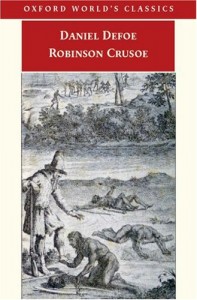
Robinson Crusoe by Daniel Defoe

Posted February 10, 2014 by Michael @ Knowledge Lost in Classic / 0 Comments

Robinson Crusoe by Daniel DefoeTitle: Robinson Crusoe (Goodreads)
Author: Daniel Defoe
Published: Oxford World's Classics, 1719
Pages: 321
Genres: Classic
My Copy: Personal Copy

Buy: AmazonBook DepositoryKindle (or visit your local Indie bookstore)

When Robinson Crusoe gets shipwrecked on an island, everything changes for him. Now stuck on the island of despair, Crusoe has to learn how to survive. Daniel Defoe’s classic survival novel has been the inspiration for many stories to come. Most people know the story so I won’t go into too much detail summarising the book.

Some may disagree but I found that Defoe set out to shatter the misconceptions that Europeans had towards colonialism. When Robinson Crusoe lands on the island he adopts colonialism, as it is familiar to him and the political nature he recognises. You see the progression of this social structure from when Crusoe first found himself on the island. He built his shelter, farmed the lands and hunted. Then when other people were introduced, the social order fell into place, putting himself as lord and master. Others like Friday and his father were slaves, but the Spaniard and the Englishmen were treated completely differently.

Another theme I noticed while reading Robinson Crusoe was the idea of isolation; this was portrayed in a literal sense. Stuck on the island, Crusoe had so much time on his hand he spends it contemplating society, religion, politics and the world. What was interesting to note is the fact that there was no real mention of women in the book; there were some but none played a significant role. This detail is something I spent a lot of time contemplating, it felt like with all his reflections, women never were an important part of the world. I’m not sure what Defoe meant by this but I’m sure it is something worth investigating.

I found Robinson Crusoe fascinating; I was studying it for university so I had to look at what Daniel Defoe was trying to say about colonialism. However there is something that really annoyed me about the book and that is the way the writing style kept changing. It felt like Defoe wasn’t sure how he was writing the novel, switching between diary entries and first person narrative. It didn’t feel intentional just changing whenever it suited him and that, in turn, just felt sloppy.

Robinson Crusoe isn’t a great book; I’m glad I read it but it just isn’t something I can praise. It wasn’t a problem with the themes or the style; it just focused too much on survival and missed opportunities to explore other topics. Sure, this is a classic and you have to give a book credit for staying around so long, but Robinson Crusoe just wasn’t for me.


A Rogue by Any Other Name by Sarah MacLean

Posted February 8, 2014 by Michael @ Knowledge Lost in Historical Fiction, Romance / 10 Comments

A Rogue by Any Other Name by Sarah MacLeanTitle: A Rogue by Any Other Name (Goodreads)
Author: Sarah MacLean
Series: The Rules of Scoundrels #1
Published: Avon, 2012
Pages: 386
Genres: Historical Fiction, Romance
My Copy: Audiobook

Buy: AmazonBook DepositoryKindle (or visit your local Indie bookstore)

After a broken engagement and years of disappointing courtships, Lady Penelope Marbury has all but given up on finding love. That was until she married the Marquess of Bourne, a prince of London’s underworld, a man cast from society into nothingness who is out for revenge. This wasn’t a marriage of love but convenience, Bourne married for the dowry and Penelope to avoid scandal and to ensure her sisters wouldn’t suffer the same fate.

You can guess how the story goes. He wants to keep Penelope away from his world and his underground gambolling house. She is bored, he is a prick. She wants adventure, hot sex and happily ever after. That is how regency romances work, right? Well, it does in this case with Sarah MacLean’s A Rogue by Any Other Name. I feel like I need to go back to my review of Outlander and pretty much cover the same issues again. The whole fantasy verse reality issue; my wife loves Outlander but I know her well enough to know she doesn’t really want someone like Jamie. In reality, if you were in a relationship with Jamie (from Outlander) or Michael Lawler (the Marquess of Bourne) you would be in an abusive one.

People are probably wondering why I decided to read A Rogue by Any Other Name; it wasn’t because it won the RITA Award for Best Historical Romance in 2013 because I don’t care about awards. There are a few reasons. Obviously I needed a romance novel for the Literary Exploration Reading Challenge. I know I could have gone with a literary romance novel but I was curious about Sarah MacLean mainly because she often talks about the intersection of feminism and the romance genre but also because the sex scenes are hot. Why not find out for myself?

Interestingly enough there was a very feminist vibe in this novel along with the whole cliché romance story arc. Penelope is portrayed as a very strong willed woman, willing to stand up to Michael’s stupid behaviour. She was in a situation where she had to think about her family and to avoid the scandals she made the choice to marry. The novel has a lot of other examples of feminism but what I liked about this book was the fact that most of the women were feisty and strong minded; they didn’t let the men control them. At times the men may think they are in control but they had no idea what they had gotten themselves into.

When it came to the sex scenes, yes they were hot and steamy but the fact that MacLean avoided most of those flowery euphemisms was what stood out to me. There were some cringe worthy phrases but as a whole the words seemed fitting. I know sex scenes are an important factor in deciding on which romance novels to read so I will say they were erotic, but there weren’t enough of them. Most of the time Penelope was the lonely wife and Michael didn’t want to corrupt her innocence, even if she was begging to be corrupted. However this is book one in The Rules of Scoundrels series so I’m assuming sex will be a more common thread in the next two books.

I’m not sure what the appeal is with romance novels but I will continue to try them. Personally I’m not that interested in reading more from The Rules of Scoundrels  series but maybe I’ll try book one of her other series, Nine Rules to Break When Romancing a Rake (just because I like the name). Sarah MacLean’s written style is pretty good, the plots are pretty basic but she makes up for that with strong women and steamy sex. There is a black strip along the right hand side of the book cover; does anyone know what that means? If you are a fan of romance then I’m sure Sarah MacLean is someone you should be reading; it is better than the Outlander series.


Mini Reviews: Books about Books

Posted February 6, 2014 by Michael @ Knowledge Lost in Non-Fiction / 0 Comments

I don’t often write mini reviews but I do think they might be handy at times. I like to write a few hundred words on each book for documentation purposes, this is my reading journal after all. Having said that there are two books that I wanted to talk about, I can’t say I’ve ‘read’ them as these are the types of books you keep on your shelf and skim through. Both are a similar theme, my favourite non-fiction theme in fact (books about books) so I thought I would combine them into the one post.

The Novel Cure: An A-Z of Literary Remedies by Ella Berthoud, Susan Elderkin

“Sick? Tired? Lost your job? Take one dose of literature and repeat until better.”

I would like to be known as a Bibliotherapist; it is on my twitter profile so it must be true. I received this book for Christmas from the most amazing person (my wife) and now I finally have the textbook to officially hand out some bibliotherapy. You have a shopping addiction, please go away and read American Psycho by Bret Easton Ellis (that’s what it recommends); I can tell you after that book you’ll not want to be so concerned about what clothing labels are trendy enough to buy and reference in conversation. This is the medical handbook that I can truly get behind and I had a lot of fun looking through it and finding out just how to deal with my parents during Christmas. I loved this book, it was so much fun to flick through. My only problem was the fact that Frankenstein was never prescribed to cure an illness, why can’t it help a god complex, isolation or something like that?

Book Lust: Recommended Reading for Every Mood, Moment, and Reason by Nancy Pearl

“What to read next is every book lover’s greatest dilemma.”

Any real book lover knows that picking the next book is hard, but this is not the book that solves this issue. Book Lust is a collection of different reading lists for different topics, moods and so on. Say you want to know what Russian books to read or want a list of coming of age books. That is all well and good, hats off to Nancy Pearl for able to make a collection of book lists into a book series. The problem I found is book lovers are aware of most of the books mentioned in these lists; they have millions of books they want to read and this book doesn’t really help them at all. Personally I don’t think anyone apart from book lovers will read a book like this so really it feels pointless. There are lists in the book so obscure they start to feel like filler. My major beef with this book was there were no original thoughts, all books seemed like obvious choices and the presentation of each list needed work.  Each topic isn’t a book list and they are not essays of literary criticism either, for me, this just felt sloppy.  I will give credit to Nancy Pearl for being able to turn her love of book lists into a collection of books.


Guest Review: The Flavours of Love by Dorothy Koomson

Posted January 27, 2014 by jus_de_fruit in Crime, Guest Posts, Thriller / 0 Comments

Guest Review: The Flavours of Love by Dorothy KoomsonTitle: The Flavours of Love (Goodreads)
Author: Dorothy Koomson
Published: Quercus, 2013
Pages: 429
Genres: Crime, Thriller
My Copy: Paperback

Buy: AmazonBook Depository (or visit your local Indie bookstore)

I came across this book at the bookshop while looking for Christmas presents for my husband. He was with me at the time and saw my reaction when I read the synopsis on the back. Cooking and murder and secrets! So much that interested me. The Flavours of Love tells the story of Saffron Mackleroy and her family after the murder of her husband 18 months earlier. The killer of her husband has started sending letters to Saffron to make her aware that she is being watched. And on top of all that, she has all the usual family drama to deal with. Her teenage daughter has some very confronting issues to deal with, the younger son is withdrawing from life, her husband’s aunt has been asked to leave her nursing home. This story is more than just about trying to solve a murder; it’s about how to survive life.

Dorothy Koomson’s writing was very compelling. I was mesmerized from the first chapter and at the end of the night, I had to force myself to put the book down to get some sleep, as I knew I wouldn’t ever find a place I would willingly stop. It was so great to get to Friday night and know I could stay up as late as I wanted and power through the last half of the book. It was after 4am when I got to bed, knowing the family was safe again after Joel’s killer had been caught.

This book could have easily just focused on the murder aspect, but it incorporated so many other things. It gave me so much to reflect upon about my own relationships and how I might cope in a similar circumstance but I hope I never have to find out. Losing the love of your life would be devastating, but then you have to send the kids back to school, return to work, keep paying bills. Life goes on and doesn’t slow down when tragedy strikes. And there are all those little things, the little neuroses that your spouse would be able to talk you through, and to suddenly lose that voice of reason and do things you might not have done in the past. So many little things that we take for granted in the normality of our lives.

I loved learning about the love that Saffron and Joel shared with little flashback scenes to their life together, while they were dating and married. There is so much magic in this book amongst all the tragedy and drama that is revealed between the pages. I wasn’t really sure of the genre to class this book as when I started it, but wanted to include it in my Literary Exploration Challenge. I eventually settled on Thriller, because I certainly felt thrilled all the way through it as all the secrets were unraveled.

I don’t think I’d ever heard of Dorothy Koomson before, but she is now firmly planted on my radar and I will be hunting down her other books to read.

This is a guest post by Mary; not only is she my wonderful wife, she is also my editor and helps moderate the Literary Exploration group on Goodreads. Big thanks to her for this post and everything she does to help me with this blog.


Loaded by Christos Tsiolkas

Posted January 25, 2014 by Michael @ Knowledge Lost in Contemporary / 42 Comments

Loaded by Christos TsiolkasTitle: Loaded (Goodreads)
Author: Christos Tsiolkas
Published: Vintage, 1995
Pages: 151
Genres: Contemporary
My Copy: Paperback

Buy: AmazonBook Depository (or visit your local Indie bookstore)

Ari feels very much alone in the world, a Greek immigrant, unemployed and struggling with his sexuality. That is to say he has a same sex attraction but his friends and family would never approve of that. In Christos Tsiolkas’ normally overlooked Loaded we follow Ari through his struggles as an outsider in this autobiographical novel.

Christos Tsiolkas is a critically acclaimed author with books like Barracuda and my personal favourite The Slap. It is a shame that his debut novel Loaded just doesn’t get the attention it deserves. Was this published at the wrong time? I remember the nineties as a time where homosexuality was thought of as disgusting; granted I was still in high school in a small backwards country town but I couldn’t imagine what it would be like for someone that actually was struggling with their sexuality.

What little I know about Tsiolkas, I’ve come to the conclusion that Loaded was a reflection of his own struggles living in Melbourne with a traditional Greek family that expects so much from you. They went through all the effort to move to Australia in the hopes for a better life; the least you can do is make the most of it. Do well in school, get a good job, marry and have kids. What if this isn’t part of your plan? How would your parents react to this news?

I had to read this book for university, right after studying Joseph Conrad’s Heart of Darkness so I’ve naturally made some connections between the two. Marlowe and Ari are very similar in the sense they both are outsiders, though one deals with this during colonial times and the other is a post-colonial take. Without going too much into the parody of Heart of Darkness, because my mind has really made some interesting connections (some are probably a stretch). The different ways the two protagonists (Heart of Darkness and Loaded) are portrayed as loners in a world that doesn’t feel like home were done in interesting ways.

The whole sense of belonging is a huge part in Loaded; even the way Christos Tsiolkas talks about Melbourne is done as a parody. In Tsiolkas’s Melbourne people are divided into different cliques, much like a diverse multi-cultural city, but there is also are separation into the north, south, east and west. This is interesting to see the separation of power, wealth, religion and culture; sure this normally happens in a normal city, each suburb seems to be stereotyped as a good or bad neighbourhood. In Loaded the division is more extreme, highlighting all these groups of people and showing the reader just how much Ari doesn’t fit in anywhere he goes.

Read More