Tag: Classic

If on a Winter’s Night a Traveler by Italo Calvino

Posted October 27, 2013 by Michael @ Knowledge Lost in Classic / 4 Comments

If on a Winter’s Night a Traveler by Italo CalvinoTitle: If on a Winter's Night a Traveler (Goodreads)
Author: Italo Calvino
Translator: William Weaver
Published: Everyman's Library, 1979
Pages: 254
Genres: Classic
My Copy: Library Book

Buy: AmazonBook DepositoryKindle (or visit your local Indie bookstore)

If on a Winter’s Night a Traveler is an experimental classic that follows two protagonists, the Reader and the Other Reader. The Reader buys a fashionable new book that opens with those famous lines “You are about to begin reading Italo Calvino’s new novel, If on a Winter’s Night a Traveler. Relax. Concentrate. Dispel every other thought.” Thirty pages or so into the book he realises his copy is corrupt and consists of the same thing over and over again. Returning to the book store he discovers that what he thought was Calvino was a book by a Polish writer Bazakbal. Given the choice between the two he goes for the Polish book, as does the Other Reader, but his book turns out to be yet another novel by a different writer, as does the next, and the next.

Trying to write a synopsis for this book is tricky, there is no way I can do the novel justice in a paragraph.  This Italian surrealist novel (1979) was translated in 1981 to critical acclaim. The novel is best known for its structure. The odd number chapters are written in second person, but you have to ask yourself is it possible to have a novel in second person. As you read along eventually the narrator “you” does something that will take the reader out of the equation and turning them into a character called You. For instance, in this novel You is male, this will rule out about 50% of the readers in one hit.  This doesn’t take away from the enjoyment of this novel but is something I was deeply aware of throughout this book. There were times where I felt like the novel was in first and third person as well, so you end up with characters called You, I and He/She.

This whole book is subjective, I’m sure some people get different things out of If on a Winter’s Night a Traveler than I did but that is just what makes for a great novel. I want to talk a little about post-structuralism as I believe this novel is a great example of this literary theory. Firstly you need to understand structuralism, which is a theory that states that in order to understand a piece of literature you need to understand its relationship with the bigger picture, the overarching system or structure. You need to look into its influences, the genre, narrative and any other elements that might be relevant. The problem with this is you going further and further back eventually you might lose sight of the original text. Basically this is a set of specific rules that govern literature. Post-structuralism is basically taking those rules (they often study and analyse the rules) then setting out to critique the premises. It isn’t really throwing out the rules, more demonstrating how the rules don’t always apply.

Italo Calvino doesn’t stop at narrative modes and post-structuralism, the novel explores many more literary themes; the most obvious is the use of metafiction; a book within a book. You won’t find Outside the Town of Malbork by Tazio Bazakbal on Goodreads, I’ve checked. Then you have intertextuality, pastiche, post-modernism and so on. If you are interested in exploring literary theories this novel might be a good way to experience a whole range of different concepts in one hit. I don’t know much about literary theory so I hope my understanding on these concepts have come across as accurate and I haven’t missed it completely. I would love to attend a series of lectures where this book is deconstructed and looked at in real detail; I think that would be incredibly interesting.

Don’t worry, this isn’t a dense or hard-to-read book and I’m aware that talking about literary theory might turn people off this novel but please reconsider. This book is not only devilishly clever but it is beautifully executed. I took my time with this novel because I wanted to re-read sections, write done quotes and just talk about the book to anyone that would listen. If I didn’t borrow this from the library I would have highlighted the entire books (seriously, every line is just that great). I have brought my own copy now (yes, I broke my book buying ban) and I hope to be able to re-read this again. I’m not sure if reading this with others will help but the whole experience of reading this novel is worth sharing.

I’ve heard Italo Calvino is heavily influenced by Vladimir Nabokov which makes a lot of sense to me, the writing style does feel similar, even the humour and wit. A literary labyrinth that is so masterfully executed that the novel needs to be read again and again. I won’t go into any more details as there are a few things you just need to experience. I’m jealous of anyone that gets to read this novel for the first time as that is an experience I will never have again.

 I have to wonder why the Vintage classics cover of the word “Traveller” written correctly but throughout the book it is written in the American (wrong) spelling. I have to wonder if there is anything in that. I wonder if there is a reading companion to If on a Winter’s Night a Traveler that you can read alongside this book (similar to Infinite Jest) to discover the brilliance of this novel. I really enjoy Post-Modern literature but there is so much that I’m probably missing.

All book lovers should experience If on a Winter’s Night a Traveler, there is nothing like that feeling of pure joy when you read a beautifully clever novel. You never want it to end, that ecstasy is like a drug and you immediately want to read it again only to find that feeling is just not the same. This is a masterpiece, I know I didn’t talk much about the plot but this was so I don’t give anything away. Go read it.


The Mysteries of Udolpho by Ann Radcliffe

Posted October 4, 2013 by Michael @ Knowledge Lost in Classic, Gothic / 0 Comments

The Mysteries of Udolpho by Ann RadcliffeTitle: The Mysteries of Udolpho (Goodreads)
Author: Ann Radcliffe
Published: Oxford World's Classics, 1794
Pages: 693
Genres: Classic, Gothic
My Copy: Library Book

Buy: AmazonBook DepositoryKindle (or visit your local Indie bookstore)

Emily St. Aubuert was imprisoned by her evil guardian, Signor Montoni. We follow her misadventures from his dark fortress in the Apennines as she suffers physical and psychological terror. The Mysteries of Udolpho is told in a dream-like hallucination that gives the reader a sense of Emily’s psychological state.

Writing a synopsis for this novel was one of the hardest things about this review. There are so many fragments in this book which makes it difficult to summarise what this book is about. Written in four volumes, Ann Radcliffe’s gothic romance manuscript has reported to have been brought for £500 in 1794, I’m not sure if that takes into account the inflation, if not that seems huge I can’t imagine an author receiving that much for a book nowadays.

This classic novel is a quintessential gothic romance but there are fragments of so many other genres with the supernatural, psychological mysteries that fill the pages. I really wanted to enjoy this book but I found it incredible wordy and at the time I was not in the right frame of mind for it, but I will do my best to be fair. The major downfall for me was the extensive descriptions of the landscapes; in particular Pyrenees and Apennines which while stunning just caused the book to drag on.

Emily is orphaned after the death of her father and taken in by her aunty Madame Cheron who married an Italian brigand Count Montoni. As romance between Emily and Valancourt, Montoni became increasingly frustrated and Cheron disapproved, believing him too poor, until she realised his aunt is Madame Clairval. When Count Montoni and Madame Cheron married he refused to allow Emily to married as he figured he could sell her. The major theme I got from this novel was the idea of indifference and the cruelty that can go along with it. Count Montoni is the definition of the gothic villain archetype; evil, sinister, greedy, and motivated by money. Even his marriage to Madame Cheron is for mercenary reasons and tried to force her to sing over her estates.

The novel is not all dark and gothic, I did mention that this was a gothic romance.  Emily’s devotion to Valancourt is unshakeable and his heart seems to belong to her as well. He does make some mistakes and his behaviour eventually causes Emily to renounce him but even after that her thoughts were always towards him. The devotion or loyalty is always fighting against the gothic themes of this novel as you expect from a novel like this. Even the romance between Annette and Ludovico’s is not always happy, especially when he locks her up for her safety. Gothic romance is an unusual genre and you always get a sense that the entire book is fighting to counteract the romance, but then this is the type of book I enjoy.

This is a hard novel to review, there are so many plot lines and if I go off and talk about each of them this post will just go on and on. I know trying to condense the review down to a blog post doesn’t really do the book justice but I tried to focus on the main plot line. While the book felt wordy and dragged on,  this was an interesting book, one I feel needs to be revisited sometime in the future. It would be interesting what I can pull out of the book once I have improved my critical reading skills. Have you read this classic? If so I would love to know your thoughts on it.


The Castle of Otranto by Horace Walpole

Posted September 19, 2013 by Michael @ Knowledge Lost in Classic, Gothic / 0 Comments

The Castle of Otranto by Horace WalpoleTitle: The Castle of Otranto (Goodreads)
Author: Horace Walpole
Published: Penguin, 1764
Genres: Classic, Gothic
My Copy: Audiobook

Buy: AmazonBook DepositoryKindle (or visit your local Indie bookstore)

Conrad, the heir to the house of Otranto, died under mysterious circumstances on the day of his wedding. His father, Manfred, lord of the castle, who feared the end of his dynasty, was determined to marry his son’s betrothed. However as Manfred tries to marry Princess Isabella, she escapes to a church and a number of supernatural events stand in his way. These terrifying omens soon threaten this unlawful union, as the curse placed on Manfred’s ancestor, who usurped the lawful Prince of Otranto, begins to unfold.

The Castle of Otranto established the Gothic as a literary genre and inspired Ann Radcliffe, Bram Stoker, Daphne Du Maurier and Stephen King. The Castle of Otranto has a unique blend of psychological realism, supernatural terror, guilty secrets and unlawful desires but I read this book as a critic on marriage. In 1773 The Marriage Act was passed, an act that is also known as “An Act for the Better Prevention of Clandestine Marriage”. The act was successful in preventing marriages not performed by an Anglican clergyman but also this act didn’t apply to royalty.

This act was passed eleven years before The Castle of Otranto was published and considering the fact that Horace Walpole was the Member of Parliament for Callington (1741–1754), Castle Rising (1754–1757) and King’s Lynn (1757–1768), I get the sense that he would have had strong opinions on the topic. From some quick research on Horace Walpole, I know that he had a strong interest in social and political issues. We can’t overlook his sexuality either, Walpole never married or had relationships with women; some claim he was asexual but I tend to side with the people that claimed he was a homosexual. Some of his closest friends including Anne Seymour Damer and Mary Berry are apparently lesbians as well. This information and the reading of this novel led me to interpret the fact that Walpole was against The Marriage Act.

Let’s look at the novel, Manfred was planning on ending his marriage with Hippolita and marry the much younger Isabella. The introduction of the Marriage Act (despite this book being set sometime between 1000 and 1200) meant that the marriage would have been easier to achieve and Isabella’s fear of Manfred more realistic. Putting aside Isabella’s reluctance to the marriage, there were also the supernatural events (the Church) standing in his way, in which I interpreted as the church still being against clandestine marriage despite it being possible for Manfred. I read the entire book as a metaphor of society and the church standing in the way of a desired marriage. This brings me to an interesting thought; Lord Manfred is considered the antagonist on the novel, portrayed as being deranged but I viewed this as the social view of homosexuality at the time.

There is so much more I can talk about here, like the archetype of Gothic characters (involving heroes and anti-heroes) and the setting (the Castle). While I have talked about Manfred, I want to quickly talk about Isebella and the castle. When Isebella tried to escape she turned into the outsider, a person thrown out of her community; this could also be used as a metaphor for Walpole’s feelings and sexuality. When she escaped she used the underground passages of the castle, which invokes all the characteristics of the Gothic genre; the darkness, obscurity, vastness, and the terror that may arising. Yet the castle and its mysterious characteristic could be a motif for Horace Walpole’s loneliness in the universe.

I won’t go into any more symbols, themes or motifs or this would turn into a really long review. My main interpretation of this novel is clear and I hope I have given you enough to back up my claims. While this isn’t my favourite example of Gothic literature, it was a great read and while short, there is a lot to digest. For all Gothic fans, I recommend checking out The Castle of Otranto; this is an excellent example of the gothic form.


The Third Man by Graham Greene

Posted August 29, 2013 by Michael @ Knowledge Lost in Classic, Thriller / 0 Comments

The Third Man by Graham GreeneTitle: The Third Man (Goodreads)
Author: Graham Greene
Narrator: Martin Jarvis
Published: Penguin, 1943
Pages: 180
Genres: Classic, Thriller
My Copy: Library Book

Buy: AmazonBook Depository (or visit your local Indie bookstore)

American western writer Rollo Martins arrives in Post-World War II Vienna at the request of his childhood friend, Harry Lime. Lime has a job for him but when Martins arrives, he soon finds out that his friend has died. Convinced that Harry Lime’s death was no accident, Martins starts his own investigation, which leads him on a hunt to find the other witness, The Third Man.

If you are a loyal listener of The Readers or follow Simon Savidge’s blog or twitter you may know he recently lost his grandmother. To pay tribute to the memory of Dorothy Savidge he has asked people to read something by Graham Greene, as he was her favourite author. Greene for Gran (or on twitter #GreeneForGran) was born and I took this as an opportunity to try my first Graham Greene book, as well as join in this beautiful memorial to a fellow book lover.

Now The Third Man is an interesting book; it is actually written in preparation to writing the screenplay to what will become a film noir classic. Graham Greene wrote this novella and then converted it into the screenplay. I’m not sure how or why the original novella ended up being published but I suspect that the huge success of the movie may have had something to do with it. So when reading The Third Man you are basically reading the novelisation of the movie; everything is exactly the same.

This is not necessarily a bad thing, the movie was fantastic but then again I’m a fan of Orson Welles (Citizen Kane is the greatest movie of all time) so I might be biased. Who am I kidding, it’s not bias; The Third Man is a classic film noir movie and if you haven’t seen it then you are missing out. It’s hard to review a novella that is exactly the same as the movie, there may not be any point to reading the book if you can watch the movie but I wanted to see how Graham Greene wrote and I think I’m a fan.

What I found fascinating about the novella was the fact that the entire story is told from the perspective of Major Calloway and not the Rollo Martins. Just a quick side note here Rollo Martins name was changed to Holly Martins in the movie just in case you thought I made a mistake there. So I look back at the movie and try to imagine The Third Man from the perspective of Calloway and it just doesn’t seem right, but it works really well for the book. Just another example of what a novel can do that film can’t and gives the novella something unique that you wouldn’t get from the movie.

This only took me about an hour to read (I read slow) and while it is pretty much the exact same thing as the movie, I’m glad I read it. It gave me a sense of Graham Greene’s style and I know what to expect when I try another book (any suggestions). I loved the movie and I think the book is a great companion for fans of The Third Man. Now I want to rewatch the movie, sounds like a good idea right?


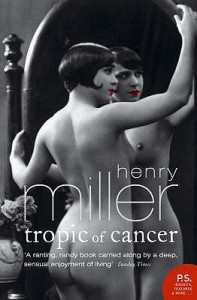
Tropic of Cancer by Henry Miller

Posted August 24, 2013 by Michael @ Knowledge Lost in Classic, Erotica / 0 Comments

Tropic of Cancer by Henry MillerTitle: Tropic of Cancer (Goodreads)
Author: Henry Miller
Published: Harper Collins, 1934
Pages: 336
Genres: Classic, Erotica
My Copy: Library Book

Buy: AmazonBook DepositoryKindle (or visit your local Indie bookstore)

Tropic of Cancer is probably best known for being about sex, a book that was banned for over thirty years. An autobiographical novel of a struggling writer living in Paris in a community of bohemians. A fictionalised account of Miller’s life living underground, with prostitutes, painters and other writers.

This is an odd novel, not necessarily good but a literary landmark. Without Henry Miller we may never have books like Lolita, Naked Lunch, A Sport and a Pastime and even Tampa. On the plus side, we may never have Fifty Shades of Grey. This novel pushed the boundaries of literature in the 1930’s and found itself being banned, which developed a cult following that helped influence the future of literature. I tend to think, much like Lady’s Chatterley’s Lover, if it wasn’t for the banning of the book, this novel wouldn’t be a classic; it would have just faded away into obscurity.

There are some advantages to reading this book, there are the autobiographical elements but then Miller focuses on his friends and colleagues. Almost off topic, like he is commentating on what is happening in their lives. Then it gets a little more complex because there is a stream of consciousness reflecting on the occasional epiphany. The whole narrative gets really confusing with its non-linear approach, the tangents and reflections. It makes the whole book hard to read and in the end not really enjoyable.

I can’t help but compare this novel to The Dud Avocado, the sexual adventures in Paris is similar but Tropic of Cancer wasn’t as interesting and a female lead makes for a less sex obsessed narrative and tends to focus on life abroad as well. I can’t help thinking just how narcissistic Henry Miller must have been with all those autobiographical novels of his life; do people still do that? Or is this just a thing of the past, pushing the boundaries.

I have to give Henry Miller one thing; he doesn’t hold back, he will expose the good, the bad and the disturbing parts of his life. If I ever wrote a book like this (which I have no interest in doing anyway) I would be more inclined to hold back, to paint myself in a more favourable light; Miller doesn’t do that at all. There isn’t much I can say about this book, it’s about sex and that is about it. The stream of consciousness part was interesting but I still find that difficult to read. I would probably tell people to skip this and read The Dud Avocado or something similar but for the book snobs (like myself) if you do read this book I hope you get something out of it apart from the historical significance of a book like Tropic of Cancer.


Top Ten Tuesday: Most Intimidating Books

Posted July 2, 2013 by Michael @ Knowledge Lost in Top Ten Tuesday / 0 Comments

I don’t normally participate in Top Ten Tuesday, which is a book blogger meme that is hosted by The Broke and the Bookish. But due to not having a post planned today and the fact I couldn’t resist the topic today, I thought ‘why not’. I suspect most people are going to go for the big classics that people expect you to read, so I thought I might add some other books too. So in no particular order;

10. Twilight by Stephenie Meyer
Have you seen Liberal Arts? There is a scene where Jesse (Josh Radnor’s character) decided to read an unnamed popular vampire novel (Twilight) just so he can properly see what is wrong with it. I feel like I might have to do the same.

9. The Lord of the Rings by J.R.R. Tolkien
I don’t really enjoy reading Fantasy, so I’m not looking forward to these high fantasy novels.

8. Birdsong by Sebastian Faulks
I watched the miniseries and was so bored, but that could be because Eddie Redmayne has no facial expressions.

7. Jasper Jones by Craig Silvey
I’m expecting that my experience to this book will be similar to that of The Book Thief. Everyone loves it and I’ll think it was overrated.

6. Anything by D.H. Lawrence
After my hatred for Lady Chatterley’s Love I’m too afraid to try this author again.

5. Finnegans Wake by James Joyce
Have you tried to read this one?

4. Catching Fire by Suzanne Collins
I was satisfied with the ending of The Hunger Games, I don’t feel the need to continue except there is a movie coming out.

3. Atlas Shrugged by Ayn Rand
Heavy stuff, but someone’s got to read it.

2. The Pillars of the Earth by Ken Follett
My wife loves this book and I don’t want to end up hating books she loves (see Outlander)

1. In Search of Lost Time (Remembrance of Things Past) by Marcel Proust
Long and unfinished, I’m not sure what to expect from this one.


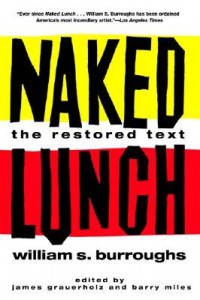
Naked Lunch by William S. Burroughs

Posted June 14, 2013 by Michael @ Knowledge Lost in Classic / 5 Comments

Naked Lunch by William S. BurroughsTitle: Naked Lunch (Goodreads)
Author: William S. Burroughs
Published: Grove Press, 1959
Pages: 289
Genres: Classic
My Copy: Personal Copy

Buy: AmazonBook Depository (or visit your local Indie bookstore)

In a complex and disturbing string of events, William Lee finds himself fleeing from the police. While on the run, this drug addict finds himself journeying across the United States and into Mexico. His travels lead him into the underground world of both drug and homosexual culture. The coun
ter story revolves around the use of mind control by the government and psychiatrists to manipulate and direct the public.

Considered one of the most important novels of the twentieth century, William S. Burroughs’ Naked Lunch is a bizarre cut up narrative protesting the death penalty. You got that the book was trying to do that from the synopsis right? Naked Lunch is a non-linear narrative that does make it really difficult to summarise the plot. Burroughs is famously known for his cut-up narrative; which is a literary technique that can be traced back to the Dadaists in the 1920s. For more information about Burroughs and cut-up check out my post called William S. Burroughs & Surrealist Writing Methods.

The book looks into two key groups; the drug and homosexual subcultures. The two unite early in the novel by the narrator but are never mutually exclusive. At the start of the book William Lee believes he will be punished more harshly for his involvement in homosexual activities than using and selling illegal drugs, which is really sad to think that people are being still victimised over their sexuality and drugs have just become socially acceptable.

Then the subplot largely focuses on the way in which psychotherapy combines with the government to institute mind control. Dr Benway experiments on ways to manipulate the minds of his patients in order to further his research. With no ethical consideration, he often changes his patient’s sexual identity and then tries to cure them. He also creates a mental controlling device for the towns as a way to use the population for his sadistic experiments and put them through psychological torture. Many of these experimental towns are based on the utopian idea and Burroughs like to explore the problems with the idea in a rather sinister way.

So how is this novel a protest to the death penalty? Well that would be in the same way Jonathan Swift’s Modest Proposal ideals with economics. William S. Burroughs uses Juvenalian satire to highlight the barbaric, disgusting and anachronism of capital punishment. While the sex in Naked Lunch can be considered as mutual satisfaction sometimes, it is also used as a metaphor (especially in the more violent sexual acts) for defeating an enemy, self serving idol worshipping and capital punishment. The results of these metaphors are often confusing, shocking, taboo and sickening. Sex is a powerful tool with this novel and while it does look at sex and relationships in a positive way (rarely), the majority is used to symbolise the dark and cynical themes within the book.

William Lee is obviously William S. Burroughs alter ego and the book can be read as a semi-autobiographical novel through a serious drug addiction but like Infinite Jest there is so much more going on. This book did remind me a lot of Infinite Jest; not just with how it dealt with drug addiction but the way it used very dark themes to look at other social issues. William S. Burroughs had a similar experience to the narrator, taking trips around the world in order to avoid being arrested. Even the addition and sexual experimentation is similar to the authors own experiences, as part of his attempts to separate himself from mainstream culture. William S. Burroughs is a fascinating man and I’m interested to learn/blog more about him.

I’m not sure what the difference between the original and restored text but I did read the restored edition. While this was a really weird and somewhat difficult book to get though there is so many interesting themes to explore that I feel very satisfied by completing this novel. It is disturbing and some of it will make you feel sick to your stomach and I can understand why people hate this book. This is a really intense novel that will drain you emotionally and mentally. The book is full of violent and graphic sex, so it will never be for everyone but I can see why it is an important novel, not just because of the obscenity trial but also for all the themes.

I’ve not read many Beat novels in my life, I think On the Road was the only other one but I do like the gritty and surreal approach both books take. I’m not sure if this is a major theme for all beat novels but if so, I will have to read more. I doubt I’ll ever return to Naked Lunch simply because of how disturbing some of the scenes are but I know I can be completely satisfied with having read this one and judging by this review, I can also take comfort in the fact I was able to pick it apart and understand some of the themes.


ArmchairBEA 2013: Introduction & Classics

Posted May 28, 2013 by Michael @ Knowledge Lost in ArmchairBEA / 54 Comments

armchairBEAIt’s here again for another year; while most book bloggers or book lovers in America get to spend the next week at BEA, we sit here being green with envy and wishing we were there. BEA is the Book Expo of America, held in New York, where all the bibliophiles of America get to be enticed with new books from publishers. While us poor Australian book bloggers don’t have this kind of opportunity we can still participate with Armchair BEA. This is a virtual conference for people that can’t make it to BEA. Over the next few days I will be joining in with this event and their daily blog post topic suggestions.

I participated in Armchair BEA last year and found it to be a great success for finding great book blogs and for my little blog which was only just starting out. Now I’m older (maybe wiser), I hope this will be another successful event for both me and my blog. Day one is a general introduction, like last year we are given a choice of some questions to answer as a way to introduce ourselves and our blogs. Also today’s genre discussion will revolve around classic literature which I will talk on quickly after the questions.

  • Please tell us a little bit about yourself: Who are you? How long have you been blogging? Why did you get into blogging?

I think I answered this question last year as well but I wanted to answer it again for any new readers and because I think I have had an interesting reading journey. My name is Michael and before 2009 I wasn’t a reader but then suddenly something clicked and I started becoming obsessed with books. I started this blog a little over a year ago as a way to document my literary explorations and talk about my new addiction.

  • Which is your favourite post that you have written that you want everyone to read?

I think this would be My Experience with the 1001 Books You Must Read Before You Die List, the reason I love this post so much is because it serves as a good introduction to me as a reader and blogger. I talk about starting out as a reader and my hunger to discover great literature and also talks about my long term goal of reading the entire list.

  • What literary location would you most like to visit? Why?

I would love to visit the Cemetery of Forgotten Books and adopt a book just like Daniel Sempere did, and if you tell me this place doesn’t exist you are only shattering my dreams. In all seriousness there are many places I would love to visit but I think I would have to say Lake Geneva, the birth place of my favourite novel of all time. If I had a choice, it would be during that dark and stormy night in 1816; those romantics are nuts but they are also really interesting people.

  • What is your favourite part about the book blogging community?

I just love the community behind book blogging, I follow some great book bloggers and I hope to discover some more during Armchair BEA. I love reading new reviews and chatting to other bookish people via twitter and comments, it’s just the highlight of blogging. But there is a huge negative that comes with the book blogger community  and that is the way my TBR suffers, I think it grows faster than I can read, I have no idea how I’m ever going to catch up and get it under control.

  • Is there anything that you would like to see change in the coming years?

I’d love to see more male book bloggers; it’s hard to find them. I’m not sure if it reflects on the amount of male readers out there; I hope not but I would love to know there are more men out there that share a passion for literature. I’d also like to more bookish opinion posts rather than just book reviews and interviews; there are a lot of things we can talk about on our blogs and I think we fall into the trap of just writing reviews. I know I fall into this trap.

Now that I’ve answered these questions, it’s time to move on to talking about classic literature. As part of the 1001 Books You Must Read Before You Die list I will be reading a lot of books that are considered western cannon and I’m looking forward to them most of all.  There are so many books out there I want to read and I feel like I’m still playing catch up with all the ‘must read’ novels. For people starting out with classics I would recommend picking which ever one looks the most interesting. There are classics in all genres and if you love Science Fiction maybe try Philip K Dick or Isaac Asimov, Fantasy try J.R.R. Tolkien or even mysteries I recommend Raymond Chandler or James M Cain.

It’s hard to recommend books to non classic readers, you just have to take your own reading journey and try books that interest you. I’m sure once you experience the joys of reading classics you will want recommendations and I recommend joining something like The Classics Club to challenge yourself to more classics. I don’t want to say too much about classics, I want to take to the conversation to the comments but I’d like to ask some questions of the readers to help the conversation along;

  • What is your favourite classic?
  • Which classic would you like to read but are dreading?
  • Are there any classics that you were presently surprised by?
  • Finally are there classics that just seem too hard and why?

ArmchairBEA is a virtual convention for book blogger who can’t attend Book Expo America and the Book Blogger Convention. Banner by Nina of Nina Reads and button by Sarah of Puss Reboots


Mrs Dalloway by Virginia Woolf

Posted May 21, 2013 by Michael @ Knowledge Lost in Classic / 0 Comments

Mrs Dalloway by Virginia WoolfTitle: Mrs Dalloway (Goodreads)
Author: Virginia Woolf
Published: Oxford World's Classics, 1925
Pages: 185
Genres: Classic
My Copy: Personal Copy

Buy: AmazonBook Depository (or visit your local Indie bookstore)

Clarissa Dalloway goes around London preparing to host a party that evening. It’s a nice day and she finds herself being reminded of her youth in the Bourton and wondering about her life and her choice of husband; marrying the reliable Richard Dalloway instead of the mysterious and challenging Peter Walsh, as she never had the option to be with Sally Seton. These conflicts have been reintroduced when Peter pays her a visit.

The novel begins with Clarissa’s point of view and follows her perspective closely, travelling forwards and back in time and in and out of her mind to construct an image of her life. Clarissa is bubbly and lively, caring a great deal about what people think of her, but she is also self-reflective. She is often questioning life and constantly wondering whether happiness is truly possible. Though she is happy with her marriage to Richard she feels both great joy and dread towards her life and struggles to strike a balance between her desire for privacy and her need to connect with others.

Her husband Richard Dalloway is a member of the conservative government and plans to write a history of The Brutons, a great military family. He is a loving husband and father and devoted to social reform while appreciating English tradition. Peter Walsh is a close friend of Clarissa, once desperately in love with her. When she rejected his proposal, he moved to India; though frequently having romantic problems with women throughout the novel he is currently in love with a married woman in India. A socialist and highly critical of people, he is conflicted about everything in his life. Then there is Sally Sutton, a close friend of Clarissa in their youth, she was a wild handsome woman who would say anything. They were sexually attracted to each other as teenagers. Sally now lives in Manchester where she is married and is known as Lady Rosseter.

This is primarily a novel about life and relationships, with Clarissa reflecting on her life and wondering if she has made the right choices when it comes to marriage. There are so other themes that play a big part within this novel as well; some of these include disillusionment towards the British Empire, fear of death, oppression and balancing life between the need to keep up appearances and having some privacy. I won’t go into these themes in any detail, for the simple reason that I feel that Virginia Woolf leaves it very open to interpretation and it is up to the individual reader to make of it what they will.

For me, the major theme that came out was the struggle Clarissa had with trying to play the good hostess by drawing people together through her parties and her introverted nature. I saw Clarissa as an introvert, though she has a bubbly personality, she is often feels shrouded within her own reflective soul and thinks the ultimate human mystery is how she can exist in one room. She likes the idea of being independent and able to spend time to reflect but she is also aware of the inevitable loneliness that comes with a life of self reflection. If you understood something completely different from this novel, please let me know how you read this book in the comments below.

Now that I’ve looked at the themes of this novel, I want to have a quick look at some of the motifs and symbols used in Mrs Dalloway. The most important of them is time, which is so important to the structure, themes and characters of this novel that Virginia Woolf almost called it The Hours. Time keeps order to this novel; with all the thoughts, memories, and encounters within Mrs Dalloway, it becomes a vital element to the book. Also the old woman in the window across from house symbolises the life Clarissa desires; a private life with time to reflect. You also have things like the flowers with all their colour, varieties and beauty being a motif for emotions, Shakespeare and poetry representing these emotions as well and water suggesting the possibility of death.

Virginia Woolf can be a difficult author to read and requires a lot of thought but as I’ve now discovered with Mrs Dalloway, it is worth the effort. I remember reading To the Lighthouse and really struggling, but when I was told it was about sex, I thought I really missed the point. It’s a novel I plan to revisit again but as I mentioned in this review, I think Woolf writes her novels in such a way that you can interpret it anyway you want.

I don’t know if I would call myself a Virginia Woolf fan now, but I was really impressed reading and studying Mrs Dalloway. I will admit that that I’m planning to read A Room of One’s Own and reread To the Lighthouse. Maybe after that I might call myself a fan but I would recommend reading Virginia Woolf for all serious literature readers and studiers and anyone that needs to increase their pretentious levels. For me, Mrs Dalloway was both an interesting book and an interesting endeavour into improving my critical reading skills.


Invitation to a Beheading by Vladimir Nabokov

Posted May 19, 2013 by Michael @ Knowledge Lost in Classic / 0 Comments

Invitation to a Beheading by Vladimir NabokovTitle: Invitation to a Beheading (Goodreads)
Author: Vladimir Nabokov
Published: Vintage, 1936
Pages: 240
Genres: Classic
My Copy: Personal Copy

Buy: AmazonBook Depository (or visit your local Indie bookstore)

In this bizarre and irrational world, Cincinnatus has been convicted and condemned to death by beheading for gnostical turpitude, an imaginary crime with no definition.  Cincinnatus spends his remaining days in prison where he is visited by the chimerical jailers, an executioner who masquerades as a prisoner, and his in-laws. When Cincinnatus is finally brought out to be executed, he simply wills his executioners out of existence: they disappear, along with the whole world they inhabit.

There is no denying that Invitation to a Beheading is a weird novel; often compared with Franz Kafka’s The Castle, it is important to know that Vladimir Nabokov had not read any German novels, let alone Kafka when writing this. The reason this is important is to avoid trying to compare the two novels; sure they have similarities but they are still also vastly different. Originally published as a serial, with the title Sovremennye Zapiski (Contemporary Notes), Nabokov has stated while Lolita holds his greatest affection, this novel holds his greatest esteem.

While people call this Kafkaesque, the impossible and dreamlike world reminds me more of Haruki Murakami’s style. From the very start the reader understands there is something not right about this world, this reminded me of Hard-Boiled Wonderland and the End of the World. I got the feeling that this wasn’t reality but a world constructed in Cincinnatus’ mind based on his fears, doubts, and insecurities. Cincinnatus’ enemy is the society he’s created and the people of that society act according to ridiculous rules that have been set. We never know what gnostical turpitude is and this will probably remind people of Kafka’s The Trial. Cincinnatus is rebelling against the construction of this reality and the rules the people of this society observe and perhaps this is what makes him a criminal.

Maybe gnostical turpitude is the crime of being different from all the other people in this reality. Maybe Cincinnatus is being oppress for his ideas and his nature. Maybe he is so different from everyone around him; he has an internal depth that the others lack. A lot like Lolita, Vladimir Nabokov has a way about his writing that just leaves you with so many questions that you need to think through, this whole reality and society leaves me perplexed. Though this is the point; life isn’t simple and being an outsider sometimes feels like you are Cincinnatus in a bizarre reality.

While this book primarily looks at society and oppression it also looks at human connection. Cincinnatus desires to connect with his wife Marthe, despite her unfaithfulness and lack of concern for him. The one thing he craves the most is to make a connection and she felt like the logical choice; also the fact that he loved her helped. He begs her to come alone and reveal her true self to him but there is always something that interferes with the communicating.

While this was a very odd book, Vladimir Nabokov is just a brilliant writer and that really makes up for the weirdness. Also the weird and bizarre act as motifs within the narrative and without the symbolism and meaning it would just be trippy book. Nabokov does a good job of weaving his messages and ideas while entertaining the reader in unexpected ways. Most people only ever read  Lolita by Vladimir Nabokov and I think that means they miss out on his brilliance, I hope to read more; currently on my To Be Read list is Mary, Pnin and Pale Fire. Are there any others I should add?