Tag: Translated Fiction

In the Miso Soup by Ryū Murakami

Posted October 4, 2015 by Michael @ Knowledge Lost in Horror / 2 Comments

In the Miso Soup by Ryū MurakamiTitle: In the Miso Soup (Goodreads)
Author: Ryū Murakami
Translator: Ralph McCarthy
Published: Kodansha International, 1997
Pages: 180
Genres: Horror
My Copy: Library Book

Buy: AmazonBook Depository (or visit your local Indie bookstore)

Kenji is a tour guide of the night, normally taking Americans to the sex clubs within Tokyo. Frank, an overweight business man that appears to have only one thing on his mind wishes to take advantage of Kenji’s knowledge of the sex industry, hires him to guide him for three days. However Frank’s strange behaviour begins to make Kenji suspicious and he quickly suspects that his client is in fact the serial killer currently terrorising Tokyo. In the Miso Soup is a fast paced, philosophical piece of translated fiction by the Murakami that does not often get talked about, Ryū Murakami.

Translated by Ralph McCarthy, this Japanese novel is a short punchy novel that really explores culture clash in a really interesting way. The attitudes towards sex between the Japanese and Americans are what really stands out to me while reading In the Miso Soup. The whole novel plays around with the cultural differences in an interesting way, exploring attitudes, personalities and even philosophical views. I enjoyed Ryū Murakami’s approach to these themes within In the Miso Soup, I think it was a unique take on East meets West, and I do not think I have seen the approach before.

One thing I like about Japanese fiction is the writing style, it is almost like a slow burn but novels like this still manage to build tension. I have read a few Japanese novels that explore really dark themes in this way; Revenge by Yōko Ogawa comes to mind. Be aware when reading In the Miso Soup, Ryū Murakami does not hold back and it can get descriptive in its depictions of sex and violence.

I really enjoyed reading Ryū Murakami’s In the Miso Soup and am eager to read more of his novels; in particular Coin Locker Babies and Audition. I am fascinated by the philosophical and psychological look into the darker side of humanity that seems to be a common theme within Japanese literature. Other novelists I am interested in checking out include Natsuo Kirino, Banana Yoshimoto and Kenzaburō Ōe. This does not include the authors I have already read, like Haruki Murakami, Yōko Ogawa and now Ryū Murakami. In the Miso Soup is a short novel but it packs a huge punch, not for the faint hearted but well worth reading. I have also done a video review of this book, if you are interested in checking that out.
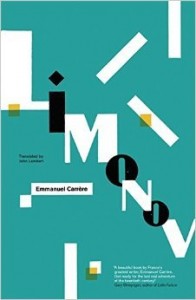

Limonov by Emmanuel Carrère

Posted September 26, 2015 by Michael @ Knowledge Lost in Non-Fiction / 3 Comments

Limonov by Emmanuel CarrèreTitle: Limonov (Goodreads)
Author: Emmanuel Carrère
Translator: John Lambert
Published: Allen Lane, 2011
Pages: 340
Genres: Non-Fiction
My Copy: Library Book

Buy: AmazonBook DepositoryKindle (or visit your local Indie bookstore)

Eduard Limonov1 is a Russian born writer and politican. Best known for founding and leading the banned National Bolshevik Party which opposed Vladimir Putin from 1994 till 2007. The National Bolshevik Party2 (Natsbols) was a militant type organisation that defended Stalinism, it was never register as an official political party. Nowadays Eduard Limonov is a member of the umbrella coalition known as The Other Russia3 which oppose the leadership of Putin for a variety of reasons from political to human rights issues. The Other Russia has a mixed group of supporters from liberals, nationalists, socialists and communists all working together to achieve a Russia without Vladimir Putin leading it.

Firstly I would like to point out that the subtitle for Limonov by Emmanuel Carrère is ‘a novel’ and there can be debates around if this should be considered a biography or a novel. Eduard Limonov’s life reads very much like a novel and this could be in part because Emmanuel Carrère is an excellent writer and John Lambert translated it into English wonderfully. I do not know enough about Limonov to be able to disagree with categorising of this as a novel but I do think all good biographies have elements of fiction to make them more readable.

Having said that the life of Eduard Limonov is a fascinating read; some consider him a terrorist, others a political leader, and there is no denying that. The beauty of Limonov is the way Emmanuel Carrère has captured this complex character in a way that shows all sides of the man while avoiding a biased portrayal. There is a lot worth talking about when it comes to Eduard Limonov but I do not want to go too much into his life story; there just is not enough time.

I am fascinated by the history of Russia, especially when it comes to the Soviet and post-Soviet eras. I love the way Emmanuel Carrère has captured the life of Eduard Limonov, a political figure that I knew nothing about. I am tempted to try some of Limonov’s own books, in particular It’s Me, Eddie: A Fictional Memoir and Memoir of a Russian Punk. Has anyone read anything by Eduard Limonov and is he worth reading? With his life experiences, I am interested to see just how he portrays himself in his books and explore more of his life story.


Belle de jour by Joseph Kessel

Posted September 4, 2015 by Michael @ Knowledge Lost in Erotica / 0 Comments

Belle de jour by Joseph KesselTitle: Belle de Jour (Goodreads)
Author: Joseph Kessel
Translator: Geoffrey Atheling Wagner
Published: Overlook Books, 1928
Pages: 188
My Copy: eBook

Buy: AmazonBook DepositoryKindle (or visit your local Indie bookstore)

Belle de Jour is the story of Séverine Sérizy, a beautiful young housewife married to a successful doctor. Her life is pretty great, except she feels like she cannot fulfil her sexual affinity for masochistic desires with her husband. She gets a job as a prostitute under the pseudonym Belle de Jour, only working from two to five each week day, so she can return before her husband gets home. Her job gets her involved with a young gangster named Marcel who allows her to explore all her sexual fantasies. However this relationship of thrills becomes far too much and life gets complicated for Séverine.

Most people will know the story of Belle de Jour as it also a classic piece of French cinema from 1967. Directed by Luis Buñuel and staring Catherine Deneuve, the film explores the exact same story in a richer and interesting way. Buñuel is a Spanish director who has worked on movies in Spain, Mexico and France; he is also acclaimed for his avant-garde surrealist style. I was blown away by this movie and I only saw the movie recently. The concepts of the movie kept swimming through my mind that I needed to read the book to find out more.

What I have found is that the story in the novel is very similar but the surrealist nature of the movie was not there. I did however gain a few insights into the life of Séverine Sérizy that I never picked up on. There is some interesting observations to be made between the connection in literature and fetish, especially with sexual sadism and sexual abuse. This has been a common problem found in books like Fifty Shades of Grey and other novels that deal with BDSM. It is a little sad to think this trope steams all the way to 1928 and maybe further. I think French erotica is really interesting and it is weird to think this was written so long ago.

If you have seen the movie Belle de Jour, then reading the book is not really beneficial. Joseph Kessel does not offer anything interesting and I think everything that made the movie great was all original content from the mind of Luis Buñuel. I plan to re-watch the film sometime so I can write a review of it. As for French erotica, I plan to read more and I am not sure what to read.  I think might have to read The Story of O, but I am open to more suggestions.


Let the Right One In by John Ajvide Lindqvist

Posted August 23, 2015 by Michael @ Knowledge Lost in Horror / 10 Comments

Let the Right One In by John Ajvide LindqvistTitle: Let the Right One In (Goodreads)
Author: John Ajvide Lindqvist
Translator: Ebba Segerberg
Published: Quercus, 2009
Pages: 519
Genres: Horror
My Copy: eBook

Buy: AmazonBook DepositoryKindle (or visit your local Indie bookstore)

Twelve-year-old boy, Oskar is having a hard time with life. While he has a loving mother, his alcoholic father is very absent in his life. At school, Oskar is the constantly being bullied. One day he meets Eli, and a friendship is formed between the two. However Eli is not a normal girl and it is quickly revealed that she is in fact a vampire. Let the Right One In by Swedish writer John Ajvide Lindqvist is a horror novel unlike any other that I have read before.

While Let the Right One In is a gothic horror that explores the unusual relationship between a 12-year-old boy and a vampire, for me this novel was something completely different. I found this to be a book that explores the darker side of humanity; looking at issue of alcoholism, divorce, bullying, abuse, self-mutilation, murder and paedophilia. Think of it more of an existential look at life and the horrors of the world around us.

I do not want to go into too much detail about what to expect when reading this novel. I just enjoyed the way it looked at the way we handle the horrors of the world from the view point of a struggling boy trying to cope with his situation. The relationship between Oskar and Eli is complicated, and unusual. This allows John Ajvide Lindqvist to explore so many interesting issues and push the reader to contemplate more of the world around them.

Most people would be familiar with the plot of this novel by the movie adaptation done in 2008, which was then horribly remade again by Hollywood in 2010 under the name Let Me In. I saw the Swedish version many years ago and felt it to be a brilliant movie but I have not re-watched it since reading the novel. I did however watch the American addition and it made me very angry. I feel like Hollywood is too afraid to deal with the dark side of humanity if it involves a twelve year old boy. Also America has a terrible habit of trying to remake movies that are already brilliant, I understand some people do not want to read subtitles but they do it to movies that are already in English as well. Soon there will also be a TV show based on this novel, which is set to air on A&E later this year.

I am so glad to have read Let the Right One In; I had a great time exploring the world. This is an extremely dark novel and this will not be everyone. I am curious to see what the TV show will be like but I will not be holding my breath. If you are willing to explore the dark side of humanity you will find Let the Right One In to be a compelling and thought provoking novel.


Wolf Totem by Jiang Rong

Posted May 30, 2015 by Michael @ Knowledge Lost in Book of the Month, Historical Fiction / 0 Comments

Wolf Totem by Jiang RongTitle: Wolf Totem (Goodreads)
Author: Jiang Rong
Translator: Howard Goldblatt
Published: Viking, 2004
Pages: 527
Genres: Historical Fiction
My Copy: Library Book

Buy: AmazonBook Depository (or visit your local Indie bookstore)

Wolf Totem is the story of a Chen Zhen, a young Beijing student who is sent to the countryside of Inner Mongolia in 1967. He lived with the nomadic Mongols, who are a proud, brave, and ancient race of people, exploring the harmony, beauty and also cruelness of nature. As well as learning the philosophy the Mongols have towards nature and their attitudes towards the wolf; who keep the ecological balance.

This is a semi-autobiographical novel that follows an experience that the author, Lü Jiamin (writing under the pseudonym Jiang Rong) had during the height of China’s culture revolution. This revolution was a social-political movement that took place within the People’s Republic of China between 1966 and 1976. The communist chairman Mao Zedong’s goals were to preserve the true communist ideals within China. This meant the purging of capitalism and even traditional culture.

In the height of this purge, the protagonist is exploring the folk traditions, rituals, and life on the Steppe, looking into the culture and traditions of the ethnic Mongolian nomads and the Han Chinese farmers. These traditions were at risk of being purged under Chairman Mao’s rule, allowing the author to talk about the importance of keeping ancient traditions alive.

Also within Wolf Totem there is a whole obsession Chen Zhen has with wolves. They are seen to keep nature in balance. He fears and respects the wolves but he also questions their role in nature. A connection could be made between the wolves and the Communist party but that is up to the reader to decide.

I found this book to drag on a bit too much; there is a lot of information about wolves and agriculture that seemed to just go on and on. However, Wolf Totem explored some unfamiliar cultures to me and gave me great insight into one man’s opinions about the culture revolution. I think I would have enjoyed the book a lot more if it did not drag on so much; could have purged at least a hundred pages. Having said that, I am glad I read it and I think it is worth exploring different points of view.


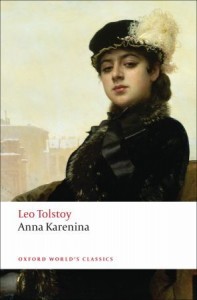
Anna Karenina by Leo Tolstoy

Posted May 28, 2015 by Michael @ Knowledge Lost in Classic, Russian Lit Project / 0 Comments

Anna Karenina by Leo TolstoyTitle: Anna Karenina (Goodreads)
Author: Leo Tolstoy
Translator: Aylmer Maude, Louise Maude
Published: Oxford World's Classics, 1873
Pages: 831
Genres: Classic
My Copy: Personal Copy

Buy: AmazonBook DepositoryKindle (or visit your local Indie bookstore)

Anna Karenina is the tragic story of the socialite’s marriage to Karenin and her affair with the wealthy Count Vronsky. The novel begins in the midst of their families break up due to her brother’s constant womanising; a situation that preferences her own situation throughout the novel. Running in parallel to this story of Konstantin Levin, a humble country landowner that wishes to marry Kitty, who is Anna’s sister in-law. Anna Karenina is a pinnacle piece of realist literature, exploring a wide range of family issues.

At over 800 pages, Anna Karenina can be a daunting novel to pick up; the large cast of characters does not make it any easier. I look at this classic novel as an exploration into melodrama that just about every family experiences. Born in 1828, Lev (Leo) Nikolaevich Tolstoy was born into a large and wealthy Russian landowning family, and has often been suggested that Anna Karenina is based on a similar social upbringing. While there are vast differences, issues with wealth, religion, farming and morality are issues that seem to parallel between reality and fiction. The story arch of Levin is considered to be autobiographical; Tolstoy’s first name is Lev (although in English he is known as Leo) and the Russian surname Levin actually means Lev.

Leo Tolstoy has been known for adding real life events into his fiction as a way with dealing with current political and social issues. Within Anna Karenina, events like the liberal reforms initiated by Emperor Alexander II of Russia and the judicial reform are used as the backdrop for the novel. This allows him to explore current issues, like the developing of Russian into the industrial age and the role of agriculture in these changing times. Also Tolstoy questions the role of the woman in this changing society and (the ever popular in Russian lit) class struggles.

The story of Anna Karenina is probably the most interesting for me and I enjoyed reading the struggle between love and the public opinion. She was trapped in a marriage and wanted to divorce but Karenin, who was a politician cared more about his public image. Then there is the fact that Anna’s brothers womanising destroyed the family and now she is faced with a similar situation that could cause the same damage. Adultery becomes a big theme within the book and seems to be a common theme within Russian literature to this day. However with Nathaniel Hawthorne’s The Scarlet Letter (1850) and Gustave Flaubert’s Madame Bovary (1857), these three novels seemed to start a fascination in exploring the themes of passion and adultery in the mid to late nineteenth century.

There is a lot to explore within this book, and re-reading Anna Karenina was such an enjoyable experience. I know big books often scare me but there is something about going back to a much-loved novel that I find enjoyable. Leo Tolstoy intentionally made this novel long, he wanted to replicate life’s journey and the struggles people face along the way. I think he was able to capture that struggle and Anna Karenina will remain a favourite on my shelves and in Russian literature. There are so many more themes that could be explored within the novel but I will leave that for others to discover on their own.


Colorless Tsukuru Tazaki and His Years of Pilgrimage by Haruki Murakami

Posted November 13, 2014 by Michael @ Knowledge Lost in Contemporary / 13 Comments

Colorless Tsukuru Tazaki and His Years of Pilgrimage by Haruki MurakamiTitle: Colorless Tsukuru Tazaki and His Years of Pilgrimage (Goodreads)
Author: Haruki Murakami
Translator: Philip Gabriel
Published: Harvill Secker, 2014
Pages: 298
Genres: Contemporary
My Copy: Hardcover

Buy: AmazonBook DepositoryKindle (or visit your local Indie bookstore)

Tsukuru Tazaki was lucky enough to have four close friends in high school. They were a tight knit group and they all shared their hopes and dreams with each other. When it came to college Tsukuru went off to Tokyo to pursue his dream career while the others remained in Nagoya at various schools. They vowed to remain close and Tsukuru made an effort to visit as much as possible. That was until one day Tsukuru was told that the other four wanted nothing to do with him anymore.

I am not going to go too much into the plot; I think this is something that needs to be discovered within the book. However I do need to talk a little about it. Tsukuru Tazaki had always felt like an outsider, even though he was accepted into the group for a while. He was always colourless in a group of colours; Akamatsu (which means red pine), Oumi (blue sea), Shirane (white root), and Kurono (black field), while his name means ‘to build’. Essentially this is a novel about friendship, rejection, isolation and the psychological scars that can be caused by others who never took that into account. There is a whole other side that can be explored but that would involve spoilers.

I had a rocky start with Haruki Murakami; the first book I read was 1Q84 and lets face it, this is the worst place to begin. I was exposed to the world of Murakami with the awkward fetishes and magical realism but 1Q84 was ultimately a little clunky and way too big. Luckily I am a bit of a hipster and picked up What I Talk About When I Talk About Running and while I’m not a runner, I found it to be an interesting read. It wasn’t till I read Hard-Boiled Wonderland and the End of the World that I truly understood his brilliance. I still have a lot more to read but Colorless Tsukuru Tazaki and His Years of Pilgrimage was a perfect next choice.

I have often heard people recommending beginning with Norwegian Wood because it is rooted in realism and I would like to think Colorless Tsukuru Tazaki and His Years of Pilgrimage would work as well. I obviously haven’t read Norwegian Wood yet but the idea of beginning with some of his realistic novels before getting into the magical realism and exploring the weirdness of Murakami’s brain is probably a good idea. His style is a little unusual but once you get an understanding of how his mind works you should be readying do dive into something fantastical.

What I have found reading Haruki Murakami is that he has a strong interest in both the conscious and the subconscious. His books explore the complexities of the mind and how different situations have a psychological impact on a person. This is a really interesting theme and one that I am particularly interested in; if I knew that a long time ago, I am sure I would have been more willing to explore his works.  Even What I Talk About When I Talk About Running explored this theme and it was a memoir.

I do wish I didn’t begin with 1Q84 but after a few other books, I finally can say that Haruki Murakami has another fan. I am keen to read all his other books; both fiction and non-fiction. There is something enthralling about the way a mind works and I really like the way that Murakami explores that. While Colorless Tsukuru Tazaki and His Years of Pilgrimage was far from perfect, there are some weird and awkward moments in the writing that I believe is synonymous with his writing style but I found this a captivating read. I have reserved Norwegian Wood at the library and I am hoping to read that one very soon.


Beowulf by Anonymous

Posted October 19, 2014 by Michael @ Knowledge Lost in Classic / 0 Comments

Beowulf by AnonymousTitle: Beowulf (Goodreads)
Author: Anonymous
Translator: Michael Alexander
Published: Penguin, 800
Pages: 137
Genres: Classic
My Copy: Paperback

Buy: AmazonBook DepositoryKindle (or visit your local Indie bookstore)

Beowulf is one of the oldest, complete surviving epic poems in existent. There are a few others from the same era that have survived in fragments, so the significance of Beowulf remains in regards to English literature. Written in Old English (or Anglo-Saxon) the manuscript of Beowulf is believed to date back to the 10th century (1,000AD). This is an example of a heroic poem, which can be defined as a text that deals with heroic actions in battle. Beowulf focuses on three great battles, with Grendel, Grendel’s Mother, and a Dragon.

While this is an English poem it is interesting to note that it is not set in England but southern Scandinavia, half in Denmark and the other in Geatland (or Götaland) which is one of three lands of Sweden. Beowulf does incorporate a large amount of Norse and Germanic history and legends, however I don’t have the knowledge to pick up on this within the text, just information I learnt after the reading. I suspect that this information was added into the poem to help pass on the information to Anglo-Saxon people, like a history lesson or as the poet calls it “the treasured repertory” (line 871). It is believed that Beowulf was composed in a time of stability, in a time of some democracy; an early medieval Christian civilisation. One might say this was an age where art and literature were flourishing and often used as methods of education.

Beowulf was no exception. What I got out of this poem was a reflection of the cultural and, to a lesser extent, political views of the time; a civilisation that values courtesy and formality. Chivalry, generosity and thoughtfulness are valued but still have a strong sense of precariousness, ready of imminent attack and war. Strength is still considered important; Beowulf is a warrior willing to fight against enemies both human and demonic. He even travelled to another country to fight a demonic menace. However you have to look to the other warriors as well, who appear as strong and capable as Beowulf but without their faith are rendered useless.

The role of the poet (or bard) is actually depicted in the poem itself several times. The poet is “…a fellow of the king’s” (line 868) which suggests that he is of a high rank. One who knows old and traditional stories, “Whose head was a storehouse of the storied verse, whose tongue gave gold to the language” (line 870). This allows the poem to have a unique perspective on the events that unfolds within Beowulf, a tactic that doesn’t always get explained within modern literature.

It is said that you can interpret this poem as having both Christian and pagan themes; however for me this had a very strong religious message. A battle of good and evil but I suspect this wasn’t a conflict of morality but an inevitable clash between the two. In a Christian context, Beowulf could be compared to Jesus, coming to save our souls from evil. You can even compare it to the story of Cain and Abel which is referenced within the text of Beowulf.

Given that Beowulf is meant to be experienced a spoken word I found myself struggling to read this as a written text. I had a look for the Michael Alexander translation (which was assigned to me for my university course) but was unsuccessful. However I did try to think about the text as if it was a story been spoken and I found it difficult. For me the narrative felt too slow, it lacked suspense and felt a little awkward (possibly the translation). The obscure historical allusions may not have been an issue back in the 800AD but it was for a modern reading.

I was nervous about reading Odyssey by but ended up loving it; I was hoping I would have a similar experience here. I suspected that Beowulf will remain a difficult text. There is some historical context that would be helpful before going into the poem that I just didn’t get. Reading the epic poem as part of a university course did help but for me it wasn’t enough. Medieval literature will remain difficult for me and would rather enjoy something a little more recent, like the 19th century. If you have read Beowulf and have some interesting insights that might help get my head around it, please let me know.


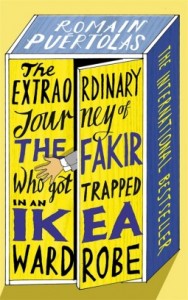
The Extraordinary Journey of the Fakir Who Got Trapped in an Ikea Wardrobe by Romain Puértolas

Posted June 22, 2014 by Michael @ Knowledge Lost in Contemporary / 6 Comments

The Extraordinary Journey of the Fakir Who Got Trapped in an Ikea Wardrobe by Romain PuértolasTitle: The Extraordinary Journey of the Fakir Who Got Trapped in an Ikea Wardrobe (Goodreads)
Author: Romain Puértolas
Translator: Sam Taylor
Published: Harvill Secker, 2014
Pages: 320
Genres: Contemporary
My Copy: ARC from Netgalley

Buy: AmazonBook Depository (or visit your local Indie bookstore)

“A heart is a little bit like a large wardrobe” — Ajatashatru Oghash Rathod

The Extraordinary Journey of the Fakir Who Got Trapped in an Ikea Wardrobe (or L’extraordinaire voyage du fakir qui était resté coincé dans une armoire Ikea) is the debut novel by Romain Puértolas that has been marketed to fans of The Hundred-Year-Old Man Who Climbed Out of the Window and Disappeared (or Hundraåringen som klev ut genom fönstret och försvann) by Jonas Jonasson. For the purpose of making things easier (and to avoid the insanely long titles) I’ll refer to these two books as The Fakir and The Hundred-Year-Old Man (I hope you can work out which is which. I picked up The Fakir simply because I need to read more translated fiction, with that logic I probably should read The Hundred-Year-Old Man. While the writing styles might not be similar, if you enjoyed The Hundred-Year-Old Man because it was a quirky, fun novel then The Fakir is a book you’ll need to go out and buy.

The novel reminds me of something David Niven (The Pink Panther) or The Marx Brothers would adapt to screen. You know the type of movies I’m talking about; the comedies full of misfortunes and stupidity but everything somehow works out in the end. The novel tells the story of a fakir named Ajatashatru Oghash Rathod flown to Paris for the purpose of visiting Ikea and buying a new bed of nails. Dressed in a fine silk suit to pass himself off as a wealthy Indian business man, the con man had nothing but a counterfeit 100-Euro note (printed on one side only) in his pocket. This trip to Paris sends him off on an adventure that finds him in places like London, Barcelona and Rome and not one sight was seen. No Eiffel Tower, Big Ben, Sagrada Família (unfortunately) or Colosseum.

I’m not sure if it is a problem with the translation but I expected a little more from The Extraordinary Journey of the Fakir Who Got Trapped in an Ikea Wardrobe and I can’t tell if it didn’t translate or a deep seeded desire for something more complex. I enjoy that light read but found nothing funny about the novel and thought it was too inconsequential; I wanted more meat to the story. There were opportunities to explore themes of immigration, friendships, celebrities, travel and Europe but all these were just background and the focus remained on trying to write a quirky comedy. I’m not saying this is a bad thing, sometimes a light palate cleanser is all you need, and I was just ready for something with substance. It doesn’t take much effort to read The Fakir and the book did explore the concept of a culture clash but this was to the extent of something like The Gods Must Be Crazy.

Sam Taylor was the translator for this novel and he has worked on a number of great French novels that are all still sitting on my TBR pile. He has translations include A Meal in Winter by Hubert Mingarelli, The Truth About the Harry Quebert Affair by Joël Dicker and HHhH by Laurent Binet. This leads me to believe that my issues with The Fakir are not with the translation but with the book itself. One other concern I have is not with this book per say but with this need to add real people into the story. I’m not entirely comfortable with basing a novel around a person who is deceased, so it feels a little weird when you have a character named Sophie Marceau in this novel. The Fakir actually refers to Sophie Marceau as the French actress from the James Bond film The World Is Not Enough so we know the author is referring to the celebrity. I often wonder how these people feel about being put into a novel and if they are being portrayed accurately. It doesn’t sit right with me and I’m not sure if I’m the only one that wonders about something as small as using celebrities in a novel; I am sure some novels call for it but it this one didn’t.

I know it sounds like I didn’t enjoy this novel but I tend to pick out the parts of a book that didn’t work for me. I think it is freeing to express all my problems with a book and it may come across as a little negative, but in all honesty, this was a fun, short read. I normally gravitate to books with more substance but something light is a nice change. In all honesty I would have liked the novel to explore at least one of the issues that it presented rather than use them as plot points. Even going deeper into the concept of culture clash could have improved my enjoyment of the novel but I have come to expect that not everyone likes to read complex novels. I suspect The Extraordinary Journey of the Fakir Who Got Trapped in an Ikea Wardrobe to be a runaway success and to be adapted into a film; I wonder who they would get to play Sophie Marceau.


Summer House with Swimming Pool by Herman Koch

Posted May 16, 2014 by Michael @ Knowledge Lost in Contemporary / 8 Comments

Summer House with Swimming Pool by Herman KochTitle: Summer House with Swimming Pool (Goodreads)
Author: Herman Koch
Translator: Sam Garrett
Published: Hogarth, 2014
Pages: 304
Genres: Contemporary
My Copy: ARC from Netgalley

Buy: AmazonBook DepositoryKindle (or visit your local Indie bookstore)

Herman Koch has a unique ability for taking something that seems so normal and turning it into something much darker. If you’ve read his amazing novel The Dinner then you’ll know exactly what I’m talking about; that book sets up a style that I was hoping continued for this Dutch author. Luckily I wasn’t disappointed; Koch’s second novel to be translated into English is Summer House with Swimming Pool. The novel tells the story of Dr Marc Schlosser who is forced to conceal a medical mistake that costs Ralph Meier, a famous actor, his life. The only problem with that is the truth doesn’t stay hidden for too long.

Fear not, much like The Dinner, Summer House with Swimming Pool is much more complex than it appears on the surface. Herman Koch likes to take a dark and graphic look at the world and raise the questions of morality, this is something seems to pull off effortlessly, but I will try to avoid giving spoilers. We spend most of the book following around the general practitioner who seems like an unsympathetic character and rather unlikeable. Koch likes to play with the idea that everything is not as it seems and this novel does this really well.

I can’t remember if I went into The Dinner with the same expectations as I did for Summer House with Swimming Pool but I suspect I might have had a similar reading experience. It is hard to review a novel like this because you want to talk about it but there is a voice in the back of your mind telling you not to spoil it for everyone else.

One thing that I find interesting with Koch’s novels is the number of characters and scenery. I thought this about The Dinner as well, these novels are perfect for a small stage production; they have just the right blend of dark satirical plot and moral questions to make for a thrilling stage play. I wonder if these books have been converted to the stage, I would love to see a production of The Dinner.

I’m rather annoyed with this review, there is so much I want to say but everything will say too much. You will all have to read this book so we can discuss it. Herman Koch’s books are perfect choices for a book club; there is just so much to discuss. I wonder if I can convince my local book club to do this book as well; they normally don’t like to do the same author too many times but Koch is too good to resist.