Tag: Translation

1Q84 by Haruki Murakami

Posted July 28, 2012 by Michael @ Knowledge Lost in Literary Fiction, Magical Realism / 0 Comments

1Q84 by Haruki MurakamiTitle: 1Q84 (Goodreads)
Author: Haruki Murakami
Translator: Jay Rubin, Philip Gabriel
Narrator: Allison Hiroto, Marc Vietor, Mark Boyett
Published: Knopf Doubleday, 2011
Pages: 925
Genres: Literary Fiction, Magical Realism
My Copy: Audiobook

Buy: AmazonBook Depository (or visit your local Indie bookstore)

This book is a bit too excessive; like most other people I think it could have had at least 300 pages removed without affecting the story. At times it gets really repetitive; like the author has thought the reader has already forgetting information about Aomame or Tengo. 1Q84 is the story of two people who meet and fall in love in school and then, many years later spend the entirety of the book trying to find each other again. As the story obviously isn’t as simple as that; it is fair to say it is very weird and probably what you expect from Haruki Murakami. I’ve not read anything else from him and I don’t pretend to understand the genre Magical Realism but this book was indeed somewhat enjoyable to read.

I mentioned that this book was everything you’d expect from Murakami and that I’ve never read anything by him before. But I do know of his works and I’ve seen the movie adaptation of Norwegian Wood so I had a decent idea of what I was getting into. But I didn’t except what I got. As the story unfolds and you get a better understanding of Aomame and Tengo, you can’t help but love these two characters with all their flaws, quirks and of course their personalities.

While this book was way too long, I am very glad to have read this book and to dive into the parallel world of 1Q84. I do feel more of a book snob for reading this and I think I will have to read some more from this weird author. For people looking for a great but odd story about two people and have a lot of time to spare, then I would suggest this is the book for you.


We by Yevgeny Zamyatin

Posted June 10, 2012 by Michael @ Knowledge Lost in Classic, Dystopia, Speculative Fiction / 0 Comments

We by Yevgeny ZamyatinTitle: We (Goodreads)
Author: Yevgeny Zamyatin
Translator: Clarence Brown
Published: Penguin, 1921
Pages: 226
Genres: Classic, Dystopia, Speculative Fiction
My Copy: Library Book

Buy: AmazonBook Depository (or visit your local Indie bookstore)

Yevgeny Zamyatin wrote his seminal dystopian novel We (1921) based on his personal experiences during the two Russian revolutions (1905 and 1917) and the first World War. The book ended influencing dystopian authors like Aldous Huxley and George Orwell. This book not only influenced the dystopian genre but could also be the influence towards the post-apocalyptic genre as this was set in a world where all was wiped out but “0.2% of the earth’s population”.  The book is set in ‘One State’ which has been organised to be a workers’ paradise; everything has to work like clockwork and everything is based on logic and mathematics. This society is heavily surveillanced, has martial law and is heavily censored; a totalitarian world.

The protagonist, D-503, is an engineer who begins writing a journal (much like in 1984) to document Integral, the spaceship being built to invade other planets. D-503 is under constant surveillance by the Bureau of Guardians (the secret police) as is everyone else. He is assigned a lover O-90, but ends up having an uncontrollable attraction to I-330. This leads to nightmares and furthermore into what could be considered a mental illness. I-330 reveals to D-503 a world that was previously unknown to him. Will he hang onto hope or will reason get the better of him?

We was an impressive novel; not only with the themes that it explores but also with the technology and the simple fact that it was years and years ahead of its time. While some say We was released in 1920 and others 1921, there is no denying that, because of the subject matter, this was an impressive piece of literature. If it wasn’t for this book we may never of been able to enjoy Aldous Huxley’s Brave New World (1932), George Orwell’s Nineteen Eighty-Four (1949) or even Kurt Vonnegut’s Player Piano (1952). By today’s standards this book would be overlooked but something innovative and so complex to be written so long ago makes this worth a read.


Crime and Punishment by Fyodor Dostoevsky

Posted May 26, 2012 by Michael @ Knowledge Lost in Classic / 0 Comments

Crime and Punishment by Fyodor DostoevskyTitle: Crime and Punishment (Goodreads)
Author: Fyodor Dostoevsky
Translator: David McDuff
Published: Penguin, 1866
Pages: 671
Genres: Classic
My Copy: Personal Copy

Buy: Amazon (or visit your local Indie bookstore)

While I often find it hard to review a classic novel because we already know it’s stood the test of time, it is even harder to review one that has been translated into English as well. Some of the beauty in the writing could have been lost in the translation and because there is so many different translations out there, how do you choose which one to read. This version of Crime and Punishment was translated by David McDuff and I must admit I didn’t really notice anything wrong with the translation at all. It was only upon reflecting that I realised that something could have been lost in the translation.

I have to admit I really love Russian literature and Crime and Punishment will be the front runner for my favourite Russian piece of literature. Raskolnikov is a conflicted character; he is showing a lot of interest in the classes and thinking he is of a higher class than others believes he has the right to commit murder. Contrary to the title, this novel doesn’t really focus on the crime or the punishment but rather the inner turmoil of Raskolnikov as well as the impact on his intellect and emotions. It is not until the very end that the sense of guilt overwhelms him and he confesses and ends his alienation.

Despite the rest of the characters in this book, the bulk of this novel plays out in the mind of Raskolnikov. Fyodor Dostoevsky must have been a very skilled writer to be able to get into the mindset of such a deranged mind. While the murder of two people is definitely a crime, I think the moral that comes across in this book is that the biggest crime was that Raskolnikov placed himself above his fellow man. I wonder if Dostoevsky was trying to also show the reader the dangers of rationalism and maybe utilitarianism.

I’m really surprised how fast I got through this book and the fact that I really enjoyed this book even though I was warned time and time again that this was a very difficult book and not to expect to enjoy it. I’m a huge fan of a book that deals with the inner turmoil of a person especially in a macabre way. It reminded me so much of Markheim by Robert Louis Stevenson and makes me wonder if books like the Dexter series by Jeff Lindsey were influenced by this classic novel. I have a feeling that I will be thinking about this book for a long time and might have to reread it one day.


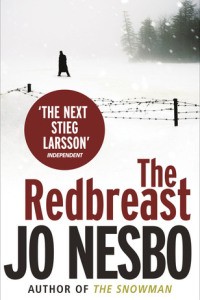
The Redbreast by Jo Nesbø

Posted May 6, 2012 by Michael @ Knowledge Lost in Crime / 0 Comments

The Redbreast by Jo NesbøTitle: The Redbreast (Goodreads)
Author: Jo Nesbø
Translator: Don Bartlett
Series: Harry Hole #3
Published: Harvill Secker, 2000
Pages: 368
Genres: Crime
My Copy: Personal Copy

Buy: Amazon (or visit your local Indie bookstore)

When they advertise Jo Nesbø as ‘The Next Steig Larsson’, I’m inclined to pass on this author. But since a lot of people seem to be raving about this author, I thought I better check him out, especially when they class his Harry Hole series as hard-boiled. I’ve found the only reason they are calling him the next Larsson is simply because he is another Scandinavian crime writer; which means some overly graphic murders, Nazis and an expected twist. The Redbreast is the third book in the Harry Hole novel but the first available in English. Hole is investigating neo-Nazi activity which leads him to further explore Norway’s activities on the Eastern Front during WWII.

Throughout the book it switches between telling the story of Harry Hole in 1999 and the man he is hunting Daniel Gudeson during the World War II. I like how Nesbø switched between the two times and characters to flush out the back story that was leading up to a much bigger current day threat. But that is where I stopped liking this book; I just felt this book was generic and too predictable for my liking. I want to be shocked, excited and enjoy myself when reading crime novels; one out of three just doesn’t cut it.

Now to address the genre issue; Harry Hole could be classed as a hard-boiled detective, as he drinks, smokes and seems to be a very bitter man. However, this novel seems to missing some of the elements that makes hard-boiled novels what they are; for starters where was the dark and gritty realism that I’ve come to love in pulp novels. Also the book was missing a femme fetale as well as the strong dialogue with hints of wittiness and/or irony. This felt more like the generic bestseller crime formula and if we are going to call Jo Nesbø ‘hard-boiled’,  we would have to let Michael Connelly in as well; and we don’t want that.

While this was in fact a fun book to read, I went into this book expecting something more pulp like and ended up getting generic. I’m sure there are plenty of people that will love this book, just don’t expect pulp; you’ll be sadly disappointed. If you are interested in knowing more about pulp fiction,  check out my blog entries on pulp for recommendations.


The Stranger by Albert Camus

Posted July 19, 2010 by Michael @ Knowledge Lost in Classic / 3 Comments

The Stranger by Albert CamusTitle: The Stranger (Goodreads)
Author: Albert Camus
Translator: Matthew Ward
Published: Knopf Doubleday, 1942
Pages: 123
Genres: Classic
My Copy: Library Book

Buy: Amazon (or visit your local Indie bookstore)

L’Étranger, known as The Outsider, or The Stranger by Albert Camus offers an interesting perspective of the philosophical movement; existentialism. Though, as a stand alone novel, it was very simple and uneventful. You need to read this book for its philosophical merit or not read it at all. Previously, I wrote a post about this book and The Cure song Killing An Arab, in which I talked about how the book covered topics like; absurdism, atheism, determinism, existentialism, nihilism, and stoicism.

I thought I needed to read the book and try to understand the connections. The book does an interesting job at covering this issues without being too noticeable. Sure, if you spend your time digesting or picking apart books, you are sure to notice it, but if you are reading the book just for the story, then you may miss the complexity of the story.

It is unusual to read a book that has a complexity to it, but still tells the story too simply. It might have lost some of its density when translated from French to English. I just look for more substance in my books, so I was a little disappointed.


Foucault’s Pendulum by Umberto Eco

Posted May 10, 2010 by Michael @ Knowledge Lost in Historical Fiction, Speculative Fiction / 0 Comments

Foucault’s Pendulum by Umberto EcoTitle: Foucault's Pendulum (Goodreads)
Author: Umberto Eco
Translator: William Weaver
Published: Vintage, 1989
Pages: 623
Genres: Historical Fiction, Speculative Fiction
My Copy: Personal Copy

Buy: Amazon (or visit your local Indie bookstore)

Foucault’s Pendulum may not be for everyone and I will try not to give away any of the story. Personally, I really enjoyed the way it was written.  I went into the book knowing it was about Secret Societies and conspiracy theories, but as I kept reading the book, I started to think it was real. I had to snap myself out of this thought process. The story follows a group of publishers who started deconstructing and analysing what they knew about the Templers, eventually they were drawing connections to other secret societies like the Rosicrucians, the Freemasons & the Jesuits. I don’t know how much of the information was real, but this book was written in such a way that you may get sucked in. It defiantly isn’t a book for everyone, it is very content heavy, but well worth the read if you have any interest in the topic.

If you want to know more about this book, check out my previous post about Foucault’s Pendulum.