Source: Personal Copy

Belle de jour by Joseph Kessel

Posted September 4, 2015 by Michael @ Knowledge Lost in Erotica / 0 Comments

Belle de jour by Joseph KesselTitle: Belle de Jour (Goodreads)
Author: Joseph Kessel
Translator: Geoffrey Atheling Wagner
Published: Overlook Books, 1928
Pages: 188
My Copy: eBook

Buy: AmazonBook DepositoryKindle (or visit your local Indie bookstore)

Belle de Jour is the story of Séverine Sérizy, a beautiful young housewife married to a successful doctor. Her life is pretty great, except she feels like she cannot fulfil her sexual affinity for masochistic desires with her husband. She gets a job as a prostitute under the pseudonym Belle de Jour, only working from two to five each week day, so she can return before her husband gets home. Her job gets her involved with a young gangster named Marcel who allows her to explore all her sexual fantasies. However this relationship of thrills becomes far too much and life gets complicated for Séverine.

Most people will know the story of Belle de Jour as it also a classic piece of French cinema from 1967. Directed by Luis Buñuel and staring Catherine Deneuve, the film explores the exact same story in a richer and interesting way. Buñuel is a Spanish director who has worked on movies in Spain, Mexico and France; he is also acclaimed for his avant-garde surrealist style. I was blown away by this movie and I only saw the movie recently. The concepts of the movie kept swimming through my mind that I needed to read the book to find out more.

What I have found is that the story in the novel is very similar but the surrealist nature of the movie was not there. I did however gain a few insights into the life of Séverine Sérizy that I never picked up on. There is some interesting observations to be made between the connection in literature and fetish, especially with sexual sadism and sexual abuse. This has been a common problem found in books like Fifty Shades of Grey and other novels that deal with BDSM. It is a little sad to think this trope steams all the way to 1928 and maybe further. I think French erotica is really interesting and it is weird to think this was written so long ago.

If you have seen the movie Belle de Jour, then reading the book is not really beneficial. Joseph Kessel does not offer anything interesting and I think everything that made the movie great was all original content from the mind of Luis Buñuel. I plan to re-watch the film sometime so I can write a review of it. As for French erotica, I plan to read more and I am not sure what to read.  I think might have to read The Story of O, but I am open to more suggestions.


Let the Right One In by John Ajvide Lindqvist

Posted August 23, 2015 by Michael @ Knowledge Lost in Horror / 10 Comments

Let the Right One In by John Ajvide LindqvistTitle: Let the Right One In (Goodreads)
Author: John Ajvide Lindqvist
Translator: Ebba Segerberg
Published: Quercus, 2009
Pages: 519
Genres: Horror
My Copy: eBook

Buy: AmazonBook DepositoryKindle (or visit your local Indie bookstore)

Twelve-year-old boy, Oskar is having a hard time with life. While he has a loving mother, his alcoholic father is very absent in his life. At school, Oskar is the constantly being bullied. One day he meets Eli, and a friendship is formed between the two. However Eli is not a normal girl and it is quickly revealed that she is in fact a vampire. Let the Right One In by Swedish writer John Ajvide Lindqvist is a horror novel unlike any other that I have read before.

While Let the Right One In is a gothic horror that explores the unusual relationship between a 12-year-old boy and a vampire, for me this novel was something completely different. I found this to be a book that explores the darker side of humanity; looking at issue of alcoholism, divorce, bullying, abuse, self-mutilation, murder and paedophilia. Think of it more of an existential look at life and the horrors of the world around us.

I do not want to go into too much detail about what to expect when reading this novel. I just enjoyed the way it looked at the way we handle the horrors of the world from the view point of a struggling boy trying to cope with his situation. The relationship between Oskar and Eli is complicated, and unusual. This allows John Ajvide Lindqvist to explore so many interesting issues and push the reader to contemplate more of the world around them.

Most people would be familiar with the plot of this novel by the movie adaptation done in 2008, which was then horribly remade again by Hollywood in 2010 under the name Let Me In. I saw the Swedish version many years ago and felt it to be a brilliant movie but I have not re-watched it since reading the novel. I did however watch the American addition and it made me very angry. I feel like Hollywood is too afraid to deal with the dark side of humanity if it involves a twelve year old boy. Also America has a terrible habit of trying to remake movies that are already brilliant, I understand some people do not want to read subtitles but they do it to movies that are already in English as well. Soon there will also be a TV show based on this novel, which is set to air on A&E later this year.

I am so glad to have read Let the Right One In; I had a great time exploring the world. This is an extremely dark novel and this will not be everyone. I am curious to see what the TV show will be like but I will not be holding my breath. If you are willing to explore the dark side of humanity you will find Let the Right One In to be a compelling and thought provoking novel.


August 2015 Mini-Reviews

Posted August 21, 2015 by Michael @ Knowledge Lost in Historical Fiction, Romance, Science Fiction / 4 Comments

August 2015 Mini-ReviewsTitle: Black Girl / White Girl (Goodreads)
Author: Joyce Carol Oates
Published: Fourth Estate, 2006
Pages: 272
Genres: Historical Fiction
My Copy: Library Book

Buy: AmazonBook DepositoryKindle (or visit your local Indie bookstore)

Black Girl / White Girl tells the story of Genna Hewett-Mead who is reflecting on a traumatic event in her past. Fifteen years ago, in 1975 while attending an exclusive women’s liberal arts college near Philadelphia, her roommate Minette Swift died a mysterious and violent death. Minette was a scholarship student and one of the few African American women to be let into the college. Genna, a quiet woman of privilege got to witness the effects of racism first hand as the racist harassment escalated from vicious slurs to something far worse. However whoever was responsible for this murder still remains a mystery to this day. I had never read Joyce Carol Oates before and I thought this may be my chance to experience her writing. The premise of this novel intrigued me and I was looking forward to uncovering the mystery at play. However, this turned out to be a novel about reflecting on the changing times; I was interested in learning about racism within America during the time of civil rights movements but this focused too much on Genna.

I understand that Joyce Carol Oates may not want to write a novel from the perspective of a person of colour, since she is Caucasian and probably could not do the situation any justice. Rather she took on the perspective of a woman of privilege experiencing the issue first hand. This may have made the book a little more autobiographical and allowed Oates to still explore the issue of racism. While I enjoyed this book, I did not find anything special about it. Maybe this was not the best example of Joyce Carol Oates’ writing but I will try more of her novels in the future.


August 2015 Mini-ReviewsTitle: The Testimony (Goodreads)
Author: James Smythe
Published: Harper Collins, 2012
Pages: 368
Genres: Science Fiction
My Copy: Library Book

Buy: AmazonBook DepositoryKindle (or visit your local Indie bookstore)

First there was static and the whole world freaked out. Then came a voice that said “My Children, Do not be afraid”. People said it was God, others said it was the government and still others believed it was aliens. The whole world was brought to a halt but no one had the answers. The Testimony details the apocalypse from the perspective of twenty six people around the world. James Smythe is a master at writing science fiction that will really make you ponder life and The Testimony is no different.

I was curious to check out James Smythe’s debut novel ever since I discovered his novels. The Machine was my first Smythe and still remains my favourite although many do prefer The Explorer. For me, while The Testimony was a thrilling read, it just was not on the same level as the other books I have read. Dealing with so many different perspectives was a great way to capture the different opinions and question the events. However this novel was not overly impressive, still a great book but if I compare if to James Smythe’s other novels, it falls short. This is proof on just how far Smythe has improved and makes me excited to read something new by this great author.


August 2015 Mini-ReviewsTitle: The Firebird (Goodreads)
Author: Susanna Kearsley
Published: Sourcebooks Landmark, 2013
Pages: 539
Genres: Historical Fiction, Romance
My Copy: Audiobook

Buy: AmazonBook DepositoryKindle (or visit your local Indie bookstore)

Nicola has a rare gift, she can touch an item and glimpse the lives of its previous owners. When she holds a small wood carving called The Firebird she sees a glimpse of Catherine I, wife and later successor to the Tsar Peter the Great. The Firebird is a fresh take on the time traveling romance genre, blending it with the ever popular paranormal romance genre. This is the second book in the Slains series by Canadian author Suzanna Kearsley.

My wife is a big fan of Kearsley and since this novel is partly set in Russian she thought I should check it out. There is some interesting aspects of the life and times of Peter the Great and allowed me to learn a little more about Russian history and culture. However there is something about this novel that I did not like. The Firebird is a story with no conflict and no antagonist and for me this meant it was a really boring novel. I understand people would read this book for the romance but I was uninterested in that story line, I was reading this for the Russian setting. Obviously I am the wrong person to judge The Firebird, it really was not my type of book.


Aquarium by David Vann

Posted August 12, 2015 by Michael @ Knowledge Lost in Contemporary / 6 Comments

Aquarium by David VannTitle: Aquarium (Goodreads)
Author: David Vann
Published: Text, 2015
Pages: 259
Genres: Contemporary
My Copy: Paperback

Buy: AmazonBook DepositoryKindle (or visit your local Indie bookstore)

Caitlin is a twelve-year-old leaving with her mother in subsidised housing next to the Seattle airport. Every day after school she visits the local aquarium where she spends her time studying the fish. She dreams of becoming an ichthyologist when she grows up. One day she meets and befriends an old man by one of the fish tanks. This new friendship leads Caitlin to a dark family secret and causes her once blissful relationship with her mother to fracture.

I have great respect for David Vann as a writer; while I have only read Dirt previously, I have found his ability to write family dysfunction mesmerising. Dirt was a very uncomfortable read and when Goat Mountain was released in 2013 I was not emotionally prepared to tackle another Vann novel. Goat Mountain still sits on my shelf waiting for me but I could not resist picking up Aquarium and reading it.

David Vann frequently writes about the domestic life, exploring the way family members react to each other and often lead to arguments. Within Aquarium, Vann looks at how destructive secrets can be and how the suffering of a parent can greatly affect their children. Parents often have this idea that they need to protect their children from the horrors of the world, which is fair enough. However, what happens when a family secret comes out? In Aquarium, Caitlin’s mother is unable to handle the situation leaving her to try and navigate this big revolution alone.

Aquarium is a coming of age story of a twelve year old being thrust into adulthood and trying to navigate the world alone. Without the family drama, Caitlin has enough to worry about with the changes in hormones and her body. However do not confuse this with a young adult novel; David Vann tackles some dark themes (although this is more accessible than Dirt) and Caitlin is reflecting on the situation later in her life. This allows for a nice blend of maturity and naiveté to come through in the writing.

While this was not as dark as I expected, I think Aquarium is a great introduction to David Vann. I still need to read Goat Mountain, Caribou Island and Legend of a Suicide before I can give a more informed opinion but I recommend Aquarium if you want to try Vann out. If I compare this novel to Dirt, it is a light read about the family life but, in reality, it is a dark grim bildungsroman that deals with abuse and sexuality. Emotionally prepare yourself when going into a book like Aquarium; it is worth the journey.


Double Indemnity by James M. Cain

Posted June 29, 2015 by Michael @ Knowledge Lost in Book of the Month, Pulp / 0 Comments

Double Indemnity by James M. CainTitle: Double Indemnity (Goodreads)
Author: James M. Cain
Published: Vintage, 1936
Pages: 114
Genres: Pulp
My Copy: Personal Copy

Buy: AmazonBook DepositoryKindle (or visit your local Indie bookstore)

When small time insurance man Walter Huff meets Phyllis Nirdlinger, her beauty quickly seduced him. The wife of a wealthy oil executive convinces him to help get rid of her husband, but not before a substantial policy was taken out on him. Accident insurance often causes suspicion but when Phyllis’ husband dies from what looks like a train accident, double indemnity kicks in and Walter’s bosses suspect foul play.

James M. Cain is the master at noir with books like The Postman Always Rings Twice, Mildred Pierce and recently The Cocktail Waitress was released posthumously.  Double Indemnity is one of his most notable pieces of work and was adapted into the 1944 classic film noir movie of the same name. The movies screenplay was written by fellow master of pulp Raymond Chandler and has been dubbed culturally, historically, and aesthetically significant by the US Library of Congress.

Double Indemnity is a clause often found in accident insurance policies where the issuer agrees to pay double (or more) if the accident happens in certain conditions. It is often used to make the policy more appealing but applies to low risk incidents. Death by train accident is one of these examples and when Phyllis’ husband died in these conditions the insurance company was naturally suspicious.

This classic pulp novel follows Walter Huff who plots the perfect murder all for the beautiful Phyllis Nirdlinger. What he didn’t count on was that he was seduced into helping a femme fatale and now he was under her thumb. In true James M. Cain style, Double Indemnity holds nothing back, both in style and plot. Everything you expect in a 1930s noir novel can be found in this thrilling novella.

This is a re-read for me of Double Indemnity and I must admit I was so happy to return to the style of James M. Cain. Everything you expect from the pulp style and dialogue can be found within this classic story. I know I need to dive into some more of Cain’s novels, with some re-reads and completing his bibliography. I have no words to describe the feeling of returning to a much-loved author and I know I need to re-watch the movie. If you have never read Cain or anything from the classic pulp genre, then you can never go wrong with a book like Double Indemnity.


H is for Hawk by Helen Macdonald

Posted June 28, 2015 by Michael @ Knowledge Lost in Non-Fiction / 0 Comments

H is for Hawk by Helen MacdonaldTitle: H is for Hawk (Goodreads)
Author: Helen Macdonald
Published: Vintage, 2014
Pages: 300
Genres: Non-Fiction
My Copy: Paperback

Buy: AmazonBook DepositoryKindle (or visit your local Indie bookstore)

Helen Macdonald has always had a fascination with birds, since a young age she was determined to become a falconer. She would read books on the topic; one book in particular had stuck with her, The Goshawk by T. H. White. When Helen lost her father, grief struck her in a big way, and soon her obsession in training her own goshawk was her own way out. H is for Hawk is a memoir on both dealing with grief and obsession.

I heard so much about this book and when it was assigned for book club, I was excited. Although in the back of my mind, my thoughts on falconry were sceptical. I find falconry to be a barbaric and cruel practice that is no longer required within our culture. To starve and cage a raptor for your own amusement seems unnecessary. With these thoughts going into the book, I had a hard time appreciating the memoir.

I know Helen Macdonald repeatedly stated that she was not starving the goshawk, I still thought of it as a cruel practice. I learned a lot about falconry, some stuff was interesting but there was so much information to process. The book never changed my feelings towards falconry, only cemented them and that become my fundamental problem with H is for Hawk. I enjoyed the parts about The Goshawk and I love reading memoirs about reading books but there was not enough there to hold my interest.

I thought I would try annotating this book, it is a habit that I want to start and thought it would be fun. However I did have to stop with the annotation, as I started to feel like Helen Macdonald was over playing her grief just to make the story more interesting. I did not want to be the heartless person that criticises the author’s emotions, especially when it comes to grief. So I quickly abandoned my annotations and I continued to try to get into the habit.

While H is for Hawk has some wonderful writing, I had a very difficult time enjoying this book. I wanted Helen Macdonald to return to talking about The Goshawk through out the entire memoir. I am interested in seeing what Macdonald will do next, she certainly can right. I hope her next book, whatever that may be, will be something I can get behind.


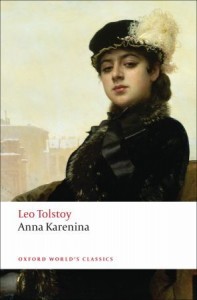
Anna Karenina by Leo Tolstoy

Posted May 28, 2015 by Michael @ Knowledge Lost in Classic, Russian Lit Project / 0 Comments

Anna Karenina by Leo TolstoyTitle: Anna Karenina (Goodreads)
Author: Leo Tolstoy
Translator: Aylmer Maude, Louise Maude
Published: Oxford World's Classics, 1873
Pages: 831
Genres: Classic
My Copy: Personal Copy

Buy: AmazonBook DepositoryKindle (or visit your local Indie bookstore)

Anna Karenina is the tragic story of the socialite’s marriage to Karenin and her affair with the wealthy Count Vronsky. The novel begins in the midst of their families break up due to her brother’s constant womanising; a situation that preferences her own situation throughout the novel. Running in parallel to this story of Konstantin Levin, a humble country landowner that wishes to marry Kitty, who is Anna’s sister in-law. Anna Karenina is a pinnacle piece of realist literature, exploring a wide range of family issues.

At over 800 pages, Anna Karenina can be a daunting novel to pick up; the large cast of characters does not make it any easier. I look at this classic novel as an exploration into melodrama that just about every family experiences. Born in 1828, Lev (Leo) Nikolaevich Tolstoy was born into a large and wealthy Russian landowning family, and has often been suggested that Anna Karenina is based on a similar social upbringing. While there are vast differences, issues with wealth, religion, farming and morality are issues that seem to parallel between reality and fiction. The story arch of Levin is considered to be autobiographical; Tolstoy’s first name is Lev (although in English he is known as Leo) and the Russian surname Levin actually means Lev.

Leo Tolstoy has been known for adding real life events into his fiction as a way with dealing with current political and social issues. Within Anna Karenina, events like the liberal reforms initiated by Emperor Alexander II of Russia and the judicial reform are used as the backdrop for the novel. This allows him to explore current issues, like the developing of Russian into the industrial age and the role of agriculture in these changing times. Also Tolstoy questions the role of the woman in this changing society and (the ever popular in Russian lit) class struggles.

The story of Anna Karenina is probably the most interesting for me and I enjoyed reading the struggle between love and the public opinion. She was trapped in a marriage and wanted to divorce but Karenin, who was a politician cared more about his public image. Then there is the fact that Anna’s brothers womanising destroyed the family and now she is faced with a similar situation that could cause the same damage. Adultery becomes a big theme within the book and seems to be a common theme within Russian literature to this day. However with Nathaniel Hawthorne’s The Scarlet Letter (1850) and Gustave Flaubert’s Madame Bovary (1857), these three novels seemed to start a fascination in exploring the themes of passion and adultery in the mid to late nineteenth century.

There is a lot to explore within this book, and re-reading Anna Karenina was such an enjoyable experience. I know big books often scare me but there is something about going back to a much-loved novel that I find enjoyable. Leo Tolstoy intentionally made this novel long, he wanted to replicate life’s journey and the struggles people face along the way. I think he was able to capture that struggle and Anna Karenina will remain a favourite on my shelves and in Russian literature. There are so many more themes that could be explored within the novel but I will leave that for others to discover on their own.


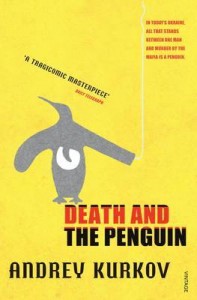
Death and the Penguin by Andrey Kurkov

Posted May 26, 2015 by Michael @ Knowledge Lost in Contemporary, Humour, Russian Lit Project / 2 Comments

Death and the Penguin by Andrey KurkovTitle: Death and the Penguin (Goodreads)
Series: The Penguin Novels #1
, 1996
Pages: 228
Buy: AmazonBook DepositoryKindle (or visit your local Indie bookstore)

Viktor Alekseyevich Zolotaryov is an unemployed aspiring writer struggling to live in a post-soviet society. He has aspirations to write novels but a job writing obituaries conveniently fell into his lap. Viktor’s job is to prepare obituaries for notable Ukrainian figures. However he quickly found out he was being assigned to write obituaries of the enemies of an unknown organisation, using the newspaper as a front. He is now trapped in a situation and there appears to be no escape.

The title of this book refers to Viktor’s job and his pet king penguin, Misha. The Kiev zoo had run out of money and could no long afford to support or feed the animals. Their solution was to give the pets to any citizen able to feed them in the hope they will care for the animals. Andrey Kurkov uses Misha to mirror Viktor Zolotaryov. An existential look into life imitating art and the balance between life and death.

Death and the Penguin is a dark comedy and political satire that portrays a bleak post-Soviet Ukraine to the reader. Kurkov takes a pragmatic approach with exploring morality. The idea of writing a mournful article in case a politician or socialite dies suddenly in exchange for money offers a morbid look at mortality but that is not enough for Andrey Kurkov and he wants to talk about politics and corruption. “People have got used to the corruption. People here are flexible and they accept the new rules and don’t dwell on moral questions. They just watch what everyone else is doing and try to find their own ways of deceiving others to make money for themselves to survive”

The Kiev Kurkov portrays is one driven by greed and corruption. A place where bribes have to be handed out before an ambulance will come and take a dying man to hospital. However, once at the hospital the staff can offer no medicines to ease the pain, let alone a cure. A place where money rules and the gangster underworld are offering a practical solution into solving corruption. Turning this society into a place where organised crime and political corruption seem to be ruling in tandem.

What really stuck with me was the parallels between Viktor and Misha’s life. Starting from struggling to feeling trapped, Misha’s life mimicked Viktor’s own life. Also Misha helped provide a contrast with Victor’s plot; exploring ideas of life and death simultaneously. While people are dying due to the hit list, Viktor struggles to keep Misha alive in an environment that is not suitable for a king penguin. These parallels and contrast make up the back-bone of the book and what really cemented my love for this novel.

Death and the Penguin is a wonderful satire that combines elements of the surreal and existential. I really enjoyed the dark comedy and the themes Andrey Kurkov explored within this novel. There is a sequel to the book called Penguin Lost which I plan to read but I have no idea how this story could continue. As part of my Russian lit project, I plan to explore a lot more post-Soviet literature and if this is anything to go by, I know I will discover some great novels.


The Whispering City by Sara Moliner

Posted May 15, 2015 by Michael @ Knowledge Lost in Crime, Thriller / 2 Comments

The Whispering City by Sara MolinerTitle: The Whispering City (Goodreads)
Author: Sara Moliner
Translator: Mara Faye Lethem
Series: Martí #1
Published: Little Brown and Company, 2013
Pages: 416
Genres: Crime, Thriller
My Copy: Paperback

Buy: AmazonBook Depository (or visit your local Indie bookstore)

General Franco was at the height of his power in Barcelona, 1952. When a wealthy socialite is found murdered in her mansion, the police scramble to seize control of the investigation. An over eager journalist named Ana Martí Noguer is assigned the task of shadowing the lead investigator, Inspector Isidro Castro. However, Ana discovers a bunch of letters that dramatically contradict the official statement made by the police. Now she is in mortal danger; her information can expose a conspiracy of murder and corruption.

The Whispering City (originally title: Don de lenguas) is a Spanish novel written by Sara Moliner and translated into English by Mara Faye Lethem. Sara Moliner is the pseudonym of the writing duo of Spanish author Rosa Ribas and former German philosophy professor Sabine Hofmann. This is their first book together and, with their backgrounds and the premise, I went into this novel with high expectations. Sadly, this turned into a run-of-the-mill thriller novel which is not a bad thing; I just was hoping for so much more.

The back drop of a fascist government, known for their shadowing tactics, mixed with the philosophical background of Sabine Hofmann meant I was hoping for some interesting insights. I was hoping to learn about the cultural landscape and the political impact of Barcelona in 1952 but the main focus on this book was the murder and the conspiracy. Having recently read Red April by Santiago Roncagliolo (translated by Edith Grossman), which explored the political and cultural issue in Peru at the time, I was expecting something similar with The Whispering City.

The Whispering City is in no way a bad novel, and I found it incredibly entertaining and worked as a palette cleanser for me while I was reading The Zone of Interest by Martin Amis and The Stranger by Albert Camus. One of the main reasons I am drawn to books in translation is the insight into the cultural life and I did not get that with this book. The Whispering City reminds me a bit of The Millennium series by Stieg Larsson, with a journalist as a protagonist investigating murder and corruption. While it was not as dark as The Girl with the Dragon Tattoo, I found it a lot more enjoyable but still the same thriller formula.


A Young Doctor’s Notebook by Mikhail Bulgakov

Posted May 14, 2015 by Michael @ Knowledge Lost in Russian Lit Project, Short Stories / 0 Comments

A Young Doctor’s Notebook by Mikhail BulgakovTitle: A Young Doctor's Notebook (Goodreads)
Author: Mikhail Bulgakov
Translator: Hugh Aplin
Published: Alma Classics, 1926
Pages: 155
Genres: Short Stories
My Copy: Paperback

Buy: AmazonBook Depository (or visit your local Indie bookstore)

A Young Doctor’s Notebook (also known as A Country Doctor’s Notebook) is a semi-autobiographical collection of short stories published early in Mikhail Bulgakov writing life in Russian medical journals. Bulgakov was educated at the Medical Faculty of the Kiev University, though his interest lied in theatre. When World War I broke out, he volunteered with the Red Cross. He was sent directly to the front lines to work as a medical doctor and was badly injured on two separate occasions.

In 1916 Mikhail Bulgakov graduated and was quickly appointed as a provincial physician to the Smolensk province. He found himself performing procedures he had only seen once or twice while at medical school. The seven stories in this collection explore the ignorance or stubbornness of people towards medical treatment, an issue that is still very relevant today. While A Young Doctor’s Notebook was set in the small village doctor in revolutionary Russia, the stories were all written in the 1920s.

Like most editions of A Young Doctor’s Notebook, my copy of the book came with one extra story called ‘Morphine’. This was also published in a medical journal and is much different to the other stories. ‘Morphine’ is yet another semi-autobiographical story that explores Mikhail Bulgakov’s own struggles with a morphine addiction. His injuries in the war lead to chronic stomach pains and the easy access to pain relief quickly lead to a morphine addiction. Bulgakov did end up leaving the medical profession to pursue a career in writing stage plays and was able abandon the use of morphine.

A Young Doctor’s Notebook is a wonderful collection of stories that illustrate Mikhail Bulgakov’s humour and writing style. If you have seen the TV adaptation, you may notice some similarities to the story, blending the seven short stories and his other story ‘morphine’ together to deliver a fabulous dark comedy. I binge watched the show over a weekend and I was not ready for it to end, so I picked up this collection and this quickly started an obsession with the life of Bulgakov.

While Mikhail Bulgakov is mainly known for his book The Master and Margarita (a book I recently re-read), A Young Doctor’s Notebook may be a more accessible book. It allows you to get a taste of Bulgakov’s style and humour with the seven short stories. I read an edition that was translated by Hugh Aplin and he is quickly becoming a favourite of mine and I will be hunting down everything he has translated (he translated mainly Bulgakov and Dostoevsky). Learning more about Mikhail Bulgakov’s life does give me extra enjoyment and context when reading his books. I am slowly reading a collection of his letters and diaries in a book called Manuscripts Don’t Burn, so you may see a lot more about Bulgakov on this blog.