Tag: Translation

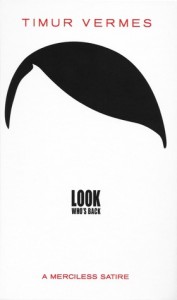
Look Who’s Back by Timur Vermes

Posted November 20, 2014 by Michael @ Knowledge Lost in Humour / 4 Comments

Look Who’s Back by Timur VermesTitle: Look Who’s Back (Goodreads)
Author: Timur Vermes
Translator: Jamie Bulloch
Published: MacLehose Press, 2012
Pages: 375
Genres: Humour
My Copy: Library Book

Buy: AmazonBook Depository (or visit your local Indie bookstore)

Adolf Hitler wakes up in the summer of 2011, lying on a patch of open ground in Berlin. However this isn’t the Germany he remembers; he calls over a nearby group of Hitler Youth but they appear to be unhelpful. He quickly discovers he is no longer the chancellor of the German Reich, in fact Angela Merkel held that role. The Kanzlei des Führers was no more and his home, The Reich Chancellery was no longer liveable. For the rest of Germany, Hitler was just a method actor who refused to break character.

Er ist wieder da (English title Look Who’s Back) is Timur Vermes first novel after working as a ghostwriter. The book is a biting satire of what might happen if Adolf Hitler was alive in the 21st Century. Of course, if he we was alive today he would be on television, spitting his ideology to the influential masses. While many thought of him as a method actor and a comedian, the novel centres on a return to power and politics with his lack of political correctness.

Interestingly enough Look Who’s Back plays on the ideas around satire; while most people within the novel believe Adolf Hitler is just a satirist, the whole notion is that there is a fine line between satire and venomous ideology. One thing I found particularly interesting within the novel is the way Timur Vermes plays with the idea that satire is meant to be funny and I want to stop and give these people a lesson on the differences between Horatian and Juvenalian satire. There are a lot of comedic values within Look Who’s Back (Horatian satire) however the satire within the novel was Juvenalian.

The way Hitler was portrayed within the book, kept reminding me of Bruno Ganz’s performance in Downfall for some weird reason.  While Vermes put a lot of effort and thought into how Hitler would react to a modern Germany, this book soon became a one trick pony. The different scenarios Hitler found himself in started off as humorous but soon the jokes got a little old. Despite this fact, I have to be impressed with the amount of thought that went into the ideas Hitler would have towards Germany today.

I do however suspect there is something lost on a reader who doesn’t live within Germany. While there is a lot of entertainment to be had with the novel the subject matter wouldn’t have the same effect. The fact remains that Adolf Hitler was very damaging to Germany and the subject matter would remain a controversial topic. While Timur Vermes depicted Hitler as a man (rather than a monster) in an effort to examine how National Socialism rose to power, Germany remains wary of the effects of this ideology. Hitler’s ideas towards Judaism and immigration have left a bad taste in the mouth of every German person and the results have led to an overly politically correct society. The damage is still visible, but despite the controversial nature of Look Who’s Back, the book sold over 1.4 million copies within Germany and has been translated into twenty eight languages (Jamie Bulloch being the English translator).

I found myself getting a little bored by the jokes within this novel and the moral message was easily recognisable half way through. While there is plenty of interesting ideas within Look Who’s Back, I believe this book might have been more enjoyable if it was cut down about half its size. Hitler comes across as an uncompromising, charismatic but deeply flawed human and while this is needed for this story, it is hard not to see him as anything but a monster.

germanlit

I read this book for German Literature Month


Colorless Tsukuru Tazaki and His Years of Pilgrimage by Haruki Murakami

Posted November 13, 2014 by Michael @ Knowledge Lost in Contemporary / 13 Comments

Colorless Tsukuru Tazaki and His Years of Pilgrimage by Haruki MurakamiTitle: Colorless Tsukuru Tazaki and His Years of Pilgrimage (Goodreads)
Author: Haruki Murakami
Translator: Philip Gabriel
Published: Harvill Secker, 2014
Pages: 298
Genres: Contemporary
My Copy: Hardcover

Buy: AmazonBook DepositoryKindle (or visit your local Indie bookstore)

Tsukuru Tazaki was lucky enough to have four close friends in high school. They were a tight knit group and they all shared their hopes and dreams with each other. When it came to college Tsukuru went off to Tokyo to pursue his dream career while the others remained in Nagoya at various schools. They vowed to remain close and Tsukuru made an effort to visit as much as possible. That was until one day Tsukuru was told that the other four wanted nothing to do with him anymore.

I am not going to go too much into the plot; I think this is something that needs to be discovered within the book. However I do need to talk a little about it. Tsukuru Tazaki had always felt like an outsider, even though he was accepted into the group for a while. He was always colourless in a group of colours; Akamatsu (which means red pine), Oumi (blue sea), Shirane (white root), and Kurono (black field), while his name means ‘to build’. Essentially this is a novel about friendship, rejection, isolation and the psychological scars that can be caused by others who never took that into account. There is a whole other side that can be explored but that would involve spoilers.

I had a rocky start with Haruki Murakami; the first book I read was 1Q84 and lets face it, this is the worst place to begin. I was exposed to the world of Murakami with the awkward fetishes and magical realism but 1Q84 was ultimately a little clunky and way too big. Luckily I am a bit of a hipster and picked up What I Talk About When I Talk About Running and while I’m not a runner, I found it to be an interesting read. It wasn’t till I read Hard-Boiled Wonderland and the End of the World that I truly understood his brilliance. I still have a lot more to read but Colorless Tsukuru Tazaki and His Years of Pilgrimage was a perfect next choice.

I have often heard people recommending beginning with Norwegian Wood because it is rooted in realism and I would like to think Colorless Tsukuru Tazaki and His Years of Pilgrimage would work as well. I obviously haven’t read Norwegian Wood yet but the idea of beginning with some of his realistic novels before getting into the magical realism and exploring the weirdness of Murakami’s brain is probably a good idea. His style is a little unusual but once you get an understanding of how his mind works you should be readying do dive into something fantastical.

What I have found reading Haruki Murakami is that he has a strong interest in both the conscious and the subconscious. His books explore the complexities of the mind and how different situations have a psychological impact on a person. This is a really interesting theme and one that I am particularly interested in; if I knew that a long time ago, I am sure I would have been more willing to explore his works.  Even What I Talk About When I Talk About Running explored this theme and it was a memoir.

I do wish I didn’t begin with 1Q84 but after a few other books, I finally can say that Haruki Murakami has another fan. I am keen to read all his other books; both fiction and non-fiction. There is something enthralling about the way a mind works and I really like the way that Murakami explores that. While Colorless Tsukuru Tazaki and His Years of Pilgrimage was far from perfect, there are some weird and awkward moments in the writing that I believe is synonymous with his writing style but I found this a captivating read. I have reserved Norwegian Wood at the library and I am hoping to read that one very soon.


Beowulf by Anonymous

Posted October 19, 2014 by Michael @ Knowledge Lost in Classic / 0 Comments

Beowulf by AnonymousTitle: Beowulf (Goodreads)
Author: Anonymous
Translator: Michael Alexander
Published: Penguin, 800
Pages: 137
Genres: Classic
My Copy: Paperback

Buy: AmazonBook DepositoryKindle (or visit your local Indie bookstore)

Beowulf is one of the oldest, complete surviving epic poems in existent. There are a few others from the same era that have survived in fragments, so the significance of Beowulf remains in regards to English literature. Written in Old English (or Anglo-Saxon) the manuscript of Beowulf is believed to date back to the 10th century (1,000AD). This is an example of a heroic poem, which can be defined as a text that deals with heroic actions in battle. Beowulf focuses on three great battles, with Grendel, Grendel’s Mother, and a Dragon.

While this is an English poem it is interesting to note that it is not set in England but southern Scandinavia, half in Denmark and the other in Geatland (or Götaland) which is one of three lands of Sweden. Beowulf does incorporate a large amount of Norse and Germanic history and legends, however I don’t have the knowledge to pick up on this within the text, just information I learnt after the reading. I suspect that this information was added into the poem to help pass on the information to Anglo-Saxon people, like a history lesson or as the poet calls it “the treasured repertory” (line 871). It is believed that Beowulf was composed in a time of stability, in a time of some democracy; an early medieval Christian civilisation. One might say this was an age where art and literature were flourishing and often used as methods of education.

Beowulf was no exception. What I got out of this poem was a reflection of the cultural and, to a lesser extent, political views of the time; a civilisation that values courtesy and formality. Chivalry, generosity and thoughtfulness are valued but still have a strong sense of precariousness, ready of imminent attack and war. Strength is still considered important; Beowulf is a warrior willing to fight against enemies both human and demonic. He even travelled to another country to fight a demonic menace. However you have to look to the other warriors as well, who appear as strong and capable as Beowulf but without their faith are rendered useless.

The role of the poet (or bard) is actually depicted in the poem itself several times. The poet is “…a fellow of the king’s” (line 868) which suggests that he is of a high rank. One who knows old and traditional stories, “Whose head was a storehouse of the storied verse, whose tongue gave gold to the language” (line 870). This allows the poem to have a unique perspective on the events that unfolds within Beowulf, a tactic that doesn’t always get explained within modern literature.

It is said that you can interpret this poem as having both Christian and pagan themes; however for me this had a very strong religious message. A battle of good and evil but I suspect this wasn’t a conflict of morality but an inevitable clash between the two. In a Christian context, Beowulf could be compared to Jesus, coming to save our souls from evil. You can even compare it to the story of Cain and Abel which is referenced within the text of Beowulf.

Given that Beowulf is meant to be experienced a spoken word I found myself struggling to read this as a written text. I had a look for the Michael Alexander translation (which was assigned to me for my university course) but was unsuccessful. However I did try to think about the text as if it was a story been spoken and I found it difficult. For me the narrative felt too slow, it lacked suspense and felt a little awkward (possibly the translation). The obscure historical allusions may not have been an issue back in the 800AD but it was for a modern reading.

I was nervous about reading Odyssey by but ended up loving it; I was hoping I would have a similar experience here. I suspected that Beowulf will remain a difficult text. There is some historical context that would be helpful before going into the poem that I just didn’t get. Reading the epic poem as part of a university course did help but for me it wasn’t enough. Medieval literature will remain difficult for me and would rather enjoy something a little more recent, like the 19th century. If you have read Beowulf and have some interesting insights that might help get my head around it, please let me know.


A Death in the Family by Karl Ove Knausgård

Posted October 9, 2014 by Michael @ Knowledge Lost in Contemporary / 0 Comments

A Death in the Family by Karl Ove KnausgårdTitle: A Death in the Family (Goodreads)
Author: Karl Ove Knausgård
Translator: Don Bartlett
Series: Min Kamp #1
Published: Harvill Secker, 2009
Pages: 400
Genres: Contemporary
My Copy: Library Book

Buy: AmazonBook DepositoryKindle (or visit your local Indie bookstore)

A Death in the Family is the first book in the controversial six volume series by Norwegian author Karl Ove Knausgård. The controversy started with the title of the book Min Kamp, which is the same title as Hitler’s Mein Kampf as both translate to My Struggle. Secondly, while these are marketed as autobiographical novels, Knausgård has come under fire from friends and families for exposing their private lives. Karl Ove Knausgård has been often been called a Proustian and Min Kamp often compared to In Search of Lost Time. That is just enough pretention to make me want to pick up these novels and read them.

A Death in the Family (or My Struggle Book 1 in America) tells the story of Karl Ove Knausgård, a family man living in Sweden, trying to find the balance between his writing and his family. He reflects on his childhood and teenage years, as well as the loss of his father in what feels like a brutally honest portrayal of his life. What is interesting is the idea of this being an autobiographical novel rather than a memoir; as a reader I had to continuously remind myself of this fact. I had to question what is real and were liberties were taken. Honestly, I don’t think I could write about my childhood with such clarity and I suspect that the fiction was used to fill in the gaps and tell a better story.

Karl Ove Knausgård is approaching middle age, and with a young family I suspect that this six volume series is just a way for him to make sense of his life. Allowing him to work through issues and mistakes and explore different ideas he might have towards life. This is both an effective and fascinating insight of the life of a writer and I suspect it would have been very therapeutic for Knausgård, even if it caused friends or family members to hate him. As a novel, it is a roller coaster of emotions; sometimes it might come across as slow or even dull but that is life.

This first volume is even divided into two parts, one exploring the childhood/teenage years of Karl Ove and the other the death of his father. To understand the death of his father, obviously his childhood played a big part; his mother was almost invisible, always at work or somewhere and his father was distant and unpredictable. We often have a rose-coloured memory of our childhood but as Knausgård reflects on his past, you can recognise a similar distorted view in your own life. Karl Ove has a dark view on the world and death; it is interesting read this book in the context as he tries to understand his father and his death at such a young age.

While I can’t compare Karl Ove Knausgård to Marcel Proust (I really need to read him) or Min Kamp with In Search of Lost Time, I’m glad to have read this novel. I have reserved A Man in Love (Book 2) and I plan to read all six books. I like Knausgård’s view on the world and find it fascinating to read his books as he works through his own issues. His writing style obviously helps, I found great beauty in the dark and macabre views and credit has to go to Don Bartlett for the translation.

My only problem is going to be the fact that only the first three books of My Struggle have been translated and published. I suspect I will be caught up on this series very soon and I will have begin the year long waits between volumes. Book Four is expected in April 2015 and I am never going to learn Norwegian to avoid the wait. I have always shyed away from a series that is incomplete because of the wait but this sounded right up my alley and thought I had to try at least the first book; that was a mistake.

This was a pleasant balance between literary fiction and self-reflection. Karl Ove Knausgård even threw in some of his philosophical views; I remember some references to Danish philosopher Søren Kierkegaard in the text. This was so much more than an autobiographical novel of bewilderment, grief, relationship, love, loss and rock music; hard to explain but I recommend you experience it. Even if you just wish to increase your book snobbery levels, Karl Ove Knausgård’s My Struggle series is going to be something to watch. I suspect this will become a literary sensation, if it has not become one yet.


The Odyssey by Homer

Posted October 7, 2014 by Michael @ Knowledge Lost in Classic / 0 Comments

The Odyssey by HomerTitle: The Odyssey (Goodreads)
Author: Homer
Translator: Walter Shewring
Published: Oxford World's Classics, 8th century BC
Pages: 349
Genres: Classic
My Copy: Paperback

Buy: AmazonBook DepositoryKindle (or visit your local Indie bookstore)

The Odyssey is one of two narrative poems that have been attributed to the Greek poet Homer; while it is not entirely clear that he actually composed both or any of them. While it can be said that The Odyssey is a sequel to Homer’s Iliad, reading them out of order will not put you at a major disadvantage. Iliad tells the story of the war on Troy and remains popular due to the fact that it is one of the only surviving Greek classics that actually deals with thetopic. The destruction of the Library of Alexandria was a great cultural loss and many poems and documents were lost, leaving Homer’s works even more culturally significant as it pretty much all we have left to go on. The Iliad and Odyssey remain fundamental to the Western canon for being the oldest works still in existent in literature.

While the Iliad focused on the events that happened in Troy, The Odyssey takes place ten years after the Trojan War. Odysseus has still not returned home from the war, his wife Penelope is still hopeful for his return while the Suitors (a group of over 100 men) try to persuade her to marry one of them. The Suitors are enjoying the hospitality of Odysseus, eating up his wealth while he is not around to stop them. Up on Mount Olympos, the gods are debating on whether to let Odysseus return. The goddess Athene pleads to her father Zeus in favour of letting him return, but Poseidon wishes to wipe his ship out. Obviously this is an over simplified synopsis; to give The Odyssey’s plot any justice, I would need to write a few paragraphs of information.

I was a little worried going into this epic poem; I have often found medieval literature difficult and the idea of reading something so much older scared me. I was lucky enough to be assigned a prose translation by Walter Shewring which was a perfect choice for me. Out of interest I had a look at another prose translation, the Project Gutenberg edition (translated by Alexander Pope) and was shocked to see Jove, Neptune and Minerva used in the text. A Greek epic poem that was using Roman gods, that didn’t work for me. Shewring’s was superb; it made things easier for me and helped me find the beauty with this text.

Obviously when The Odyssey was first composed (believed to be around the 8th century BC) it was shared in an oral tradition by an aoidos (poet or singer). We can see a lot techniques being used that have since been established as the literary norm. The Odyssey reads almost like a modern day thriller, continually keeping up a fast pace with slight repetition to remind the audience of key plot points. It is a story of a variety of adventures, told in a non-linear fashion that doesn’t have much in the way of philosophising or introspection.

While the Iliad and Odyssey is attributed to Homer, there isn’t much other information about this Greek poet. The bearded blind man often depicted as an image of Homer is not even one that can be historically verified. The lack of information about the author (if in fact he was the author) means that the poems have to speak for themselves; a new experience for me in my study of literature. It is surprising that the literary terms ‘Homeric Greek’ and ‘Homeric world’ were named after someone we know nothing about.

There is a lot going on in The Odyssey but I want to look at two things I found interesting; first of all the idea of hospitality. Within the poem the idea of hospitality is a little weird; the Suitors just move in and make themselves at home, taking advantage of the hospitality of someone who wasn’t around to stop them. Further in the poem, Odysseus and his soldiers are doing the exact same thing to the Cyclops. Hospitality is expected and within this poem it is often being taken advantage of. What does that say of humanity during the time this was set and has it changed much now?

Secondly I want to talk about gender inequality, ever since reading The Fictional Woman I see it in almost everything I read, so I can’t help but talk about. Odysseus is not faithful to his wife Penelope; there are countless times he is sleeping with someone else. In fact the idea of him being a highly sexual being is pretty much glorified within this poem but if it is a woman, then she isn’t an ‘ideal’ woman or evil. Just look at how Clytemnestra, the sirens and Calypso are portrayed within this poem. In fact Penelope is the symbol of a perfect woman and Odysseus has to test her before revealing who he is. My problem is the scary notion that this gender inequality is still a problem now; in the 8th century BC it was evident; why is this still a problem?

Odysseus is an interesting character, a smart and witty hero; you could even say he had the favour of Athene (goddess of wisdom, courage, inspiration, civilization, law and justice, strategic warfare, mathematics, strength, strategy, the arts, crafts, and skill) on his side. It is interesting the way Odysseus is portrayed as a hero; it is different to a modern interpretation of the word. He isn’t necessarily a good person, in fact, I would say he wasn’t but his actions are often heroic. He tries to save his men from the Cyclops but his pride and ego almost got them killed and there are many more instances of this. In this modern world we seem to combine a good character with heroics but that isn’t often the case. A person can be heroic and try to protect or save others, doesn’t mean they are not a jerk.

I went into this epic poem nervous and I ended up loving it; I will have to track down the Iliad and read that one as well. I think Walter Shewring’s translation did help and the fact that this was an Oxford World Classics edition meant that I knew I would have some helpful information to help me understand The Odyssey. On a more personal note, writing this review was rather difficult, I had to remember Homer didn’t write this, he spoke it and this is a poem not a novel or book. I have so much I want to say about this poem but I had to edit this review down already.


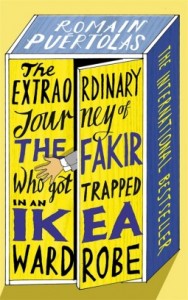
The Extraordinary Journey of the Fakir Who Got Trapped in an Ikea Wardrobe by Romain Puértolas

Posted June 22, 2014 by Michael @ Knowledge Lost in Contemporary / 6 Comments

The Extraordinary Journey of the Fakir Who Got Trapped in an Ikea Wardrobe by Romain PuértolasTitle: The Extraordinary Journey of the Fakir Who Got Trapped in an Ikea Wardrobe (Goodreads)
Author: Romain Puértolas
Translator: Sam Taylor
Published: Harvill Secker, 2014
Pages: 320
Genres: Contemporary
My Copy: ARC from Netgalley

Buy: AmazonBook Depository (or visit your local Indie bookstore)

“A heart is a little bit like a large wardrobe” — Ajatashatru Oghash Rathod

The Extraordinary Journey of the Fakir Who Got Trapped in an Ikea Wardrobe (or L’extraordinaire voyage du fakir qui était resté coincé dans une armoire Ikea) is the debut novel by Romain Puértolas that has been marketed to fans of The Hundred-Year-Old Man Who Climbed Out of the Window and Disappeared (or Hundraåringen som klev ut genom fönstret och försvann) by Jonas Jonasson. For the purpose of making things easier (and to avoid the insanely long titles) I’ll refer to these two books as The Fakir and The Hundred-Year-Old Man (I hope you can work out which is which. I picked up The Fakir simply because I need to read more translated fiction, with that logic I probably should read The Hundred-Year-Old Man. While the writing styles might not be similar, if you enjoyed The Hundred-Year-Old Man because it was a quirky, fun novel then The Fakir is a book you’ll need to go out and buy.

The novel reminds me of something David Niven (The Pink Panther) or The Marx Brothers would adapt to screen. You know the type of movies I’m talking about; the comedies full of misfortunes and stupidity but everything somehow works out in the end. The novel tells the story of a fakir named Ajatashatru Oghash Rathod flown to Paris for the purpose of visiting Ikea and buying a new bed of nails. Dressed in a fine silk suit to pass himself off as a wealthy Indian business man, the con man had nothing but a counterfeit 100-Euro note (printed on one side only) in his pocket. This trip to Paris sends him off on an adventure that finds him in places like London, Barcelona and Rome and not one sight was seen. No Eiffel Tower, Big Ben, Sagrada Família (unfortunately) or Colosseum.

I’m not sure if it is a problem with the translation but I expected a little more from The Extraordinary Journey of the Fakir Who Got Trapped in an Ikea Wardrobe and I can’t tell if it didn’t translate or a deep seeded desire for something more complex. I enjoy that light read but found nothing funny about the novel and thought it was too inconsequential; I wanted more meat to the story. There were opportunities to explore themes of immigration, friendships, celebrities, travel and Europe but all these were just background and the focus remained on trying to write a quirky comedy. I’m not saying this is a bad thing, sometimes a light palate cleanser is all you need, and I was just ready for something with substance. It doesn’t take much effort to read The Fakir and the book did explore the concept of a culture clash but this was to the extent of something like The Gods Must Be Crazy.

Sam Taylor was the translator for this novel and he has worked on a number of great French novels that are all still sitting on my TBR pile. He has translations include A Meal in Winter by Hubert Mingarelli, The Truth About the Harry Quebert Affair by Joël Dicker and HHhH by Laurent Binet. This leads me to believe that my issues with The Fakir are not with the translation but with the book itself. One other concern I have is not with this book per say but with this need to add real people into the story. I’m not entirely comfortable with basing a novel around a person who is deceased, so it feels a little weird when you have a character named Sophie Marceau in this novel. The Fakir actually refers to Sophie Marceau as the French actress from the James Bond film The World Is Not Enough so we know the author is referring to the celebrity. I often wonder how these people feel about being put into a novel and if they are being portrayed accurately. It doesn’t sit right with me and I’m not sure if I’m the only one that wonders about something as small as using celebrities in a novel; I am sure some novels call for it but it this one didn’t.

I know it sounds like I didn’t enjoy this novel but I tend to pick out the parts of a book that didn’t work for me. I think it is freeing to express all my problems with a book and it may come across as a little negative, but in all honesty, this was a fun, short read. I normally gravitate to books with more substance but something light is a nice change. In all honesty I would have liked the novel to explore at least one of the issues that it presented rather than use them as plot points. Even going deeper into the concept of culture clash could have improved my enjoyment of the novel but I have come to expect that not everyone likes to read complex novels. I suspect The Extraordinary Journey of the Fakir Who Got Trapped in an Ikea Wardrobe to be a runaway success and to be adapted into a film; I wonder who they would get to play Sophie Marceau.


Sir Gawain and the Green Knight by Anonymous

Posted May 18, 2014 by Michael @ Knowledge Lost in Classic / 4 Comments

Sir Gawain and the Green Knight by AnonymousTitle: Sir Gawain and the Green Knight (Goodreads)
Author: Anonymous
Translator: Brian Stone
Published: Penguin, 1390
Pages: 176
Genres: Classic
My Copy: Personal Copy

Buy: AmazonBook Depository (or visit your local Indie bookstore)

When I found out we had to read Sir Gawain and the Green Knight for a current university subject, I was a little worried. I often struggle with analysing poetry and something written in Middle English was not going to be easy. Thankfully we had to read the Brian Stone translation, which only hints at being Middle English. This is a famous 14th century Arthurian romance that is often known for the beheading game.

This is a typical quest narrative; The Green Knight exposes the Knights of the Round Table as timid and cowards when he challenges them to the beheading game. The rules are simple, one knight tries to behead the Green Knight and in a year and a day he will meet them for the returning blow.  The Arthurian world is governed by a well-established code of behaviour. This code is one of chivalry, a romantic notion that is deeply rooted in Christian morality, being a beacon of spiritual ideals in a fallen world.

The beheading game is a plot device used as a test in the quest narrative, Sir Gawain is thrown into participating in the game and he is left with a choice, to be a man that lives by his code or not. A game that is meant to measure the inner worth of the knights and it does it in a big way, it exposes the Knights as cowards but Gawain steps up, sort of.

There is a whole lot of humour in this story that often gets over looked when trying to analyse this difficult text. The idea of beheading someone and them returning for a reciprocating blow should have given that away. However the supernatural elements might have made this difficult to pick up on the comedic value. The Green Knight can be interpreted as an allusion of Christ and the strong religious overtones might lead you to think that but I saw him more as a plot device to represent life’s challenges.

Sir Gawain and the Green Knight was a rather beautiful and interesting exploration for me. The translation I read did make it easier to understand, I don’t think I could handle learning Middle English. I had to do an assignment on this text and the quest narrative so I feel like I’ve already said plenty about this poem before sitting down to writing this review. I hope there is plenty of information here and gives the reader an idea of what to expect when reading this poem. It isn’t hard to understand if you have the right translation and is well worth reading.


Summer House with Swimming Pool by Herman Koch

Posted May 16, 2014 by Michael @ Knowledge Lost in Contemporary / 8 Comments

Summer House with Swimming Pool by Herman KochTitle: Summer House with Swimming Pool (Goodreads)
Author: Herman Koch
Translator: Sam Garrett
Published: Hogarth, 2014
Pages: 304
Genres: Contemporary
My Copy: ARC from Netgalley

Buy: AmazonBook DepositoryKindle (or visit your local Indie bookstore)

Herman Koch has a unique ability for taking something that seems so normal and turning it into something much darker. If you’ve read his amazing novel The Dinner then you’ll know exactly what I’m talking about; that book sets up a style that I was hoping continued for this Dutch author. Luckily I wasn’t disappointed; Koch’s second novel to be translated into English is Summer House with Swimming Pool. The novel tells the story of Dr Marc Schlosser who is forced to conceal a medical mistake that costs Ralph Meier, a famous actor, his life. The only problem with that is the truth doesn’t stay hidden for too long.

Fear not, much like The Dinner, Summer House with Swimming Pool is much more complex than it appears on the surface. Herman Koch likes to take a dark and graphic look at the world and raise the questions of morality, this is something seems to pull off effortlessly, but I will try to avoid giving spoilers. We spend most of the book following around the general practitioner who seems like an unsympathetic character and rather unlikeable. Koch likes to play with the idea that everything is not as it seems and this novel does this really well.

I can’t remember if I went into The Dinner with the same expectations as I did for Summer House with Swimming Pool but I suspect I might have had a similar reading experience. It is hard to review a novel like this because you want to talk about it but there is a voice in the back of your mind telling you not to spoil it for everyone else.

One thing that I find interesting with Koch’s novels is the number of characters and scenery. I thought this about The Dinner as well, these novels are perfect for a small stage production; they have just the right blend of dark satirical plot and moral questions to make for a thrilling stage play. I wonder if these books have been converted to the stage, I would love to see a production of The Dinner.

I’m rather annoyed with this review, there is so much I want to say but everything will say too much. You will all have to read this book so we can discuss it. Herman Koch’s books are perfect choices for a book club; there is just so much to discuss. I wonder if I can convince my local book club to do this book as well; they normally don’t like to do the same author too many times but Koch is too good to resist.


The Sorrows of Young Werther by Johann Wolfgang von Goethe

Posted April 24, 2014 by Michael @ Knowledge Lost in Classic / 1 Comment

The Sorrows of Young Werther by Johann Wolfgang von GoetheTitle: The Sorrows of Young Werther (Goodreads)
Author: Johann Wolfgang von Goethe
Translator: David Constantine
Published: Oxford World's Classics, 1771
Pages: 160
Genres: Classic
My Copy: Paperback

Buy: AmazonBook DepositoryKindle (or visit your local Indie bookstore)

The Sorrows of Young Werther is an epistolary novel that has influenced the Romantic Movement. Often known as the original ‘emo’, a term that I hate, this novel is a semi-autobiographical novel that brought huge success to Johann Wolfgang von Goethe. The novel is a collection of letters written by Werther to his friend Wilhelm. These letters are an intimate account of his attraction towards the beautiful Lotte; a young woman he meets in the village of Wahlheim. Despite knowing that she is already engaged to a man 11 years her senior, Werther falls for her and attempts to develop a friendship between the two in an effort to get closer to Lotte.

You can probably guess how this story goes; Werther, an artist of highly sensitive and passionate nature heading down a road that can only lead to heartbreak. I’m not one to enjoy a novel that revolves around a love triangle but when it is done properly it can be an effective plot device; I’m thinking of books like those mentioned in this post. There is no denying the cultural impact The Sorrows of Young Werther has had on the world; unfortunately the ‘Werther effect’ is the most common reference to the novel nowadays.

I’ll be honest, I wanted to read this novel because Frankenstein’s monster finds this book in a leather portmanteau along with Plutarch’s Lives of the Noble Greeks and Romans, and John Milton’s Paradise Lost which gives you an interesting insight into FrankensteinLives of the Noble Greeks and Romans is a series of biographies of famous men to illustrate their common moral virtues or failings, while Paradise Lost is an epic poem on creationism and the fall of man. The Sorrows of Young Werther embodies the Romantic ideals; Werther being a sensitive intellect with an obsession of nature and values emotion over reasoning. All three novels represent different themes that Shelley wants the reader to explore when reading Frankenstein.

While this may sound like a morbid and depressing novel, Goethe shows the beauty behind the tragedy. One thing I loved about this book is the wording, and permit me to post a few quotes from the book to just show you the beauty in the novel.

 “Sometimes I don’t understand how another can love her, is allowed to love her, since I love her so completely myself, so intensely, so fully, grasp nothing, know nothing, have nothing but her!” 

The major theme obviously is love; a look in how it can defy all logic. Werther can’t stop his heart from falling for Lotte, even if he knew it would lead to pain. The idea that the heart has more control over someone’s actions than their head is often evident in life and The Sorrows of Young Werther captures it perfectly. For me, that is what makes this novel spectacular and significant.

“I am proud of my heart alone, it is the sole source of everything, all our strength, happiness & misery. All the knowledge I possess everyone else can acquire, but my heart is all my own” 

However, you can look at this novel as something other than love; the idea that Goethe is portraying the decline in Werther’s mental health is also a vital angle that needs to be considered. The reason I hate the term ‘emo’ I won’t go into at this time but Werther’s overly emotional journey could also be symptoms of a bi-polar depression, though not a known diagnosis of the time. We have to consider the idea that his joy and sorrow is not just unrequited love but a deeper issue. The love triangle would have added fuel to his depression and we cannot ignore that this could be the root cause of Werther’s sorrow.

For such a small novel, The Sorrows of Young Werther packs a huge punch. This is the type of book I can see myself reading again and again, not just because of the Romantic ideas but what it has to say about love and mental illness. I can’t help but think that The Sorrows of Young Werther is just a better version of The Catcher in the Ryein the sense that is a journey of a self-absorbed protagonist, but maybe too difficult for high-school student. The Sorrows of Young Werther is an important book, not only did it influence the greatest literary movement we’ve seen but it still relevant today, almost 250 years later.


Big Bad Wolf by Nele Neuhaus

Posted April 17, 2014 by Michael @ Knowledge Lost in Crime / 0 Comments

Big Bad Wolf by Nele NeuhausTitle: Big Bad Wolf (Goodreads)
Series: Bodenstein & Kirchhoff #6
, 2014
Pages: 404
Buy: Book Depository (or visit your local Indie bookstore)

After finishing The New York Trilogy I needed something light, something I didn’t have to analyse. I picked up Big Bad Wolf because I enjoyed Snow White Must Die so much. I’m not saying that I can’t analyse a novel like this one (you can analyse every text), I just think at times some light reading is needed. Big Bad Wolf tells the story of a crime that happened on the river Main near Frankfurt. Investigators Pia Kirchhoff and Oliver von Bodenstein are back to investigate the crime, as the case progresses they find it taking them into a pit of evil and cruelty in the midst of a middle class utopia.

I am trying to make an effort to read more translated fiction; I loved Snow White Must Die which is book four in the series but only the first one to be translated into English. This is book six in the same series and I have to wonder why a publisher would publish books in such a weird order; this was a similar issue that happened with Jo Nesbø. I understand that a publisher would want to translate the novels that will sell the best but if Nele Neuhaus’ popularity continues to grow at this rate we will have another Nesbø situation.

Everything I loved about Snow White Must Die is absent in Big Bad Wolf; I think the problem is that Pia Kirchhoff and Oliver von Bodenstein are considered the main protagonists while Snow White Must Die focused more on the life of a man who served ten years for a crime he didn’t commit. That is what fascinated me but Big Bad Wolf is just another crime novel.

I’ve read so many great crime novels now that I find most of them clichéd and formulaic, Big Bad Wolf isn’t that bad but I’m looking for books that do something different and fresh with the genre. There are some decent moments in Big Bad Wolf, some unexpected twists but I wanted more. The novel is darker than most popular crime novels but keeps to the standard formula. One thing I did find difficult about this novel was the amount of view points, making it difficult at times to understand what was going on but this is an acceptable method for building suspense.

I highly recommend Snow White Must Die, if you haven’t tried some German translated crime before then this might be a good starting point. As for Big Bad Wolf, I’m disappointed with the end result but others might enjoy it more than I do. I hope Nele Neuhaus’ other novels are more like Snow White Must Die but I won’t be in a hurry to try her works again.